Published on: 2026-05-19
Meta Platforms is cutting roughly 10% of its workforce while raising AI infrastructure spending to as much as $145 billion. Whether those savings can protect margins during one of the most expensive buildouts in Big Tech history is now the central question for the stock.
Shares recently traded near $611, below the January high of about $716 but above the March low near $525. The stock has recovered from its spring sell-off, but investors are still weighing the scale of Meta’s AI spending against the expected savings from its latest restructuring.

Reports citing an internal Meta memo say the company is preparing to cut about 10% of its workforce, with notifications expected on May 20.
Based on Meta’s official Q1 headcount of 77,986, a 10% reduction would imply roughly 7,800 roles, while reports describe the expected impact as around 8,000 roles.
More than 7,000 employees are reportedly being reassigned into AI-focused initiatives, making the restructuring broader than a standard layoff round.
Bank of America estimates the cuts could generate $7 billion to $8 billion in annualized savings.
Meta raised its 2026 capital expenditure guidance to $125 billion to $145 billion, up from the earlier range of $115 billion to $135 billion.
The $862.25 target remains a source-specific bullish reference point. Broader analyst-consensus data varies by provider, with some aggregators currently placing the average target closer to the low-to-mid $800s.
A reported internal memo from Chief People Officer Janelle Gale outlines a two-part restructuring. The first part reportedly targets about 10% of Meta’s workforce. Based on Meta’s official Q1 headcount of 77,986, that would imply roughly 7,800 roles, while reports citing the memo describe the expected impact as around 8,000 roles. The second part reportedly moves more than 7,000 employees into newly formed AI-related organizations.
This is not a normal cost-cutting round. Meta is reducing traditional headcount while redirecting employees and capital toward AI workflows, autonomous agents, and infrastructure-heavy product development.
If both layoffs and redeployments are counted, the restructuring touches nearly one in five employees. That makes it one of Meta’s most important operational resets since the company’s earlier efficiency drive.
Meta is also reducing management layers and shifting more work into smaller teams. Internally, these teams have been described as faster-moving pods or cohorts.
The objective is clear: fewer managers, faster decisions, and heavier use of AI tools across engineering and product workflows.
The most aggressive part of the strategy is internal automation. Meta has set high adoption targets for AI-assisted coding, with some teams expected to rely on AI tools for a majority of committed code. That is the clearest sign that “AI-native” is not only a product strategy. It is becoming an operating model.
Bank of America’s estimated $7 billion to $8 billion in annualized savings gives investors a number to work with. It suggests the layoff program is large enough to support margins, especially if Meta also leaves open roles unfilled.
| Confirmed or Reported Metric | Figure | Why It Matters |
|---|---|---|
| Official Q1 2026 headcount | 77,986 | Confirms the base for the reported 10% cut |
| Implied 10% reduction | Roughly 7,800 roles | Reconciles official data with reported 8,000 layoffs |
| Reported AI redeployments | More than 7,000 | Shows the move is a restructuring, not only layoffs |
| 2026 CapEx guidance | $125B to $145B | Main pressure point for free cash flow |
| Full-year expense guidance | $162B to $169B | Unchanged despite higher CapEx |
| Q1 operating margin | 41% | Shows Meta is still highly profitable |
That 41% Q1 operating margin is the most important context for the layoff story. Meta is not cutting from a position of weakness. It is cutting to defend a margin profile that already leads most of Big Tech, while simultaneously absorbing a CapEx budget that has been revised upward twice this year. The workforce reduction is a margin-control mechanism, not a distress response.
Meta’s updated 2026 CapEx range of $125 billion to $145 billion is now the most important number in the stock story.
That spending is tied to data centers, servers, chips, and other AI infrastructure. It is also why the market has not treated the layoffs as a clean bullish catalyst. Investors understand the savings, but they are still waiting for evidence that AI investment will produce revenue growth and productivity gains at the same scale.
This is where analyst views diverge. The bullish case says AI will strengthen advertising, improve content ranking, automate internal work, and open new monetization channels. The cautious case says Meta may be spending aggressively before returns are visible.
Meta’s CapEx commitment is large in absolute terms, but it is the smallest among the four major hyperscalers. Amazon has guided to $200 billion in 2026 capital expenditure. Alphabet and Microsoft have each guided to up to $190 billion.
Across all four companies, total planned AI infrastructure spending for 2026 now approaches $725 billion, roughly double what the group spent in 2025. For Meta, the comparison cuts both ways. It shows the company is not overextending relative to peers, but it also means Meta must compete for the same land, power, chips, and skilled workers driving costs higher across the entire sector.
Analysts remain broadly positive on Meta, but the spread between the most bullish and most cautious buy-rated targets runs to $150, reflecting genuine disagreement on whether CapEx returns will appear quickly enough to support valuation expansion.
| Firm | Price Target | Rating | Main View |
|---|---|---|---|
| Evercore ISI | $930 | Outperform | AI deployment seen accelerating customer and advertiser value |
| Bank of America | $885 | Buy | Restructuring savings could help protect margins as Meta funds its AI buildout |
| Morningstar | $850 | Buy | Stock viewed as moderately undervalued at current levels |
| Truist Securities | $840 | Buy | Robust ad demand, though target reflects higher infrastructure spend |
| Goldman Sachs | $830 | Buy | Target reduced specifically on rising CapEx and near-term free cash flow pressure |
| Stifel | $780 | Buy | Infrastructure cost trajectory remains the primary concern |
Bank of America’s view focuses on the financial benefit of the restructuring, with estimated annualized savings of $7 billion to $8 billion. Goldman Sachs remains constructive on the stock but is more cautious on valuation because Meta’s AI infrastructure spending has moved higher.
The difference between the two targets captures the central market debate. Meta’s core business remains strong, but investors still need evidence that AI spending can generate returns large enough to justify the scale of the investment.
Meta stock opened 2026 near $650 and climbed to about $716 in late January. The stock then fell sharply through March, bottoming near $525 on March 27.
That decline reflected rising concern over AI infrastructure costs and the company’s strategic shift away from a metaverse-led investment story toward a more direct AI infrastructure cycle.
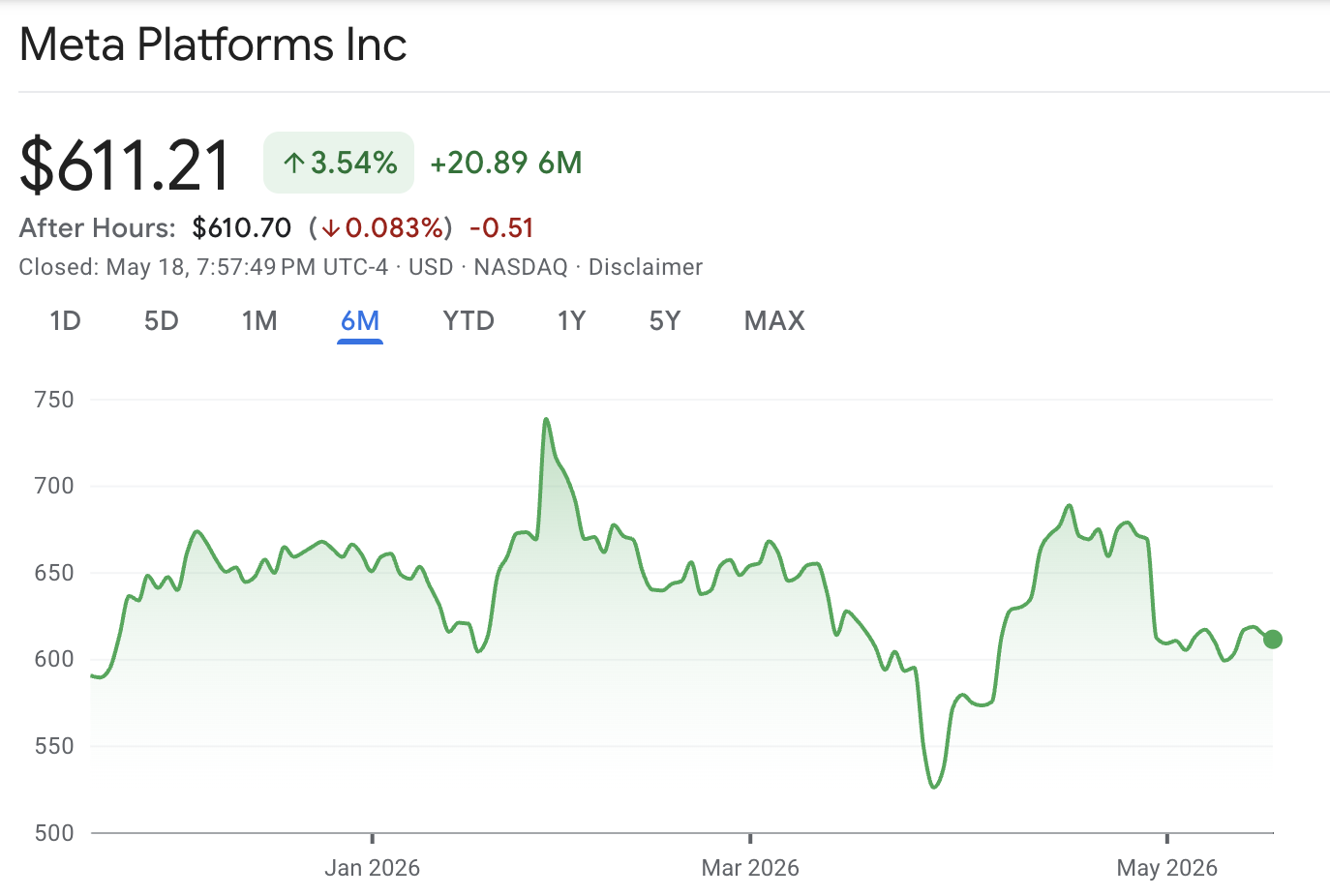
By May 19, the stock had recovered to the $611 range. The rebound shows that investors still value Meta’s advertising strength and cost discipline. The failure to reclaim the January high shows that the AI spending discount remains in place.
The market is not treating the layoffs as a distress signal. It is treating them as a margin-defense move.
Meta is not cutting jobs because its core advertising business is broken. It is cutting jobs while spending aggressively on AI infrastructure. The company is reallocating capital from labor to compute.
Near term, that supports margins. Longer term, the stock depends on whether AI tools can raise ad efficiency, increase engagement, and reduce internal operating costs.
Meta Q2 2026 earnings, expected late July. That will be the first earnings print to reflect the cost impact of the restructuring and any early read on whether AI-assisted workflows are improving operating efficiency. Margin trend and any revision to full-year expense guidance are the numbers to watch.
Further CapEx revisions. Meta has already raised its 2026 guidance twice. Any additional upward revision without a corresponding improvement in revenue or margin guidance would likely pressure the stock.
AI coding adoption rates. Meta has set internal targets for AI tools to handle a majority of committed code. Progress toward that target, if disclosed, would be the clearest early signal that the productivity case for the restructuring is on track.
Meta’s May 2026 restructuring is a direct trade-off: fewer employees, more AI infrastructure, and a leaner operating model designed to protect margins.
The expected $7 billion to $8 billion in annualized savings is meaningful, but it is small compared with the company’s $125 billion to $145 billion CapEx plan. That is why Meta stock has recovered but not fully broken out.
At around $611, the stock still offers upside if AI spending produces measurable returns. The approximately $862 consensus target captures the bullish side of that view. The wider analyst range shows the risk. Meta now has to prove that its AI pivot can convert lower labor intensity and higher infrastructure spending into measurable revenue growth, productivity gains, and durable margin protection.
Meta Platforms Investor Relations: Q1 2026 Results
https://investor.atmeta.com/investor-news/press-release-details/2026/Meta-Reports-First-Quarter-2026-Results/default.aspx
SEC Filing: Meta Q1 2026 Earnings Exhibit 99.1
https://www.sec.gov/Archives/edgar/data/1326801/000162828026028364/meta-03312026xexhibit991.htm
SEC Filing: Meta FY 2025 Results / Prior 2026 Outlook
https://www.sec.gov/Archives/edgar/data/1326801/000162828026003832/meta-12312025xexhibit991.htm