Published on: 2026-04-10
Palantir came under pressure as AI competition concerns returned.
Anthropic’s momentum added a new angle to the market’s worries.
The decline highlighted how sensitive PLTR is to valuation fears.
The next phase will depend on whether Palantir can defend its AI position.
Palantir stock fell because the market abruptly shifted from rewarding AI exposure to questioning who will capture the most value in enterprise AI. On April 9, PLTR dropped 7.3% to $130.49, with an intraday low of $128.50, even as the broader market moved higher.
The move was not driven by weak earnings, but by a more skeptical market narrative. Investors had to weigh Palantir’s premium valuation against Anthropic’s rapid enterprise momentum, which made the competitive threat feel more immediate.
The simplest answer is that investor sentiment around Palantir shifted sharply.
PLTR closed at $130.49, down 7.3% for the session, with more than 92 million shares changing hands. The stock is now down 27% in 2026 after surging 135% in 2025.
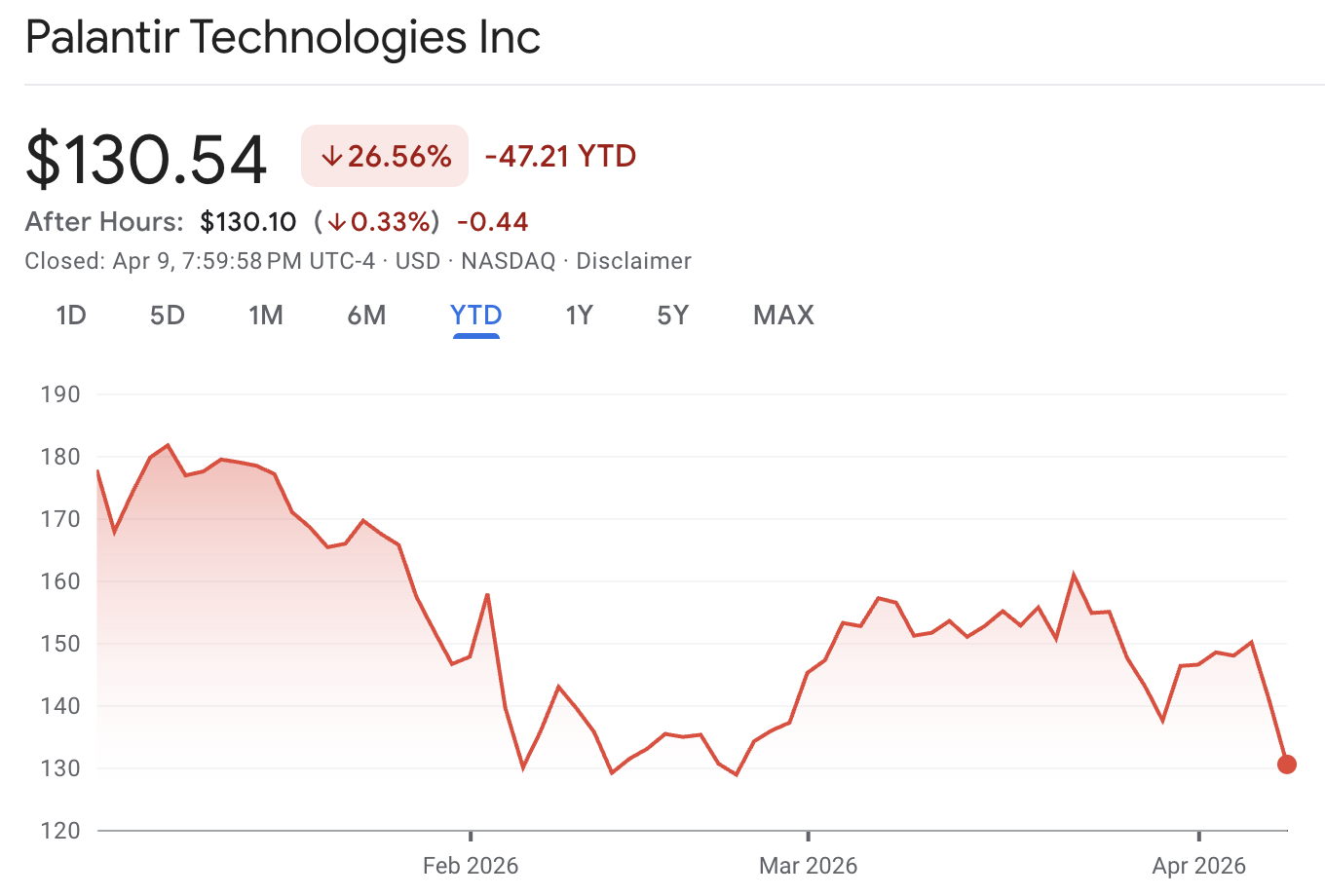
For weeks, concerns had been building that newer AI platforms could challenge established enterprise software names. That mood worsened after a reported Michael Burry post suggested Anthropic was moving ahead of Palantir in the AI race.
That matters because Palantir is no longer valued like a conventional software stock, but like one of the market’s most important AI winners. When a company trades at that kind of premium, investors do not need a weak quarter to sell. They only need a reason to question whether the long-term edge is as strong as expected.
Palantir’s drop was amplified by one factor above all others: valuation.
At roughly 109x forward earnings, versus a sector median near 21x, the stock leaves very little room for doubt. Even modest concern about competition can cause a sharp repricing when expectations are already so high.
| Metric | Palantir (PLTR) | Sector Median |
|---|---|---|
| Forward P/E | ~109x | ~21x |
| Trailing P/E | ~200x | N/A |
| YTD Performance | -26% | Mixed |
| 52-Week High | $207.18 | N/A |
| Current Price (Apr. 9) | $130.49 | N/A |
Palantir’s market capitalisation remains substantial, at roughly $336 billion. That multiple implies the market is still discounting an unusually strong path for future growth.
When that kind of expectation meets rising competition, the stock becomes vulnerable. The business is not weak, but the share price had been assuming very little could go wrong.
The selloff also reflected broader pressure on software stocks as investors reassessed how quickly frontier AI models could disrupt established SaaS names.
Anthropic did not suddenly replace Palantir in a single headline contract.
Investors are paying closer attention to how quickly frontier AI firms are improving their products, expanding enterprise distribution, and scaling customer adoption. On that front, Anthropic has been putting up numbers that are difficult for the market to ignore.
On April 6, Anthropic said its run-rate revenue had surpassed $30 billion, up from about $9 billion at the end of 2025. It also said more than 1,000 business customers were each spending over $1 million annually, double the number disclosed just weeks earlier.
Those figures suggest Anthropic is becoming a serious enterprise AI force, not just a model provider.
That commercial growth has been supported by a fast product push. Anthropic launched a $100 million Claude Partner Network to support enterprise adoption, expanded its compute partnerships with Google and Broadcom, and continued to widen Claude’s footprint across major cloud platforms.
Earlier in the year, it also highlighted stronger coding, reasoning, and long-context performance in Claude Opus 4.6. More recently, Mythos Preview reinforced the view that Anthropic is moving aggressively into high-value use cases, including cybersecurity.
Those advances do not prove Palantir is losing business directly, but they do reinforce the sense that the AI leadership race is becoming broader and more competitive.
Palantir is not a direct clone of Anthropic. Its business is built around software that connects data, logic, workflows, and actions inside large organisations. Palantir’s own documentation says AIP connects generative AI to operations and allows customers to work across commercially available models through a unified service layer.
 If Palantir is truly model-agnostic, then the rise of Anthropic should not automatically be bad news. In theory, stronger models could make Palantir’s platform more useful.
But the market is now asking a tougher question: if model makers are becoming more capable, more enterprise-friendly, and more embedded in customer workflows, how much value will stay with the orchestration layer versus the model layer? That question matters because it challenges the foundation of Palantir’s premium multiple.
The company still has a strong product story, but investors want proof that stronger third-party models will enhance Palantir’s position rather than dilute it.
Palantir itself acknowledges the competitive risk. In its 2025 annual report, the company said it faces intense competition, including from emerging firms and companies offering products that may be easier to implement, more functional, or built around AI.
Palantir’s latest reported numbers were strong across revenue, commercial growth, profitability, and balance sheet strength. That is why the stock’s decline looks more like a valuation and sentiment event than a collapse in the core business.
Q4 2025 revenue rose 70% year over year to $1.41 billion.
FY2025 revenue rose 56% to $4.48 billion.
US commercial revenue rose 109% in FY2025 to $1.47 billion.
Q4 adjusted operating income reached $798 million, with a 57% margin.
The company ended the year with $7.2 billion in cash, cash equivalents, and US Treasury securities, with no debt.
FY2026 revenue guidance is $7.182 billion to $7.198 billion, with US commercial revenue expected to exceed $3.144 billion.
The figures show that Palantir is still growing quickly, expanding commercially, and scaling profitably.
The problem is that the stock had already priced in a near-perfect execution path. Once the market began to doubt whether Palantir would remain one of the few clear enterprise AI winners, the multiple was the first thing to crack.
The next question is not whether Palantir is growing. It is whether the company can keep proving that its software layer remains essential even as model providers become stronger.
Watch four things closely:
US commercial growth: Palantir has guided to more than $3.144 billion in US commercial revenue for FY2026. That target matters even more after this selloff.
Customer expansion: The company ended 2025 with 954 customers overall and 742 commercial customers. Continued breadth would support the platform argument.
Model-agnostic execution: Palantir needs to show that stronger models from Anthropic, OpenAI, and others strengthen AIP rather than weaken it.
Valuation discipline: At roughly 109x forward earnings, PLTR still has little room for disappointment.
Palantir fell after a fresh wave of concern that newer AI platforms, including Anthropic, could challenge its enterprise AI positioning. A reported Michael Burry post intensified that fear, but the selloff reflected sentiment and valuation pressure more than any confirmed loss of market share.
Not in any confirmed one-for-one way. The market reaction was driven more by fear that Anthropic’s fast enterprise growth and product momentum could weaken Palantir’s long-term edge in AI spending.
No. Palantir’s latest reported results were strong, with Q4 2025 revenue up 70% and FY2025 revenue up 56%. The selloff was about competition and valuation, not a weak quarter.
Because richly valued stocks are judged against future dominance, not just current growth. At roughly 109x forward earnings, even a change in narrative can trigger a sharp re-rating.
Yes. Palantir says AIP connects generative AI to operations and supports integration across different model providers. If that works as intended, stronger models could support its platform rather than replace it.
Palantir’s drop on April 9 reflected a collision of three forces: rising concern about AI competition, Anthropic’s accelerating enterprise momentum, and a valuation that left little room for uncertainty.
The underlying business remains strong. Revenue is still growing quickly, commercial adoption is expanding, and Palantir continues to position itself as a model-agnostic software layer for enterprise AI.
But at more than 100x forward earnings, the stock remains highly sensitive to any shift in sentiment around competition, execution, or enterprise AI demand. The next earnings update will be a key test.
Disclaimer: This material is for general information purposes only and is not intended as (and should not be considered to be) financial, investment or other advice on which reliance should be placed. No opinion given in the material constitutes a recommendation by EBC or the author that any particular investment, security, transaction or investment strategy is suitable for any specific person.