Published on: 2026-04-03
Amazon is reportedly in advanced talks to acquire Globalstar for approximately $9 billion, according to a Financial Times report published April 1, 2026.
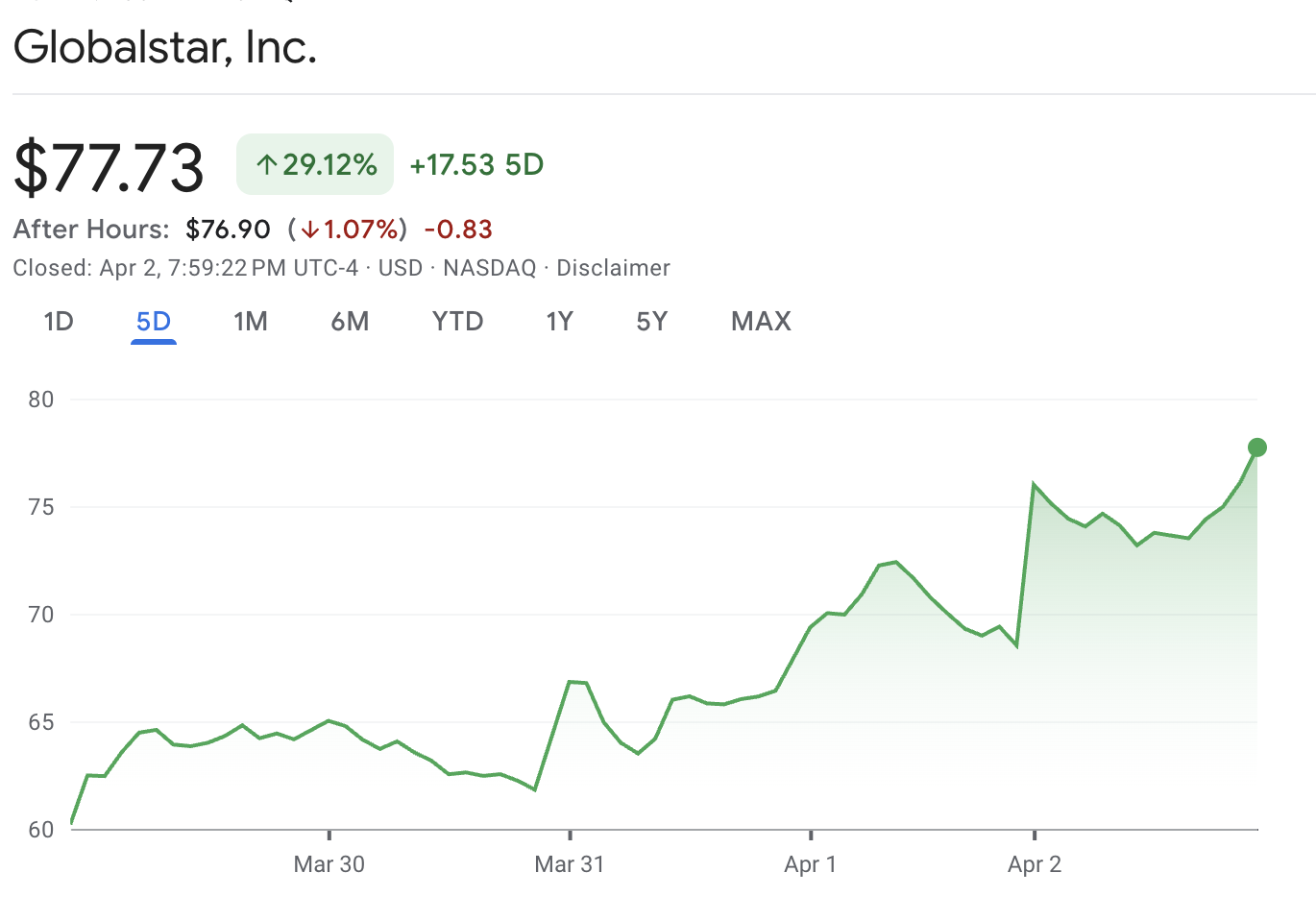
GSAT stock jumped 13% on April 2, extending a gain that began in after-hours trading the previous session.
Globalstar's Band n53 spectrum, licensed across 12 nations covering more than 870 million people, is the asset that makes this more than a standard satellite acquisition.
Apple holds a 20% stake in Globalstar through a $1.5 billion investment and has rights to 85% of network capacity, adding complexity to any transaction.
Amazon Leo has asked the FCC for a two-year extension on its satellite deployment deadline, citing a shortage of launch capacity. This makes Globalstar's operational infrastructure more valuable.
Reports on April 1 and 2, 2026, indicated Amazon is in advanced negotiations to acquire satellite provider Globalstar for about $9 billion. Following the news, Globalstar shares surged over 24%, reaching an 18-year high in early April trading.
Amazon CEO Andy Jassy has been direct about the company’s ambitions in this space. In his latest earnings commentary, he called low-earth-orbit satellites one of the “seminal opportunities” driving Amazon’s planned $200 billion in capital expenditures in 2026.
Amazon reported $86.81 billion in cash and equivalents as of Q4 2025, giving it substantial firepower for a deal. Amazon declined to comment. Globalstar also declined to address the reports.
Globalstar shares rocketed higher on the Financial Times report that Amazon is in advanced talks to acquire the satellite telecom company.
The move extends GSAT stock's remarkable run. The stock has delivered a 231% gain over the past year.
| Metric | Data |
|---|---|
| Reported Deal Value | ~$9 billion |
| GSAT Intraday Surge | Up to +24% (18-year high) |
| Prior Analyst Price Target | $69 (Hold consensus) |
| Prior Close | $68.53 |
| 52-Week Range | $17.24 to $74.88 |
| 1-Year Stock Return | +231% |
| AMZN Reaction | Down ~2% |
| Globalstar 2025 Revenue | $272.99 million (record) |
| 2026 Revenue Guidance | $280 million to $305 million |
Most coverage has framed this as Amazon buying a satellite network to compete with Starlink. That framing misses the deeper logic.
Globalstar owns a portion of its own S-band mobile satellite service spectrum, known as band n53, which is also licensed for 5G.

MSS spectrum has become more valuable because it is globally harmonised, approved by regulators, and does not interfere with terrestrial networks, enabling better direct-to-device services.
Spectrum is the lifeblood of any satellite communications business. Globalstar holds licensed bands in the S-band and L-band that could complement Kuiper’s Ka-band capacity.
More spectrum means more flexibility and bandwidth to serve customers in congested areas or to offer differentiated products like direct-to-device connectivity.
Amazon Leo is working to deploy over 3,200 satellites, with a regulatory requirement to have half of its first-generation constellation in orbit by mid-2026. With about 212 satellites launched as of December 2025, the deployment pace must accelerate dramatically.
Amazon’s LEO project filed with the FCC in February to extend the launch deadline for 1,600 satellites by two years. The company plans to place 700 satellites into orbit by mid-2026 but is hampered by insufficient launch capacity.
Absorbing Globalstar’s existing 24-satellite LEO constellation, a ground station network with 24 global gateways, and licensed spectrum across more than 120 countries would provide an immediate operational foundation that years of internal development could not quickly replicate.
Amazon has already signed connectivity agreements with Delta Air Lines and JetBlue to provide satellite internet services for their flights starting in 2027 and 2028, respectively.
Globalstar’s existing capacity serves as a bridge while Amazon Leo’s constellation scales. The $9 billion is not just a bet on the future but insurance against missing near-term commercial commitments.
In November 2024, Apple invested $1.5 billion in Globalstar to acquire a 20% stake, including a $400 million equity purchase and $1.1 billion in infrastructure prepayments. Apple gained access to approximately 85% of Globalstar’s satellite network capacity.
Apple uses Globalstar for Emergency SOS via Satellite and satellite messaging features across its iPhone lineup. Globalstar’s wholesale capacity services segment, which represents the Apple partnership, generated $46.29 million in Q1 FY2026, up 28% year-over-year.
Apple’s investment in Globalstar over the last few years exceeds $2 billion, and it also owns a 20% equity stake. Additionally, Apple reserves 85% of Globalstar’s network capacity for the iPhone. That is not a financial stake that can be bought out and reorganised cleanly.
Amazon, in other words, would be acquiring the critical safety infrastructure that supports hundreds of millions of active iPhones globally.
For Amazon to successfully acquire Globalstar, it must reach a workable compromise with Apple over infrastructure sharing and future technology roadmaps, an unprecedented situation in the tech industry.
Prior to the Amazon report, Globalstar had already surged on separate SpaceX acquisition rumours, with GSAT stock rising approximately 6.90% on reports of a potential $10 billion deal with SpaceX.
SpaceX and Globalstar already have a working relationship: Globalstar signed a launch services agreement with SpaceX for Falcon 9 missions to deploy replacement satellites.
Had SpaceX won the bid, it would have given it a more direct relationship with Apple and privileged access to the iPhone ecosystem for its growing Starlink Mobile service, said Luke Pearce of CCS Insights.
Two of the largest private space operators in the world have now reportedly evaluated the same asset. That convergence alone signals how scarce and strategically valuable Globalstar's licensed spectrum and operational infrastructure have become.
Globalstar operates a low-Earth-orbit satellite network and holds licensed mid-band spectrum used across satellite and terrestrial connectivity services.
GSAT stock jumped after reports that Amazon is in talks to buy Globalstar, but the move also reflected a broader revaluation of satellite spectrum assets.
Apple owns about 20% of the relevant entity and has rights tied to a large share of Globalstar’s network capacity, which could complicate any transaction.
Not entirely. The reaction in Iridium and Viasat suggests investors are also repricing scarce spectrum and satellite infrastructure across the sector.
The surface headline is Amazon pursuing Globalstar for $9 billion to compete with Starlink. The actual story is more precise: Amazon needs globally harmonised spectrum it cannot build, operational LEO infrastructure it cannot deploy fast enough, and a regulatory bridge to a commercial launch deadline it cannot miss.
The Amazon acquisition would give Amazon Leo Globalstar’s valuable Band 53/n53 spectrum and LEO satellite infrastructure, accelerating its competitive race against SpaceX’s Starlink.
Whether the deal closes depends on one party that has not been formally named in the negotiations: Apple, whose 20% stake and 85% network claim means no transaction can proceed without its cooperation.
Disclaimer: This material is for general information purposes only and is not intended as financial, investment, or other advice on which reliance should be placed. No opinion given in the material constitutes a recommendation by EBC or the author that any particular investment, security, transaction, or investment strategy is suitable for any specific person.