Published on: 2026-01-28
Updated on: 2026-01-28
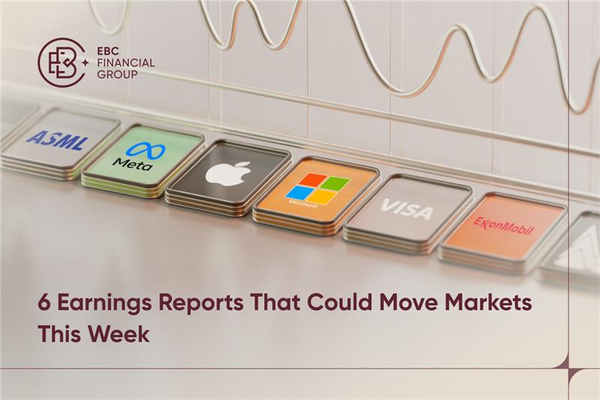
With all eyes on everything from Big Tech to chips and payments, the earnings results for these 6 companies could shape sentiment for the week ahead.
Earnings week can feel noisy when you are new. It’s the time that many companies report their performance, headlines go to the press fast, and prices can jump as soon as the announcement is made. You do not need to track everything. For the week of 26 to 30 January 2026, a few big names can shape the wider market mood.
Two main stories dominate this week: First, the AI build-out, from cloud demand to chip tools, by key industry players. Second, is driven by the everyday economy, seen through consumer spending and energy cash flow.
These earnings announcements are a company’s quarterly results for the last period plus its outlook. Markets often react more to guidance and the tone of the call than to the past quarter. This indicates the challenges the company acknowledges – or refuses to recognise. Furthermore, it is always important to remember that part performance is not a guarantee to future results. Understanding how that company looks forward indicates what could happen. Many US companies also report after the close of regular trading, when after-hours trading can amplify moves.
Mention of any company or security is for illustrative and educational purposes only and should not be taken as an endorsement or suggestion to trade.
ASML (ASML): Wed, 28 January. Press release 06:00 UTC. Investor call 14:00 UTC (09:00 ET).
Meta (META): Wed, 28 January. Results after the close of regular US trading. Call 21:30 UTC (16:30 ET).
Microsoft (MSFT): Wed, 28 January. Results after the close of regular US trading. Call 22:30 UTC (17:30 ET).
Apple (AAPL): Thu, 29 January. Call 22:00 UTC (17:00 ET).
Visa (V): Thu, 29 January. Results after the close of regular US trading. Webcast 22:00 UTC (17:00 ET).
ExxonMobil (XOM): Fri, 30 January. Press release 11:30 UTC (06:30 ET). Call 14:30 UTC (09:30 ET).
ASML: New orders and what they suggest about chip demand in 2026.
Meta: Ad demand and whether AI spending is still set to rise.
Microsoft: Cloud growth and the direction of AI investment.
Apple: iPhone demand cues, Services tone, and margin guidance.
Visa: Payment volumes, cross-border activity, and any signs of weaker spending.
ExxonMobil: Cash flow, production tone, and how management frames prices.
1) ASML: The chip supply chain checkpoint
ASML sits upstream in the semiconductor supply chain. It does not make chips, rather manufactures chipmaking equipment used in semiconductor factories. Companies like TSMC, Samsung, and Intel buy this equipment for their chips fabrication. Those chips then flow downstream into products and platforms built by chip designers and tech firms such as NVIDIA, Intel, AMD, and Apple, and into AI data centres around the world.
This matters because chip demand is tied to the AI build-out. When cloud companies and data centre operators invest more, chipmakers often would do the same to keep up with the demand. ASML becomes that early signal because chipmakers would order new equipment to expand capacity before the extra chip supply enters the market.
For beginners, one metric is simple. Order intake means new orders. Rising order intake can suggest chipmakers are still expanding. Falling order intake may suggest they are slowing down.
Watch whether new orders are rising or falling. Then listen for what ASML says about 2026 demand. If they sound confident, chip stocks may get a lift. If they sound cautious, chip stocks may come under pressure.
2) Microsoft: AI demand meets the size of the bill
Microsoft matters this week because it is both a cloud leader and a big AI spender. The tech giant sits near the centre of the AI ecosystem through partnerships. It currently works closely with OpenAI on deploying AI models through Azure. Azure’s AI infrastructure, in turn, uses GPUs from companies such as NVIDIA and AMD.
A quick bit of history helps. Microsoft used to be known mainly for its Windows operating system and Office suites. Over the last 10 to 15 years, it shifted toward cloud services, where customers pay subscriptions or rent computing power. Windows Azure became generally available in February 2010 and was later renamed Microsoft Azure in 2014.
In its fiscal 2025 annual report, Microsoft said Azure surpassed $75 billion in annual revenue for the first time. Microsoft also reported Microsoft Cloud revenue of $46.7 billion in its fiscal 2025 fourth quarter.
For this report, watch 2 things:
Are cloud and AI demand still strong?
Is spending on AI and data centres still rising fast?
Watch what Microsoft says about cloud demand. Then focus on any clear comments about data centre capacity, and whether it plans to spend more or less on building it.
3) Meta: Ads and AI spending in one report
Meta blends 2 signals that markets care about. It is still mainly an advertising company, but it is also building AI products and spending heavily on AI infrastructure.
First signal: ads. Meta says it generates all its revenue from selling advertising across its family of Apps which includes Facebook, Instagram, WhatsApp, and Messenger. Because ads are tied to marketing budgets, they can act as a rough read on business confidence.
Watch the basics as Meta often highlights ad impressions and the average price per ad. Those 2 can help explain whether growth is coming from higher activity, higher pricing, or both. Their predictions could suggest advertisers and marketers’ sentiments in the quarter ahead.
Second signal: AI. Meta has pushed AI into its products through Meta AI, an assistant built with its Llama models and integrated into apps like Instagram, WhatsApp, and Facebook.
Meta is also spending big on data centres and hardware to support AI. In its Q3 2025 results, Meta said it expected 2025 capital spending in the range of $70 to $72 billion, and Reuters reported that Meta expects capital spending to rise significantly again in 2026 as it builds more AI data centre capacity.
Focus on 3 items:
Ad demand: Are impressions and pricing holding up?
Costs and margins: Is Meta keeping expenses under control?
Spending plans: Is AI and data centre spending still set to rise in 2026, or does it start to level off?
4) Apple: The consumer heavyweight
Apple is one of the biggest companies in the world, with a market value of around $3.6 trillion in late January 2026.
Because of its size, Apple is also one of the largest holdings in major US indexes. In the S&P 500, Apple’s weight is around 5.8% in January 2026, which means a big move in Apple can pull the index with it.
Apple also gives a different signal from the pure AI names. It can show how every day demand is holding up, especially for premium devices.
When Apple talks about iPhone demand, the key regions to watch are the ones it reports in its financials. In fiscal 2025, Apple’s biggest regions by sales were the Americas, Europe, Greater China, Japan, and Asia Pacific.
Apple also own a diverse portfolio of Services including the App Store, iCloud and other cloud services, Apple Music, Apple TV, Apple News+, AppleCare support plans, Apple Pay and Apple Card, and advertising.
Focus on:
iPhone demand: Are sales holding up in the Americas, Europe, Greater China, Japan, and Asia Pacific?
Services: Is Services growth steady enough to support results if hardware is softer?
Margins: Are margins improving or tightening, and what reasons does Apple give?
Guidance tone: Does management sound confident about the next quarter?
5) Visa: A simple read on spending
Visa is neither a retailer nor a bank. It does not decide who gets a card, and it does not lend money to consumers. Instead, Visa runs a payments network that connects banks, merchants, and shoppers. When someone taps a Visa card or pays online, Visa helps route and process that payment.
That business model is why Visa can be a useful gauge of consumer demand. Visa earns revenue based on activity on its network. Basically, when more people spend, Visa usually sees higher payment volumes and more transactions. When spending slows, those numbers can cool too.
Visa also has a wide view. It works with thousands of financial institutions and a very large global merchant base. In fiscal 2025, Visa reported about $14.2 trillion in payments volume and 257.5 billion transactions processed on its networks. That scale is why investors listen closely to Visa’s trends, even though it is not a consumer brand.
Focus on:
Payments volume: Is overall spending growing or slowing?
Processed transactions: Are people still paying often, even if they buy smaller items?
Cross-border activity: Is travel-related and international spending rising or cooling?
Any change in tone: Do they say spending is still strong, or are they seeing people cut back?
6) ExxonMobil: The energy signal
ExxonMobil is one of the world’s largest integrated energy companies, which means it operates across the chain. It produces oil and gas (Upstream), and it also refines and sells fuels and lubricants, plus chemicals (Product Solutions). Exxon’s downstream business sells more than 5.4 million barrels per day of petroleum products, so its results reflect not only crude prices but also refining margins and fuel demand.
In the Energy Select Sector SPDR ETF (XLE), Exxon is the largest holding at about 24% weight (as of 22 January 2026), making it a big “index mover”.
Finally, energy powers almost every economic sector, thus feeding into inflation. Rising fuel prices pushes inflation up with it. Mobility, too, could be affected causing consumers and firms to reconsider their activities. This upward pressure would push down consumer confidence over the medium to long run, affecting rate expectations.
Focus on:
Production: Did output rise or fall, and why?
Cash flow: Is cash flow strong enough to support spending and shareholder returns?
Refining and fuel demand: Are refining margins improving or weakening?
Outlook on prices: Does management sound confident, cautious, or neutral about demand and pricing?
It leans that way because 3 of the 6 names sit directly in the AI spending chain: Microsoft, Meta, and ASML.
Microsoft is a key signal because it sells cloud computing and is spending heavily on AI data centres. Meta belongs in the same bucket because it is building AI products like Meta AI, powered by its Llama models, and it is spending heavily on AI infrastructure and data-centre capacity.
ASML links to both because it sells the chipmaking equipment that companies like TSMC, Samsung, and Intel need to produce advanced chips for AI.
Apple also has an AI angle of their own. They’re pushing AI features through Apple Intelligence, and it is working with partners such as OpenAI (ChatGPT integration) and Google (Gemini collaboration) to power parts of that experience.
Visa brings the clearest consumer-spending read, and ExxonMobil brings an energy and inflation angle. That mix is why the week can move more than one sector at a time.
This watchlist is a learning tool. Always conduct your own research and consider seeking independent financial advice before making any investment decisions. Keep your routine simple. Start with the schedule so you know when headlines may hit. Then, for each company, read guidance first. Look for what changed versus last quarter in demand, margins, and spending plans. That is often where the market reaction starts.
If any of these 6 changes their outlook, the market can change its story fast.
Disclaimer & Citation
Disclaimer: This material is for information only and does not constitute a recommendation or advice from EBC Financial Group and all its entities ("EBC"). Trading Forex and Contracts for Difference (CFDs) on margin carries a high level of risk and may not be suitable for all investors. Losses can exceed your deposits. Before trading, you should carefully consider your trading objectives, level of experience, and risk appetite, and consult an independent financial advisor if necessary. Statistics or past investment performance are not a guarantee of future performance. EBC is not liable for any damages arising from reliance on this information.