Published on: 2025-12-08
Updated on: 2025-12-08
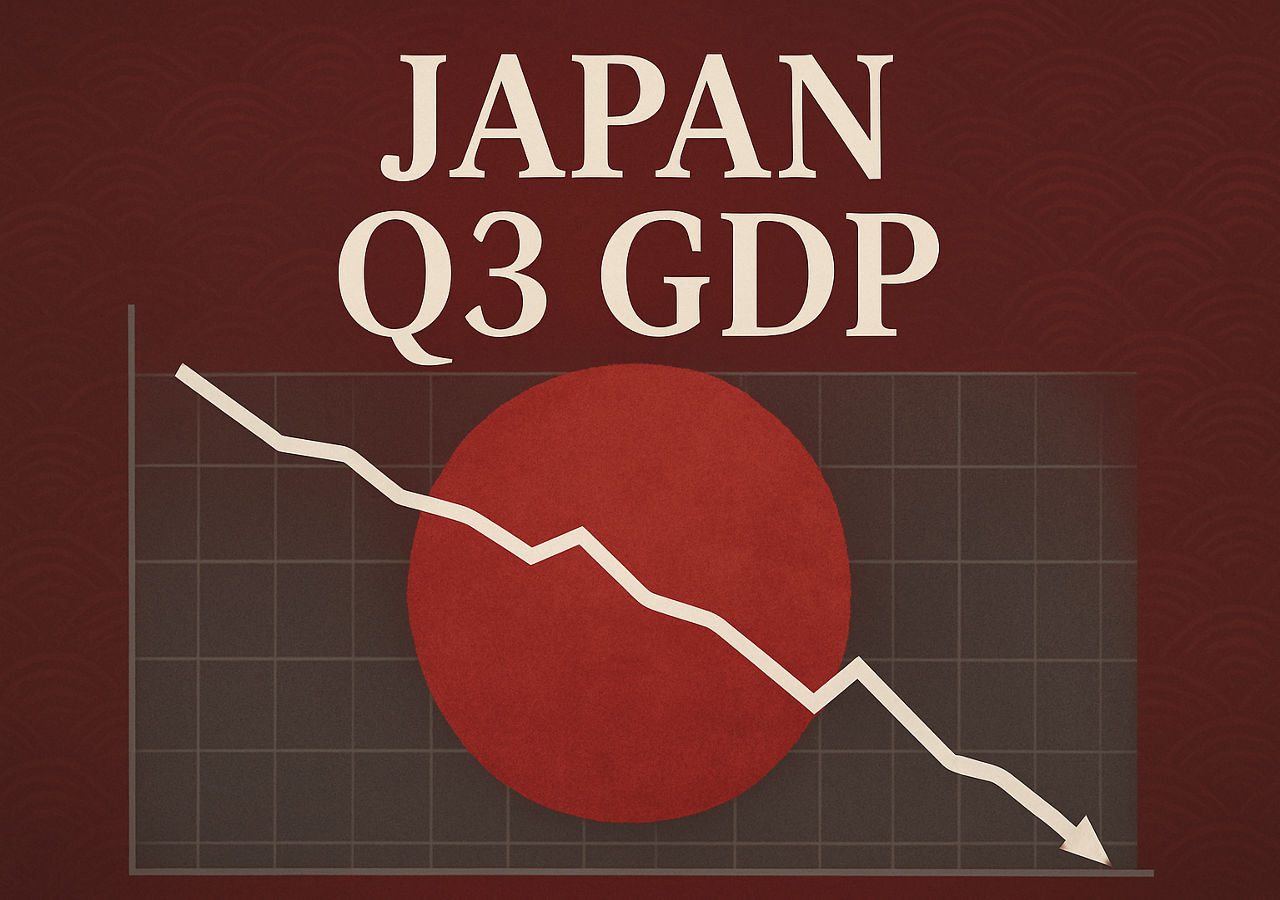
Japan's GDP print just moved from "soft" to "ugly." The revised Q3 numbers show the economy shrinking 0.6% q/q, worse than both the initial -0.4% estimate and the -0.5% forecast, equivalent to a -2.3% annualised contraction, the sharpest fall since Q3 2023.
For a central bank that is lining up a December rate hike, that's a nasty backdrop. Traders now have to juggle a weak growth print, sticky inflation, a structurally weak yen, and a Bank of Japan that still sounds determined to nudge rates higher from 0.50% to 0.75% on 18–19 December.
| Metric | Revised Q3 2025 | Initial estimate | Median forecast |
|---|---|---|---|
| Real GDP q/q (sa) | -0.6% | -0.4% | -0.5% |
| Real GDP annualised | -2.3% | -1.8% | -2.0% |
| Prior quarter (Q2 2025, ann.) | +2.3% | — | — |
Attached above is the Revised Cabinet Office data for July–September 2025.
To summarise, the economy is shrinking faster than first reported, and marginally worse than the street was braced for.
The takeaway, the revision itself is the story as a mild contraction has become a clear growth shock just days before the BoJ's final meeting of the year.
The revised GDP release shows weak capex and external demand doing most of the damage:
Private consumption: +0.2% q/q (revised up from +0.1%)
Capital expenditure: -0.2% q/q (revised down sharply from +1.0%)
Exports: -1.2% q/q, reversing Q2’s 2.3% gain
Imports: -0.4% q/q
Net exports contribution: -0.2 percentage points to growth
Domestic demand contribution: -0.4 percentage points (worse than the -0.2 pp initially reported)
In other words, households are just holding up, but companies are cutting back, and trade is hurting.
The key external drag is the Trump tariff regime:
U.S. tariffs on Japanese goods, especially autos, hammered exports in Q3.
A new agreement now applies a 15% baseline tariff on most Japanese imports, down from initial surcharges of 25–27.5%, but the damage is already showing in the Q3 data.
Export volumes fell 1.2% q/q, more than enough to drag GDP into the red despite softer imports.
Japan's growth engine has always relied heavily on external demand. Right now, that engine is misfiring.
On the domestic side, the revised numbers are a clear confidence signal from corporates and developers:
Business investment slipped 0.2% q/q in the GDP release, instead of rising 1.0% as first reported.
Beneath the surface, survey-driven capex increased by 2.9% year-over-year, yet this represents a significant decline from the 7.6% in Q2.
Private residential investment dropped around 8% q/q annualised, partly due to building code changes and caution in the housing sector.
Firms are pulling in their horns, facing:
Tariff uncertainty
Higher domestic yields and funding costs
Softer global demand.
Households are not the heroes of this story, but they're not in freefall either:
Private consumption edged up 0.2% q/q, a slight upward revision, aided by wage gains and government support measures.
Real incomes are still squeezed by years of above-target inflation, but spending has been more resilient than capex, which is why domestic demand's drag is centred on investment rather than households.
The message: Japan's consumer isn't driving growth, but the real fracture line in Q3 was corporate and external, not household.

Despite the softer GDP, markets and policymakers still see a high probability of a December hike:
Market outlets report the BoJ is likely to raise the policy rate from 0.50% to 0.75% at the 18–19 December meeting, with the government "prepared to tolerate" that move.
Governor Kazuo Ueda said the bank will weigh the "pros and cons" of a hike, his clearest signal yet that a move is under serious consideration.
OIS and futures now price roughly an 80% chance of a hike, up from around 60% before his comments.
So far, the GDP miss is not quite big enough to derail what's being framed as a normalisation step, not a tightening cycle.
The yen is still trading as a weak-currency story with a BoJ twist:
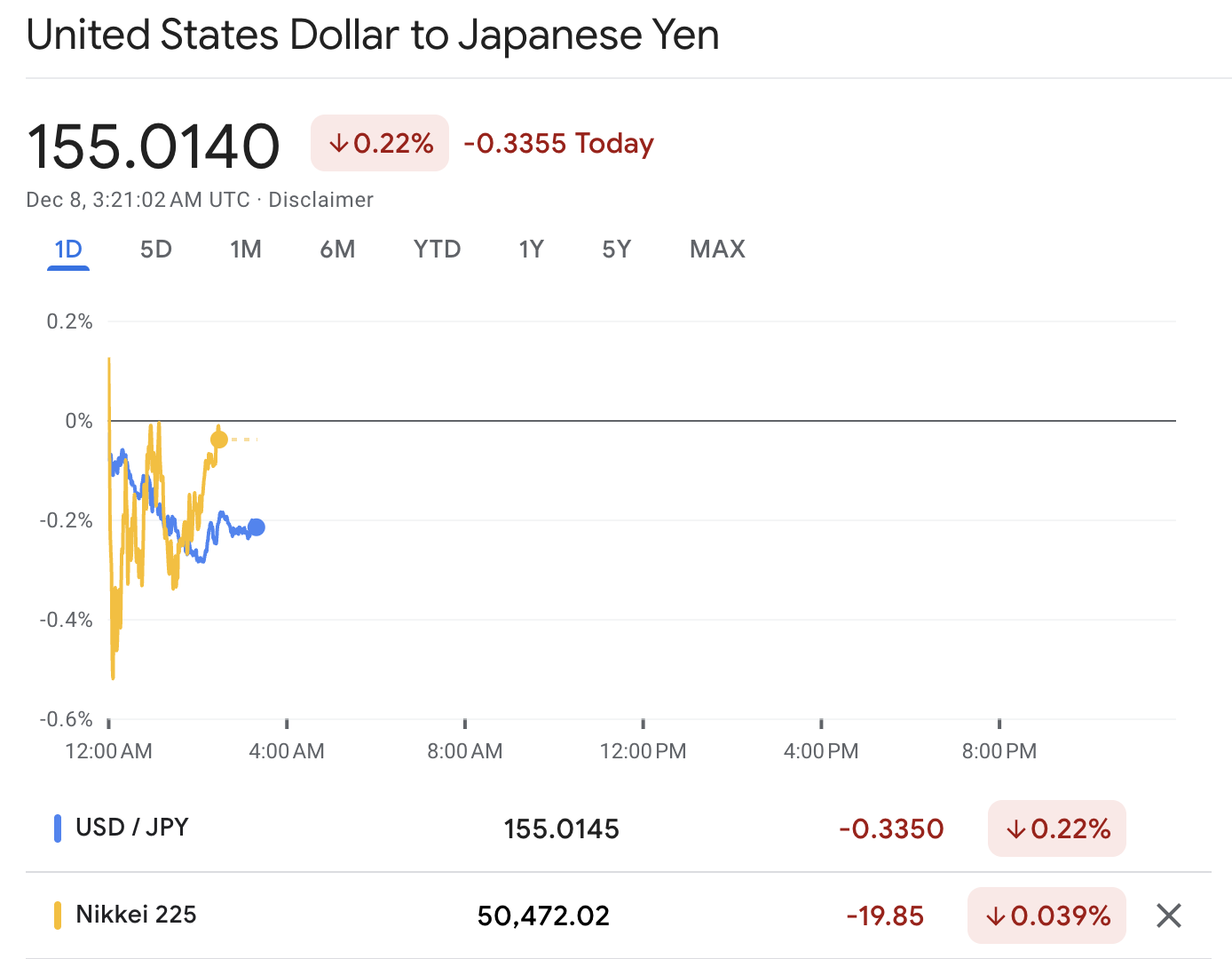
USD/JPY is hovering around 155 (roughly 155.1 print on 8 December), down from the 158.8 area touched earlier in the year.
It is a "ticking time bomb", given how far it has diverged from Japan's fundamentals and the scale of carry trades built on it.
A BoJ hike, plus any signal of further normalisation in 2026, is precisely the kind of catalyst that could force some of that carry to unwind.
Technically:
USD/JPY has dropped below 155, with 153–154 now a key pivot zone and the 50-day moving average sitting near 153. Beneath that, 150 (plus the 50-week MA) is massive psychological support.
So the GDP miss has taken some steam out of BoJ-hawkish yen strength, but the real line in the sand for traders is still how the pair behaves around 153–155 into the December meetings.
On the bond side:
The 10-year JGB yield is around 1.95% as of 8 December, close to its highest levels in decades.
Immediately after the GDP revision, yields edged lower intraday as markets priced a slightly less aggressive BoJ path, but the overall level remains elevated relative to the pre-normalisation era.
In other words, the GDP data bent the curve a bit; it didn't break the new regime of positive yields and reduced yield-curve control.
Japanese equities are caught between weak macro data and a still-powerful global risk bid:
The Nikkei 225 recently hit an all-time high of around 52,637 in early November and now trades near 50,350–50,500, a pullback of roughly 4%.
Technical dashboards show a 14-day RSI around 54, basically neutral, and a MACD that still tilts bullish, while the shorter moving averages (5-day) have started to give "sell" signals.
A recent note flagged "bearish signals as BoJ hawkish bets build", pointing to emerging downside risks as higher local yields meet a market priced for perfection.
So far, the equity market is treating the GDP miss as a wobble, not a collapse. But with yields near 2% and the BoJ hiking, the days of free money for Japanese corporates are fading.
Over the next few weeks, the focus will sit on a few key questions:
BoJ follow-through: Does the bank actually deliver a 0.25% hike to 0.75% on 18–19 December, and how "one-and-done" is the guidance into 2026?
Wage data & shuntō expectations: Strong base-pay hikes would give the BoJ political cover to look through one weak GDP quarter.
Tariff path: Any softening in U.S. tariff policy, or offsetting industrial support, would ease pressure on exports and capex.
Yen positioning: With the currency still around 155 and huge carry trades outstanding, any surprise from the BoJ could trigger violent yen short-covering.
Fiscal package size and design: The scale and structure of Takaichi's stimulus regarding infrastructure vs transfers vs tax tweaks will shape the 2026 growth profile.
For now, -0.6% GDP is a warning shot, not yet a full-blown policy pivot.
The initial estimate showed GDP down 0.4% q/q, annualised -1.8%. The revision took that to -0.6% q/q and -2.3% annualised, making the contraction clearly sharper and worse than the consensus expectation of -2.0% annualised.
It makes the optics trickier, but markets still see a high chance of a hike to 0.75% on 18–19 December.
USD/JPY remains elevated around 155, but recent drops below that level and the emergence of 153–154 as a pivot show the market is starting to price BoJ risk more seriously.
Japan's revised Q3 GDP print is a clear reminder that tariffs, a weak yen and higher domestic yields come with a cost. A 0.6% quarterly drop and -2.3% annualised contraction expose the fragility behind the headline story of wage gains and moderate recovery.
If you're trading yen, JGBs or Japan equities into the December BoJ meeting, this GDP print doesn't scream "panic". It does, however, tell you that growth is no longer a free option in the normalisation trade.
Disclaimer: This material is for general information purposes only and is not intended as (and should not be considered to be) financial, investment or other advice on which reliance should be placed. No opinion given in the material constitutes a recommendation by EBC or the author that any particular investment, security, transaction or investment strategy is suitable for any specific person.