Published on: 2026-06-05
Solidion Technology (Nasdaq: STI) surged after the company linked its battery platform to space infrastructure, AI data centers, and lunar power systems.
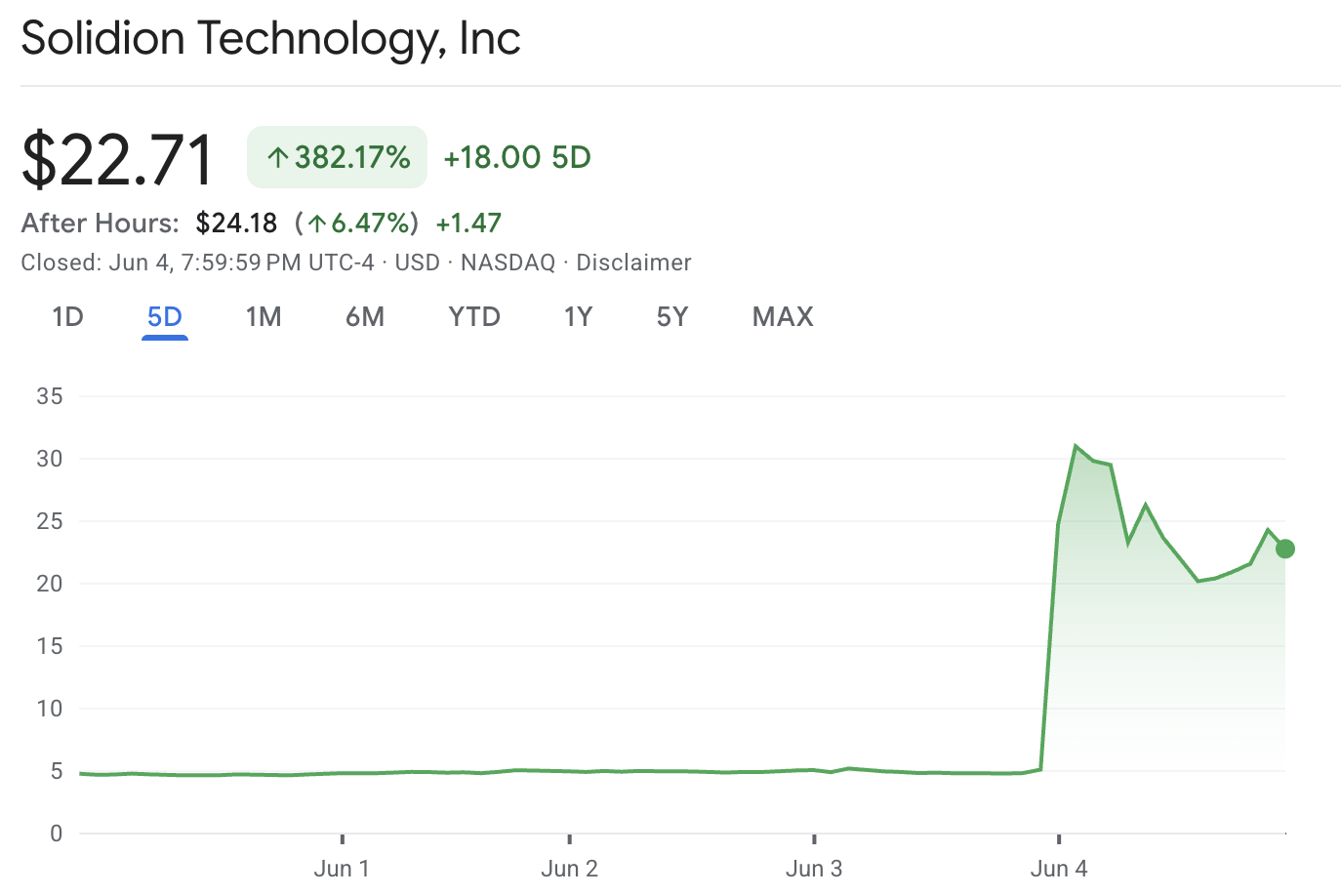
Shares closed at $22.71 on June 4, 2026, up 350.60%, after Solidion unveiled its Generation Extreme-Climate Battery, or Gen-ECB, platform for satellites, spacecraft, Low Earth Orbit AI data centers, and future lunar applications.
The rally was dramatic, but the company’s financial base remains narrow. Solidion reported $85,426 in Q1 2026 revenue, a $1.43 million net loss, and $38,887 in cash. It did not announce a confirmed SpaceX, NASA, or other major aerospace contract. That makes STI a test of whether traders are pricing a credible commercial pathway or chasing a microcap momentum trade.
STI rose 350.60% on June 4, 2026, closing at $22.71 from a prior close of $5.04, after Solidion announced its Gen-ECB platform.
The platform targets satellites, Low Earth Orbit AI data centers, spacecraft, and lunar infrastructure, placing Solidion inside several high-growth technology themes.
Solidion reported $85,426 in Q1 2026 revenue, so the rally was driven by future optionality rather than current revenue scale.
No named SpaceX or NASA contract was announced. The company referenced SpaceX-related applications and NASA Artemis use cases as targets, not agreements.
Liquidity is the central financial constraint. Solidion disclosed substantial doubt about its ability to continue as a going concern, a defaulted promissory note, and a Nasdaq compliance issue with a cure period tied to its June 11 annual meeting.
Solidion’s June 4 announcement gave traders a clear catalyst. The company said Gen-ECB uses graphene’s thermal conductivity and radiation resistance to regulate battery-cell temperature in harsh environments, dissipate heat, reduce thermal-runaway risk, and draw warmth from external sources such as solar panels during extreme cold.
Solidion said the platform has demonstrated operation from minus 80 to plus 60 degrees Celsius, with tested performance exceeding 500 charge cycles at minus 40 degrees Celsius. Development is also underway for wider deep-space temperature ranges.
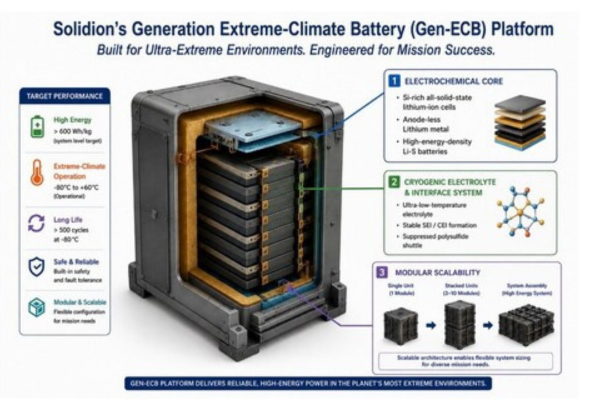
The framing around mission-critical environments, rather than standard storage, is what drew attention. Solidion named satellites, Low Earth Orbit AI data centers, crewed spacecraft, lunar rovers, habitats, and surface power grids as possible applications.
It also highlighted a broader portfolio that includes silicon-rich all-solid-state lithium-ion cells, anode-less lithium-metal cells, and lithium-sulfur designs targeting energy densities above 380 watt-hours per kilogram. Solidion says it holds more than 385 patents.
For a microcap, that combination was enough to trigger a fast rerating. The timing also helped. The news landed roughly a week before SpaceX’s expected June 12 IPO, when investor appetite for space-adjacent names is elevated.
Traders were responding less to a single specification than to the possibility that Solidion could become relevant to aerospace and AI-infrastructure markets, where energy density, thermal stability, and reliability can command premium economics.
The trading data shows how quickly the market repriced Solidion. STI moved from thin daily volume to one of the most active small-cap trades of the session.
| STI Metric | June 4, 2026 |
|---|---|
| Previous close | $5.04 |
| Open | $24.77 |
| Intraday high | $38.15 |
| Intraday low | $18.87 |
| Close | $22.71 |
| Daily change | +350.60% |
| Volume | 101.6 million shares |
The volume surge was the clearest signal. STI traded 101.6 million shares on June 4, compared with fewer than 60,000 shares the previous day. That kind of range expansion can attract momentum traders, news-driven algorithms, and short-term liquidity providers before fundamental buyers can assess the business case.
Short interest does not appear large enough to explain the move. Data showed 59,151 shares sold short as of May 15, 2026, about 0.80% of the float, with a short-interest ratio near 0.8 days to cover. A higher figure near 9.9% on some screens reflects an earlier April 30 reading of about 243,000 shares, before the short position fell sharply.
Either way, the profile makes a classic short squeeze an unlikely primary driver. The cleaner explanation is a high-impact catalyst hitting a narrow float.
Solidion remains an early-stage business. In Q1 2026, it reported its first quarterly revenue, supported by government grants and delivery of proprietary silicon anode products. It also referenced new high-power pouch cell and AI data-center UPS battery products.
| Solidion Q1 2026 Metric | Amount |
|---|---|
| Revenue | $85,426 |
| Net loss | $1.43 million |
| Operating expenses | $1.86 million |
| Cash and cash equivalents | $38,887 |
| Total liabilities | $13.60 million |
| Total assets | $5.33 million |
| Stockholders’ deficit | $8.27 million |
The first-revenue milestone is meaningful, but it does not yet prove commercial scale. Quarterly operating expenses ran many times revenue, while the balance sheet carried a stockholders’ deficit.
This is the central tension for STI. Solidion has intellectual property, product claims, and exposure to markets with long-term appeal. It has not yet shown the recurring revenue, funded customer programs, or scaled production needed to support the rally on operating fundamentals.
Solidion’s own filing makes liquidity the hardest issue. The company reported $38,887 in cash as of March 31, 2026, minimal sales, and an expectation of continued losses and cash burn.
It disclosed that projected liquidity was insufficient to fund operations and obligations for one year after the financial statements were issued, raising substantial doubt about its ability to continue as a going concern.
The filing adds further strain. Solidion disclosed a $2.2 million promissory note to EF Hutton in default, accruing interest at 24% per year, alongside other short-term notes. It was also temporarily out of compliance with a Nasdaq audit-committee independence rule following a director resignation, with a cure period tied to its June 11, 2026 annual meeting.
Financing is therefore the swing factor. A higher share price can improve Solidion’s options, and its largest shareholder, Madison Bond LLC, said in late April it intended to provide bridge support. The trade-off is dilution. Raising equity would expand the share count existing holders are measured against.
A Form 144 filed on June 4 is also worth paying attention to. It is a notice of a proposed affiliate sale, not proof of a completed sale, but it can signal potential insider selling into strength.
Solidion’s release used ambitious strategic language. It referenced SpaceX-related applications and NASA Artemis lunar use cases, and said it is actively engaging with aerospace partners. Those statements support the thematic case. They do not establish that SpaceX, NASA, or another major customer has awarded a contract.
That distinction is critical. Aerospace batteries face demanding qualification: temperature cycling, radiation exposure, vibration tolerance, mass constraints, safety standards, and mission-duration reliability. Promising chemistry and patents are not the same as a flight-qualified, customer-funded program.
For STI to sustain a higher valuation, the market will want a named partner, independent validation, customer-funded testing, purchase orders, or licensing revenue.
The AI power-storage angle adds a second theme. Solidion has described an uninterruptible-power-supply battery system for AI data centers built on its silicon-carbon anode cell, which it says can improve space efficiency and battery life compared with conventional backup systems.
This opportunity may be more near-term than lunar infrastructure, given rising data-center power demand and grid constraints. It remains a company-stated opportunity rather than confirmed demand. The case needs purchase commitments, customer names, installation timelines, or measurable revenue before the data-center story can offset balance-sheet risk.
The near-term calendar is dense. The June 11 annual meeting ties to the Nasdaq cure period. The expected June 12 SpaceX IPO may also shape sentiment toward space-adjacent names.
The developments that would most change the story are a named aerospace partner, independent test results, a funded development agreement, commercial UPS orders, a licensing transaction, or financing that strengthens the balance sheet without heavy dilution.
Until those signals appear, STI remains a high-volatility microcap trade built around future optionality. The Gen-ECB announcement explains why the stock surged. The $85,426 revenue base explains why the rally still needs proof.
STI is up because Solidion attached a high-specification battery platform to several of the market’s strongest themes: space infrastructure, AI data centers, advanced batteries, and domestic supply chains.
The financial reality is more restrained. Solidion has reported its first quarterly revenue, but sales are small, losses continue, cash is limited, and the company has disclosed going-concern risk. The announcement created a powerful narrative. The next test is whether that narrative becomes customer-backed revenue.
Solidion Technology official press release list
Solidion Technology Q1 2026 Form 10-Q, SEC EDGAR
https://www.sec.gov/Archives/edgar/data/1881551/000121390026059602/ea0288674-10q_solidion.htm
Nasdaq historical market data for STI
https://www.nasdaq.com/market-activity/stocks/sti/historical