Published on: 2026-02-05
Updated on: 2026-02-05
S&P 500 inclusion is one of the few equity catalysts where market plumbing can overpower narrative. An index add forces benchmarked capital to buy into a fixed deadline, funnels liquidity into the closing auction, and can reprice a stock before fundamentals get another word in.
The S&P 500 accounts for approximately 80 per cent of US equity market capitalisation, so membership decisions are reflected directly in ETFs, mutual funds, and institutional mandates.
With the market-cap guideline for additions raised to $22.7 billion in mid-2025, inclusion now primarily targets large, liquid stocks. The path is often the same: a headline-driven gap, a positioning window where spreads and options do the talking, and then a decisive closing print that clears the bulk of the imbalance. After that, the stock’s trading identity can change for good.
The composition of the S&P 500 is determined by a committee, and the rules referenced by investors function as gating criteria rather than an automatic ranking system. Size is the first filter, and S&P Dow Jones Indices regularly updates market-cap guidelines to keep the index representative as markets reprice and liquidity shifts across sectors.

The S&P 500 is a broad, large-cap benchmark, so its constituents span mega-cap technology leaders, major banks, industrial bellwethers, consumer franchises, and healthcare giants. Examples commonly found in the index include:
Apple (AAPL),
Microsoft (MSFT),
NVIDIA (NVDA),
Amazon (AMZN),
Alphabet (GOOGL),
Constituents can change over time due to corporate actions and committee decisions.
In July 2025, the minimum unadjusted market-cap guideline for S&P 500 additions increased from $20.5 billion to $22.7 billion, with corresponding upward adjustments to the MidCap and SmallCap ranges.
| Guideline (for additions) | Effective Jan 2, 2025 | Effective Jul 1, 2025 |
|---|---|---|
| S&P 500 minimum unadjusted market cap | $20.5B or more | $22.7B or more |
| S&P MidCap 400 range | $7.4B to $20.5B | $8.0B to $22.7B |
| S&P SmallCap 600 range | $1.1B to $7.4B | $1.2B to $8.0B |
| Additional size condition | Security-level float-adjusted market cap must be at least 50% of the respective index’s minimum threshold | Same |
S&P 500 inclusion is characterized by two key dates, each of which is traded differently by the market.
1) Announcement: typically after the close, giving the market one overnight repricing cycle to digest forced demand. This is where gaps form, options reprice, and fast money decides whether to lean into the move or fade it.
2) Effective date: when index portfolios must hold the name at the new weight, often aligned with a Monday open following a Friday close rebalance window. This is where execution becomes the story, especially in the close.
T0 (announcement, typically after the close): pricing shifts to flows and execution risk.
T+1 to T+N (the window): pre-positioning, liquidity discovery, and hedging dominate.
Effective close: the market’s most considerable one-shot demand arrives via closing-auction mechanics.
Post-effective (weeks): the “forced buyer” disappears; the stock’s behavior normalizes, but its investor base and trading ecosystem may not.
For example, during the December 2025 reshuffle, S&P Dow Jones Indices announced that CRH, Carvana, and Comfort Systems USA would be added effective before the market opens on Monday, December 22.
Even if the price premium fades, inclusion tends to leave structural footprints.
You typically get a higher baseline share of passive ownership. That can lower idiosyncratic noise, but it also means the stock increasingly trades as part of systematic de-risking and ETF flow cycles. On risk-off days, correlation can rise faster than fundamentals can defend.
Research has found that inclusion is associated with changes in comovement characteristics, meaning that a stock can become more sensitive to index-level moves even if the business remains unchanged.
More continuous two-way flow, deeper order books, and tighter execution for institutions are common outcomes, especially once post-event volatility settles. The stock may trade “cleaner” over time, even if the first week is messy.
The classic “inclusion pop” has been documented for decades. In the preannouncement era examined by Beneish and Whaley, additions showed a measurable price lift around announcement and into the effective date window, consistent with price pressure rather than new information about fundamentals.
Two modern refinements matter for today’s market:
The magnitude of the inclusion effect varies over time. Evidence suggests the effect weakened in parts of the 2010s, then resurfaced in the post-2020 environment, where retail participation and options activity can amplify announcement-driven moves.
Front-running compresses the premium. As more capital anticipates the rebalance, returns are pulled forward. That often turns the effective day into an execution milestone rather than a fresh catalyst, increasing the odds of “buy the rumour, sell the rebalance” once the last forced buyer is done.
This is why inclusion is not a free lunch. The stock can reprice sharply upward, but once passive ownership is established, the marginal bid disappears. If the announcement premium overshoots fair value, the next few weeks can look more like mean reversion than continuation.
S&P 500 inclusion often coincides with a short-term price rise, but it is not reliable enough to treat as a rule. The immediate move is usually driven by mechanical positioning into a known deadline, not a sudden upgrade in fundamentals.
When the forced buying is absorbed, the incremental bid disappears, and the “index premium” can fade quickly.
Event-study evidence shows the average impact has changed materially over time. Greenwood and Sammon find that the average price impact around inclusion rose from 3.4% in the 1980s to 7.4% in the 1990s, then eased to 5.2% in 2000 to 2009, and fell to about 1.0% in 2010 to 2020, statistically indistinguishable from zero. That decline is not a contradiction of passive growth; it reflects factors such as migrations from other S&P indices and front-running. [2]
| Period / category | Average inclusion price impact (approx.) | What it implies |
|---|---|---|
| 1980s | +3.4% | Modest, flow-driven lift |
| 1990s | +7.4% | Stronger “index game” era |
| 2000–2009 | +5.2% | Still meaningful, but moderating |
| 2010–2020 | +1.0% | Near-zero on average; effects often arbitraged |
| 2010s direct adds | +5.4% | Net demand shock remains large |
| 2010s migrations | −1.8% | Offset flows can erase the pop |
The inclusion effect is a demand shock driven by mandated ownership. S&P 500-linked assets sit across ETFs, mutual funds, separate accounts, and derivatives, but the fastest transmission typically runs through the ETF complex.
The largest S&P 500 ETFs and index funds hold substantial assets (figures change over time), which is why even a small index weight can translate into meaningful deadline-driven demand. [2]
Not all of that capital trades at once, but the deadline effect is material:
Complete replication portfolios must hold the stock at the effective close.
Sampling portfolios may buy earlier, but still converge towards the benchmark weight.
Benchmark-aware active managers often reduce tracking-error risk by initiating or scaling positions during the inclusion window.
The most durable change from S&P 500 inclusion is often liquidity quality, not price level. Inclusion tends to increase the natural buyer base, deepen two-way flow, and improve the stock’s ability to absorb institutional size. It can also reshape the stock’s volatility profile:
Lower idiosyncratic volatility, higher index sensitivity. The stock becomes more closely tied to index-wide de-risking, systematic factor flows, and broad ETF creation and redemption cycles. For traders, that means macro headlines can move the name more than company headlines.
More active derivatives ecosystem. Options markets often become more central to day-to-day price formation as dealers hedge against higher turnover and greater institutional participation. Vol can spike on announcement, then settle into a higher baseline of liquidity.
These effects do not guarantee a lower cost of capital in all market environments. Still, they do alter trading dynamics, especially during periods of market stress when index-linked selling can dominate company-specific factors.
When a company is removed from the index, index-linked investors are forced to sell. Liquidity can temporarily thin as natural holders reassess the stock’s role in their portfolios.
In December 2025, S&P DJI paired additions with deletions and cross-index migrations, moving names down the size spectrum when they no longer represented the large-cap universe.
The key point is symmetry: inclusion creates a mechanical bid, while deletion creates a mechanical offer. The short-term impact can be meaningful, even though fundamentals still drive longer-term outcomes.
Market reactions to inclusion announcements remain visible. In early February 2026, Ciena was announced as the newest S&P 500 member, replacing Dayforce following an acquisition, showing that M&A-driven changes can occur outside the standard cadence.
In late 2025, CRH and Carvana rallied sharply after their additions were announced, reinforcing how quickly the market prices a forced bid when the inclusion is credible and the deadline is clear.
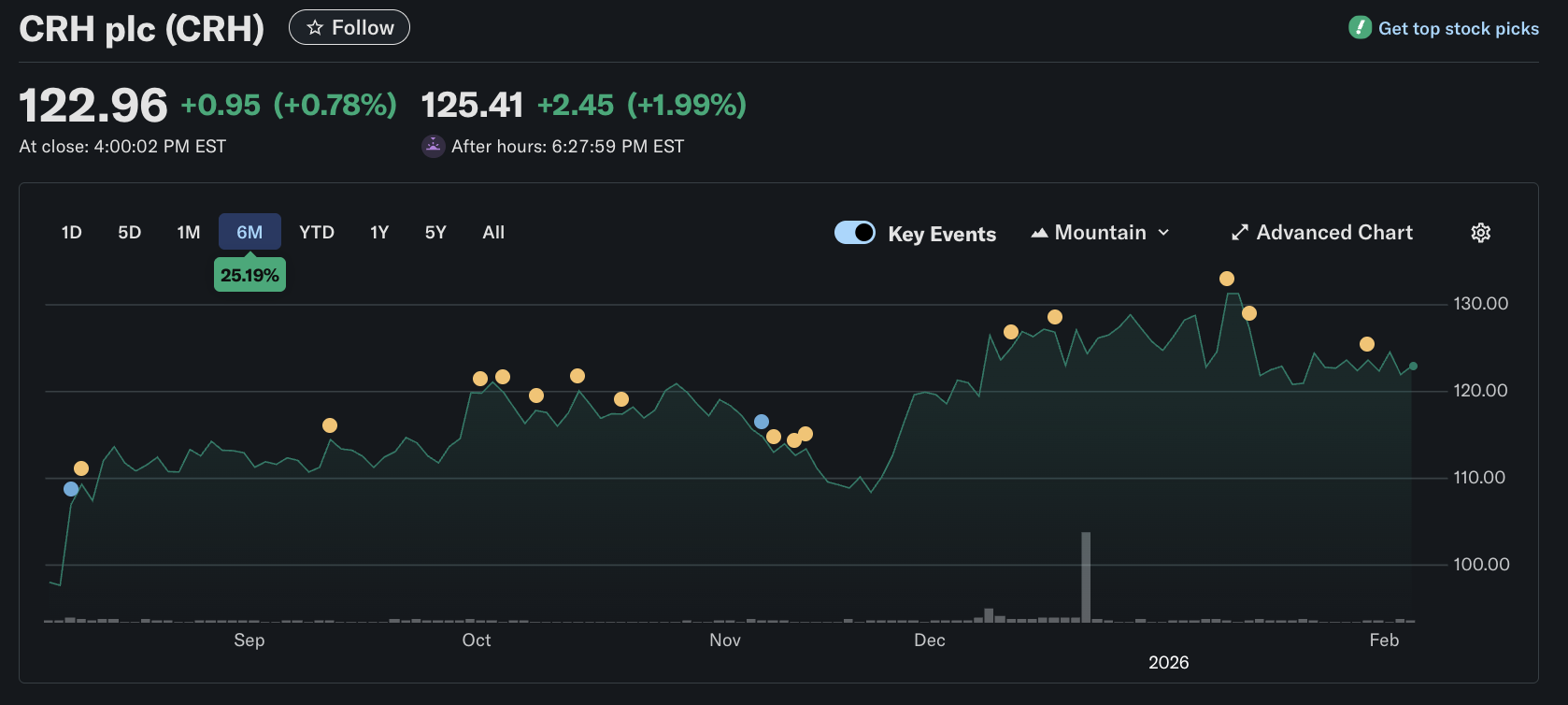
The longer-run outcomes, however, diverge. Once the index transition is complete, valuation discipline returns. Companies that use inclusion as a springboard for sustained earnings delivery tend to keep compounding. Companies that arrive after a momentum-driven run can struggle when the mechanical bid fades, and fundamentals have to re-justify the multiple.
You do not need perfect data to approximate the mechanical component of inclusion. A simple framework can indicate whether the market faces a manageable rebalance or a potential liquidity squeeze.
1) Estimate index weight.
Approximate weight = company float-adjusted market cap ÷ S&P 500 float-adjusted market cap.
2) Estimate replicating AUM that will trade.
Use a conservative subset: major ETFs plus large index mutual funds, then haircut for pre-positioning and sampling.
3) Translate dollars into shares.
Forced shares ≈ (replicating AUM × weight) ÷ stock price.
Even a small index weight can translate into substantial dollar demand. For example, a 0.10% weight against $1.7 trillion equates to $1.7 billion in benchmark exposure. At a $50 share price, that implies demand for roughly 34 million shares over a short window.
No. Inclusion can trigger a temporary demand shock into the effective date, but the effect is often short-lived. After forced buying clears, returns typically re-anchor to earnings power, guidance credibility, and valuation.
Many index portfolios aim to hold the stock at the effective date and often execute heavily into the close to align holdings with the benchmark. Some managers pre-position to reduce tracking error and execution costs, shifting part of the buying earlier.
Inclusion can pull forward returns. Once the last benchmark buyer has finished, marginal demand falls, and short-term holders may take profits. If the announcement premium pushes valuation beyond fair value, prices can mean-revert in the weeks that follow.
Yes. Committee discretion matters, and the index is designed to remain representative across sectors and the large-cap investable universe. Eligibility improves the odds of inclusion, but it does not guarantee a “next up” outcome.
Deletions face mechanical selling from benchmark-linked portfolios, and many are migrated to smaller indices rather than exiting index ecosystems entirely. The initial impact is flow-driven, while longer-term performance depends on fundamentals and investor-base stability.
S&P 500 inclusion is best characterised as a forced-flow event with two distinct phases: announcement-driven repricing and effective-date execution. The short-term premium is created by mandated ownership and a hard deadline, not an immediate change in the company’s cash flows.
Over time, the lasting effects are structural: deeper liquidity, broader ownership, and higher sensitivity to index-level risk appetite.
Disclaimer: This material is for general information purposes only and is not intended as (and should not be considered to be) financial, investment or other advice on which reliance should be placed. No opinion given in the material constitutes a recommendation by EBC or the author that any particular investment, security, transaction or investment strategy is suitable for any specific person.
1) S&P Dow Jones Index: What Happened To The Index Effect