Published on: 2026-03-20
Updated on: 2026-03-20
If you were watching the market tickers late Thursday, you witnessed a total nightmare scenario for Super Micro Computer stock. After a relatively calm regular session where the price closed at $30.79, things took a dark, sudden turn. In just a matter of minutes during after-hours trading, the stock price fell off a cliff, dropping a staggering 23%.
As we head into Friday, the value of Super Micro Computer stock is desperately trying to find a floor around the $23 mark. The AI-driven hype that fueled this company's meteoric rise over the last two years has officially slammed into a massive legal and regulatory brick wall. This isn't just a simple dip or investors taking profits; it's a full-blown crisis of confidence that hits the very core of the company's operations.

Let's be clear: this massive sell-off in Super Micro Computer stock wasn't triggered by a slight miss in quarterly revenue or a conservative analyst note. The source of this chaos is a federal investigation that reads more like a high-stakes spy novel than a corporate filing. The U.S. Department of Justice (DOJ) unsealed a formal indictment pointing to a systematic smuggling operation designed to funnel advanced AI technology into China, directly bypassing national security export bans.
The details emerging from court documents are, frankly, terrifying for anyone holding Super Micro Computer stock in their portfolio:
Bypassing Global Sanctions: Allegations suggest that roughly $2.5 billion worth of high-end servers—packed with the world's most powerful Nvidia chips—were diverted to Chinese entities currently on Washington's "Entity List."
The "Hair Dryer" Scheme: Perhaps the most shocking detail involves the physical tampering of hardware. Investigators claim that individuals linked to the firm used hair dryers to carefully peel off original serial numbers and labels from the servers, replacing them with fake identifiers to hide the true destination from auditors and customs officials.
Internal Fallout: While the corporation itself hasn't been charged as a legal entity yet, several high-ranking figures are firmly in the crosshairs. The company has already started firing contractors and placing key employees on leave—a move the market interprets as a silent admission that internal controls were virtually non-existent.
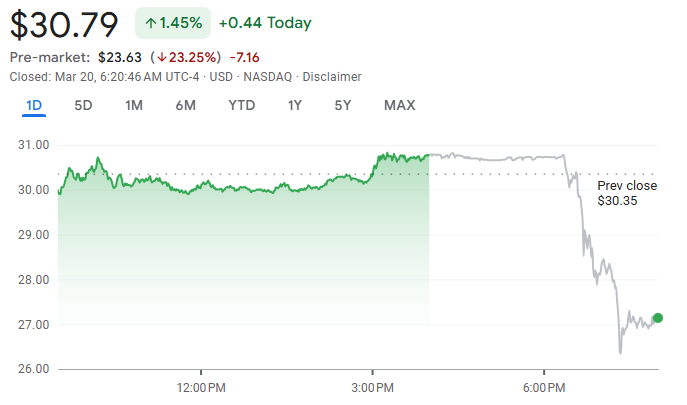
The shift in Super Micro Computer stock between yesterday's closing bell and this morning's pre-market is brutal. Billions of dollars in market capitalization simply evaporated overnight. Here is a look at the value lost in record time:
| Metric | Regular Close (Mar 19) | After-Hours Low | Total Change |
| Stock Price | $30.79 | $23.70 | -23.0% |
| Market Cap | $18.49 Billion | ~$14.2 Billion | -$4.29 Billion |
| Trading Volume | 25.75M | 12.2M (Ext. Hours) | Extreme Panic |
| Next Major Support | — | $17.25 | Critical Level |
The sheer volume of selling in the after-hours session suggests that this isn't just retail panic. It looks like institutional funds are liquidating positions before the situation gets even uglier.
From a technical perspective, the chart for Super Micro Computer stock is a disaster zone. Over the last six weeks, the stock had shown some resilience, trying to build a base between $28 and $34. Many traders were hoping this range would act as a springboard for a move back toward $40. Instead, that floor has turned into a ceiling, leaving a massive "gap down" that will be incredibly difficult to fill in the short term.
Right now, the $23.70 level is the last line of defense. It's where the price seemed to pause momentarily during the early morning hours. If Super Micro Computer stock fails to hold that level during today's regular session, the next real technical support doesn't appear until $17.25—a price point we haven't seen in a very long time.
On the upside, any attempt at a "dead cat bounce" will run into a wall of "trapped" investors. Everyone who bought yesterday at $30 is now deep in the red and will likely sell into any rally toward $27.50 just to break even. In legal crises like this, traditional indicators like the RSI (which currently shows the stock is extremely "oversold") lose their meaning because fear outweighs math.

The biggest fear for those watching Super Micro Computer stock isn't just a potential government fine. The real risk is existential: the supply chain. Super Micro is a massive customer for Nvidia's Blackwell and H100 chips. Their entire business model relies on getting priority access to this hardware.
If the U.S. government decides that SMCI is a national security risk, they could revoke export licenses or pressure Nvidia to cut ties. If Nvidia—a company that prides itself on strict compliance—decides to distance itself, Super Micro Computer stock could lose its competitive edge overnight. Without Nvidia chips, Super Micro becomes just another server assembly shop with razor-thin margins.
Furthermore, we should expect a total administrative mess. It's highly likely there will be significant delays in filing annual and quarterly financial reports. If external auditors can't verify the authenticity of sales (due to those alleged fake serial numbers), they won't sign off on the books. This could even lead to a delisting threat if the situation drags on, adding even more downward pressure on Super Micro Computer stock.
Ultimately, what has happened to Super Micro Computer stock is a harsh reminder that in the high-stakes world of AI infrastructure, ethics and compliance are just as vital as processing speed. The company has gone from being the "darling of the data center" to a cautionary tale about the dangers of poor oversight in a tense geopolitical climate.
For investors, the next few days will be a true test of nerves. This isn't a simple "buy the dip" moment; it's a "wait-and-see" scenario. Until there is a clear official statement that distances the corporate entity from the individuals accused, and until Nvidia confirms the partnership remains intact, Super Micro Computer stock will remain a high-risk gamble. The path back to $30 looks longer and darker than ever before.
Disclaimer: This material is for general information purposes only and is not intended as (and should not be considered to be) financial, investment or other advice on which reliance should be placed. No opinion given in the material constitutes a recommendation by EBC or the author that any particular investment, security, transaction or investment strategy is suitable for any specific person.