Published on: 2026-04-15
Wells Fargo beat on earnings per share, but the market focused on weaker revenue quality, lower sequential net interest income, and margin compression.
Management left 2026 net interest income guidance at about $50 billion and noninterest expense guidance at roughly $55.7 billion, giving investors stability but not upside.
The quarter was not weak across the franchise. Markets, investment banking, and wealth management all improved sharply.
The regulatory overhang has largely cleared, but WFC now needs cleaner core earnings momentum to win a higher valuation.
Why is Wells Fargo stock down today? Because Wells Fargo delivered the kind of quarter that looks acceptable in the headline and less convincing in the line items that actually drive a bank’s multiple.
WFC closed April 14 at $81.70, down 5.7%, after reporting first-quarter net income of $5.253 billion and diluted EPS of $1.60, while revenue missed expectations and management kept full-year net interest income guidance unchanged at about $50 billion.
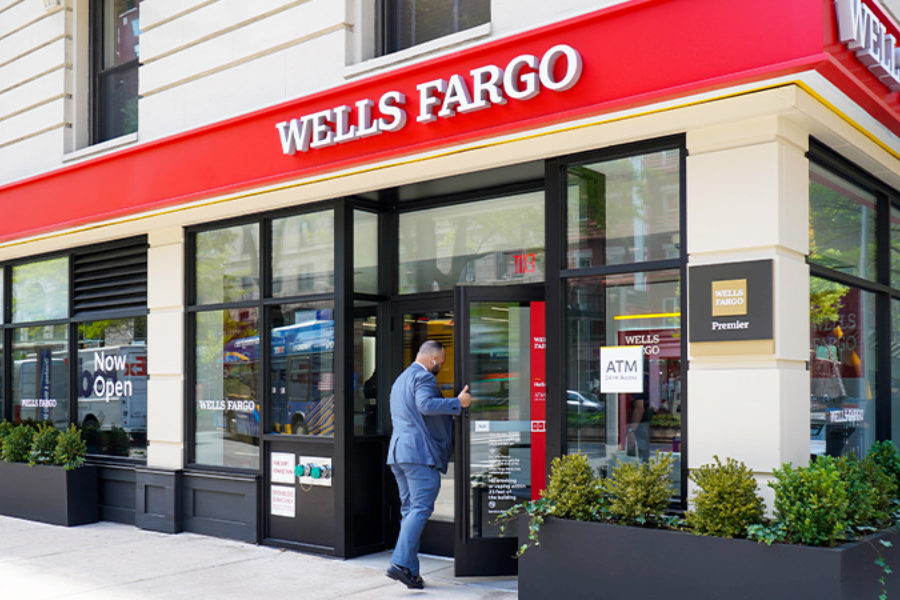
That matters because Wells Fargo is no longer trading under the old regulatory cloud alone. The Federal Reserve removed the bank’s asset-cap restriction in June 2025 and terminated the remaining 2018 enforcement action on March 5, 2026.
Even so, the stock remains roughly 16% below its 52-week high of $97.76, which suggests the market has moved on from the cleanup story and is now asking for stronger earnings quality, firmer margins, and clearer operating leverage.
On the surface, Wells Fargo’s quarter was solid. Revenue rose to $21.446 billion from $20.149 billion a year earlier. Average loans increased to $996.0 billion, average deposits rose to $1.415 trillion, return on equity improved to 12.2%, and the bank repurchased 46.3 million shares for $4.0 billion. Those are not numbers that ordinarily produce a hard selloff.
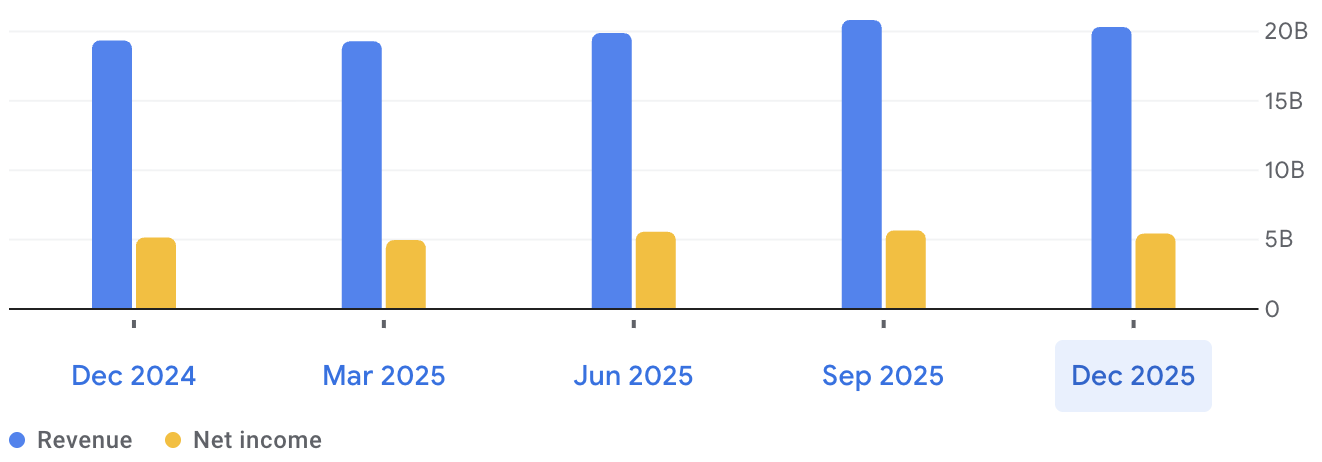
The problem was where the quarter missed. Net interest income came in at $12.096 billion, below the fourth quarter’s $12.331 billion, while net interest margin compressed to 2.47% from 2.60% in the prior quarter and 2.67% a year ago.
In bank stocks, that matters more than a modest EPS beat because spread income still anchors valuation, especially for a lender with Wells Fargo’s mix.
The quality of the EPS beat also came under scrutiny. Wells Fargo disclosed that first-quarter tax expense included $135 million, or $0.04 a share, in discrete tax benefits tied to prior-period matters. That does not erase the beat, but it does make the upside look less durable than the headline suggests.
| Metric | Q1 2026 | Q4 2025 | Q1 2025 | Why the market cared |
|---|---|---|---|---|
| Diluted EPS | $1.60 | $1.62 | $1.39 | Beat the street, but not on the cleanest mix |
| Total revenue | $21.446B | $21.292B | $20.149B | Grew year over year, but still missed expectations |
| Net interest income | $12.096B | $12.331B | $11.495B | Lower sequentially, which hit sentiment |
| Net interest margin | 2.47% | 2.60% | 2.67% | Margin compression remained the key negative |
| Noninterest expense | $14.330B | $13.726B | $13.891B | Higher costs diluted operating leverage |
| 2026 NII guidance | ±$50B | — | — | Unchanged outlook capped enthusiasm |
The financial results are from Wells Fargo’s first-quarter release and presentation; the revenue-miss framing reflects same-day market coverage.
The market reaction was not just about a single miss. It was about what the miss implied. By holding 2026 net interest income guidance at about $50 billion and keeping noninterest expense guidance near $55.7 billion, management signaled steadiness rather than acceleration.
In the current bank tape, that is usually not enough, especially when investors were already looking for a cleaner post-asset-cap rerating story.
That helps explain why Wells Fargo’s stock reaction looked harsher than peers. Same-day coverage showed Citigroup rising 2.6% after earnings, while JPMorgan slipped only 0.8%. Wells Fargo, by contrast, fell 5.7%, making it the clear underperformer among the large banks reporting that day.
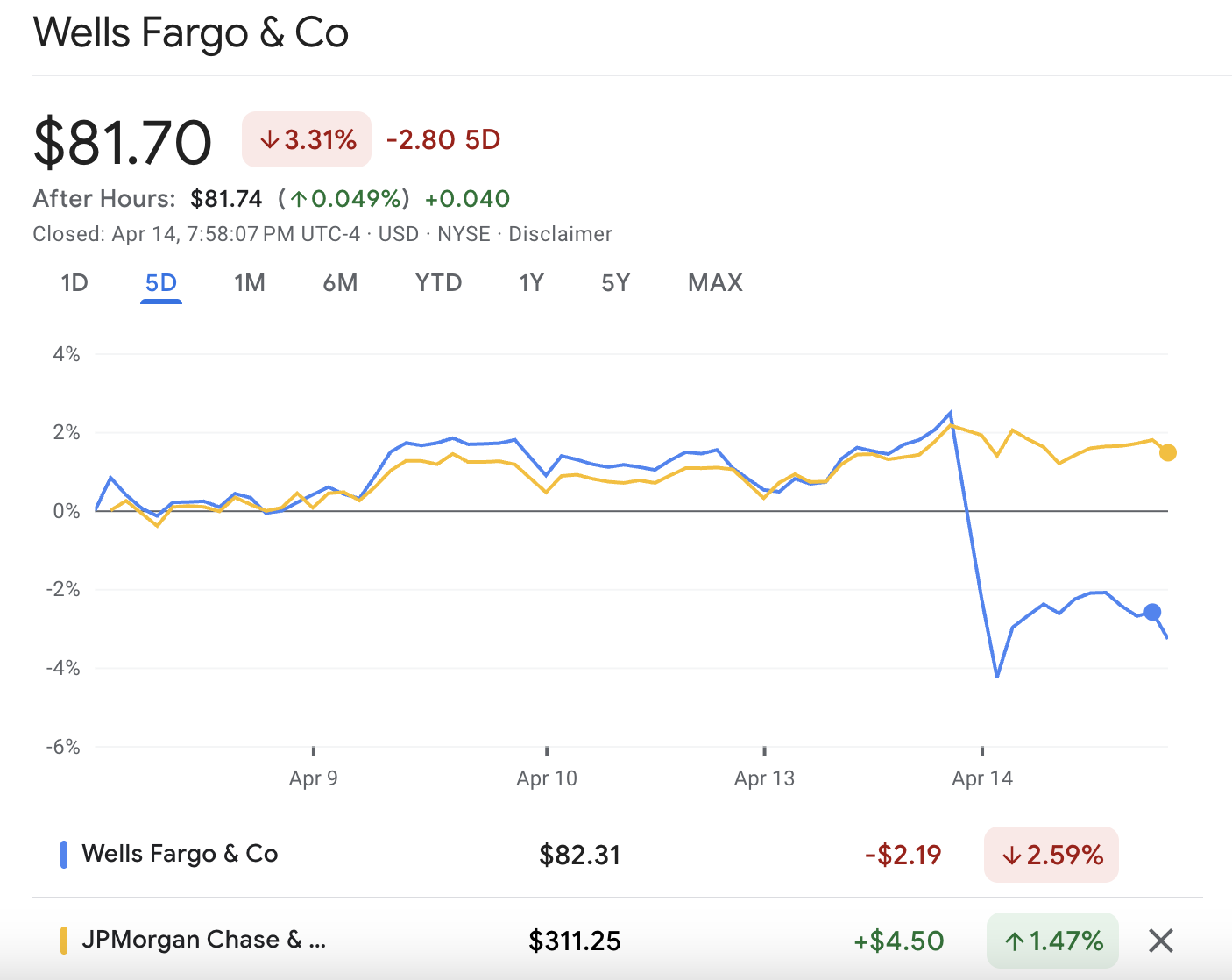
The message from the tape was straightforward: the market viewed Wells Fargo’s quarter as mixed, not broken, but mixed is often enough to trigger a rerating lower when expectations are high.
The pressure is also easier to understand in the context of the stock’s broader 2026 performance. Same-day market coverage described WFC as down about 7% year to date, even as the S&P 500 was up 1.6%. That gap suggests investors are still discounting Wells Fargo as a bank with unfinished earnings work, not as a full recovery story.
The selloff should not obscure the parts of the quarter that were genuinely strong.
Corporate and Investment Banking revenue rose to $5.278 billion. Investment banking revenue increased 13% to $602 million, markets revenue jumped 19% to $2.173 billion, and Wealth and Investment Management revenue grew 14%. Wealth segment net income rose 34% to $468 million, while total companywide client assets reached $2.483 trillion.
Those numbers matter because they show Wells Fargo is no longer only a net-interest-income story. The franchise is broadening. Fee income is stronger, client activity is healthier, and capital return remains intact.
The trouble is that these improvements have not yet been large enough to offset investor fixation on spread income, expense discipline, and the path of margins.
There is also a macro layer to watch. Wells Fargo finance chief Mike Santomassimo said some customers are spending 30% to 40% more on gasoline, a reminder that higher energy costs can pressure discretionary spending and, over time, consumer credit.
That caution matters because Wells Fargo still carries significant sensitivity to the health of the U.S. consumer even as its fee businesses strengthen.
Not on EPS. Wells Fargo reported $1.60 a share, but revenue missed expectations and net interest income fell short of what investors wanted to see.
Because it remains the clearest measure of Wells Fargo’s core earnings power. When NII falls sequentially and margin compresses, investors usually mark down the stock.
Markets, investment banking, and wealth management all posted strong growth, and the bank continued to buy back stock aggressively.
Largely, yes. The Fed removed the asset cap in June 2025 and terminated the remaining 2018 enforcement action in March 2026.
So, why is Wells Fargo stock down today? Because the market looked through the EPS beat and focused on what still did not improve enough: softer revenue quality, lower sequential net interest income, margin compression, and an unchanged forward guide. That combination was enough to turn a superficially solid quarter into a disappointing one for the stock.
The bigger point is that Wells Fargo has moved into a more demanding phase of its recovery. The regulatory cleanup is largely complete, the franchise is broader, and several fee businesses are performing well.
But until the bank can show cleaner spread income, firmer margins, and more convincing operating leverage, WFC is likely to remain judged more harshly than peers with stronger earnings visibility.
Disclaimer: This material is for general information purposes only and is not intended as (and should not be considered to be) financial, investment or other advice on which reliance should be placed. No opinion given in the material constitutes a recommendation by EBC or the author that any particular investment, security, transaction or investment strategy is suitable for any specific person.