Published on: 2026-06-12
Updated on: 2026-06-12
MANGOS names six companies now sitting at the centre of the AI trade: Meta, Anthropic, Nvidia, Google, OpenAI and SpaceX. The acronym has gained traction as investors look beyond FAANG toward companies tied to AI models, chips, users, cloud capacity, data centres, energy and space-linked infrastructure.
The test is whether MANGOS becomes the next serious Big Tech label, or a viral tag for an AI cycle already priced for perfection.
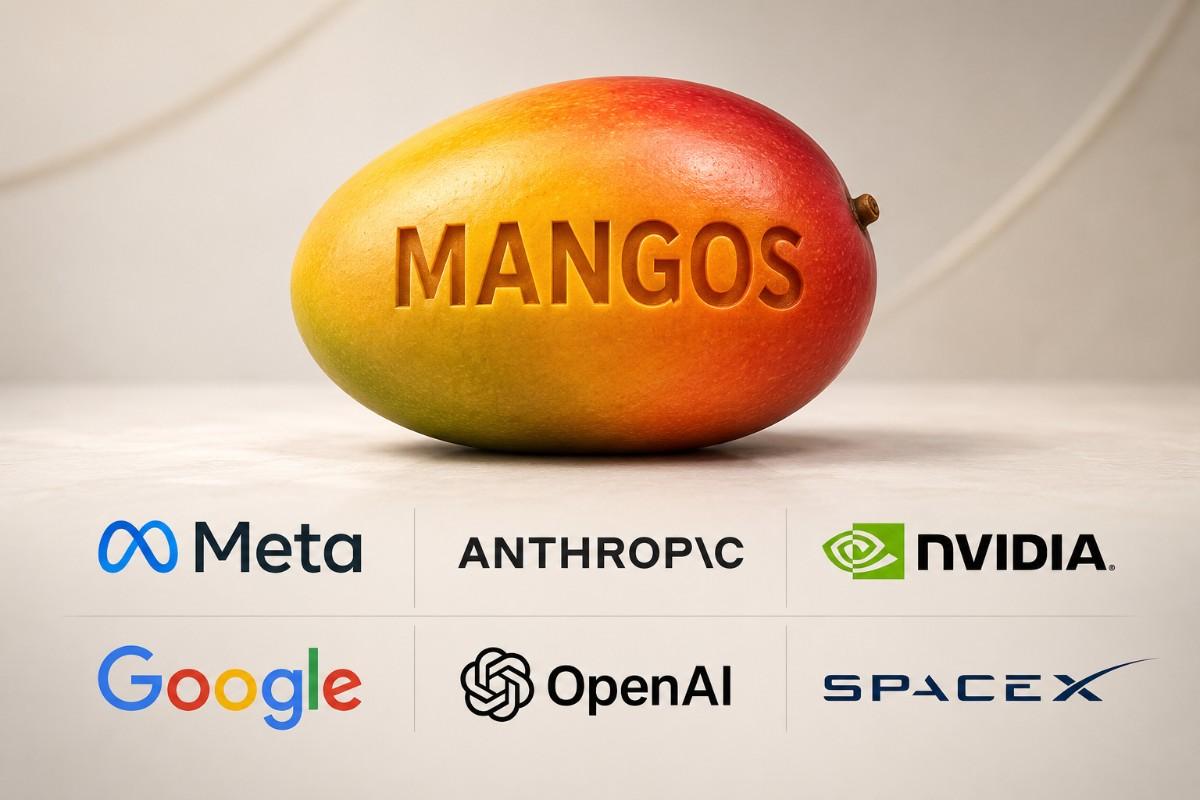
MANGOS is not an official index; it is a six-company market acronym built around AI models, chips, users, cloud capacity and infrastructure.
The public evidence is already substantial: Meta generated $56.31B in Q1 2026 revenue, Alphabet generated $109.9B in revenue, and Nvidia reported $81.6B in revenue in Q1 FY2027.
The private-market signal is aggressive: Anthropic raised $65B at a $965B post-money valuation, while OpenAI raised $122B and now generates about $2B in monthly revenue.
The bear case is capex: Meta expects $125B to $145B in 2026 capital expenditures, while Alphabet spent $35.7B on property and equipment in Q1 alone.
The next test is public-market proof: SpaceX’s Nasdaq debut, OpenAI’s confidential S-1 and upcoming AI capex updates will show whether MANGOS has substance beyond the acronym.
Each MANGOS company controls a different bottleneck in the AI economy.
| Company | AI Choke Point | 2026 Signal |
|---|---|---|
| Meta | Consumer distribution | $56.31B Q1 revenue |
| Anthropic | Enterprise models | $965B valuation |
| Nvidia | AI chips | $75.2B data-centre revenue |
| Search, cloud, TPUs | $109.9B Q1 revenue | |
| OpenAI | Consumer AI platform | 900M+ weekly users |
| SpaceX | Connectivity infrastructure | $1.77T IPO valuation |
Nvidia is the pressure point: every major AI model, chatbot, and cloud platform still depends on cheaper, more widely available compute. OpenAI already reports more than 900M weekly active users and more than 50M subscribers, while SpaceX priced its IPO at roughly $1.77T, giving the market a fresh public test for infrastructure scarcity.
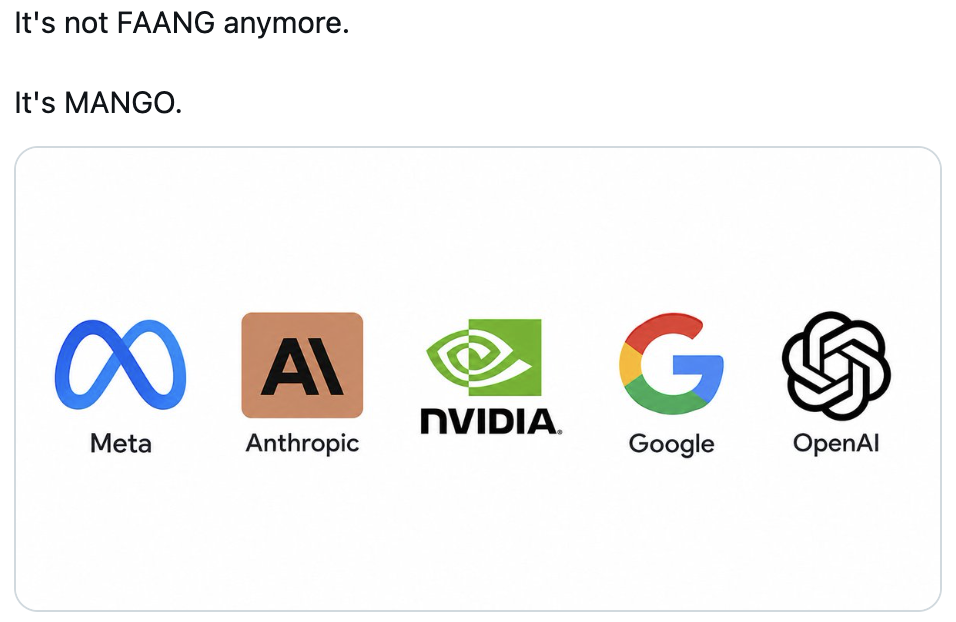
Image Credit: krishdotdev
FAANG monetised attention. MANGOS monetises intelligence, compute and infrastructure.
The financial model is heavier. Facebook, Amazon, Apple, Netflix and Google scaled through software, devices, commerce, subscriptions and advertising. MANGOS shifts power toward GPUs, cloud clusters, model training, inference capacity, data-centre leases, power access and network reach.
Nvidia proves the shift most clearly. Q1 FY2027 revenue rose 85% year over year to $81.6B, while data-centre revenue rose 92% to $75.2B. The strongest near-term economics in AI still sit with compute suppliers, not every company building applications above them.
Meta and Alphabet show the other side of the stack. Meta has the user base to push AI into ads, messaging and social discovery at a global scale. Alphabet has search, Google Cloud and TPUs inside one balance sheet. Together, they show why MANGOS goes beyond model hype: distribution and infrastructure still decide who turns AI use into cash flow.
The MANGOS trade has a cost problem before it has a demand problem. Meta expects $125B to $145B in 2026 capital expenditures, up from its prior range, as higher component pricing and data-centre capacity needs raise the cost of staying competitive. AI demand may be real, yet leadership now requires upfront spending only the largest balance sheets can absorb.
Alphabet faces the same pressure. Its Q1 revenue rose to $109.9B, while property and equipment purchases totalled $ 35.7 B. Search and Cloud still generate scale, but AI has made infrastructure spending a central valuation question rather than a background operating cost.
Power is the next constraint. Global data-centre electricity demand is projected to more than double to about 945 TWh by 2030, with AI-optimised data centres driving a major share of that increase. Compute scarcity now extends beyond chips into grids, cooling, land and long-term energy contracts.
SpaceX turns MANGOS into a physical infrastructure story. SpaceX priced its IPO to raise about $75B while valuing the company at roughly $1.77T, placing Starlink, launch capacity and future AI infrastructure value into the same market conversation as chips and frontier models. The market is pricing connectivity and hard-to-replicate networks, not only rockets.
The omission is the warning label. Microsoft, Amazon and Apple are not in MANGOS, yet all three still shape the AI economy.
Microsoft remains tied to OpenAI and enterprise AI distribution. Amazon controls AWS and backs Anthropic. Apple owns one of the world’s most valuable device networks. Any acronym excluding those three is market language, not a complete map of power.
MANGOS tracks where attention has moved; it does not rank every company that still controls AI distribution. The term works because it captures scarcity across models, chips, power, cloud capacity, users, and infrastructure. It fails if readers treat it as a complete investment universe.
MANGOS survives only if AI revenue grows faster than AI infrastructure commitments.
Anthropic’s $965B valuation and OpenAI’s confidential S-1 move frontier-AI economics closer to public-market scrutiny. Investors will look past user counts toward gross margin, compute obligations, customer concentration, retention, pricing power and cash burn.
SpaceX brings the test forward. Its Nasdaq listing under SPCX gives investors a daily price for the most infrastructure-heavy member of MANGOS. The first signal is not whether the stock pops; it is whether the market keeps paying a premium once revenue, losses, capex, and AI infrastructure claims are subject to public comparison.
MANGOS stands for Meta, Anthropic, Nvidia, Google, OpenAI and SpaceX. The term groups six companies tied to the AI economy’s main bottlenecks: models, chips, users, cloud capacity, connectivity and infrastructure.
No. MANGOS is a market acronym, not an official index or ETF. Meta, Nvidia, Alphabet and SpaceX have public-market exposure, while Anthropic and OpenAI remain tied to private-market or pre-IPO access.
Their absence exposes the acronym’s limits. Microsoft, Amazon and Apple still control major parts of AI distribution, cloud infrastructure and devices. MANGOS reflects where market attention has moved, not a complete ranking of tech power.
Yes. MANGOS weakens if filings show thin margins, heavy compute obligations, slowing monetisation or IPO valuations detached from cash flow. FAANG proved itself through profit durability. MANGOS still has to prove AI can compound margins, not only revenue.
SpaceX gives MANGOS its first public-market stress test. Its Nasdaq debut under SPCX will show how much investors are willing to pay for infrastructure scarcity before the full margin profile is settled.
The next signal comes from AI spending. Meta and Alphabet’s upcoming capex updates will matter more than another viral acronym cycle because they show whether AI demand is translating into operating leverage or simply into larger infrastructure commitments.
MANGOS earns staying power only when intelligence becomes a margin engine rather than a capital sink.