Published on: 2026-06-15
ASML stock remains one of the strongest AI hardware bottleneck trades, but it is no longer priced like a hidden winner. With 2026 sales guidance of €36 billion to €40 billion and the ADR trading near 48x forward earnings, the next move depends on EUV demand, High-NA adoption, and whether margins can still exceed high expectations.
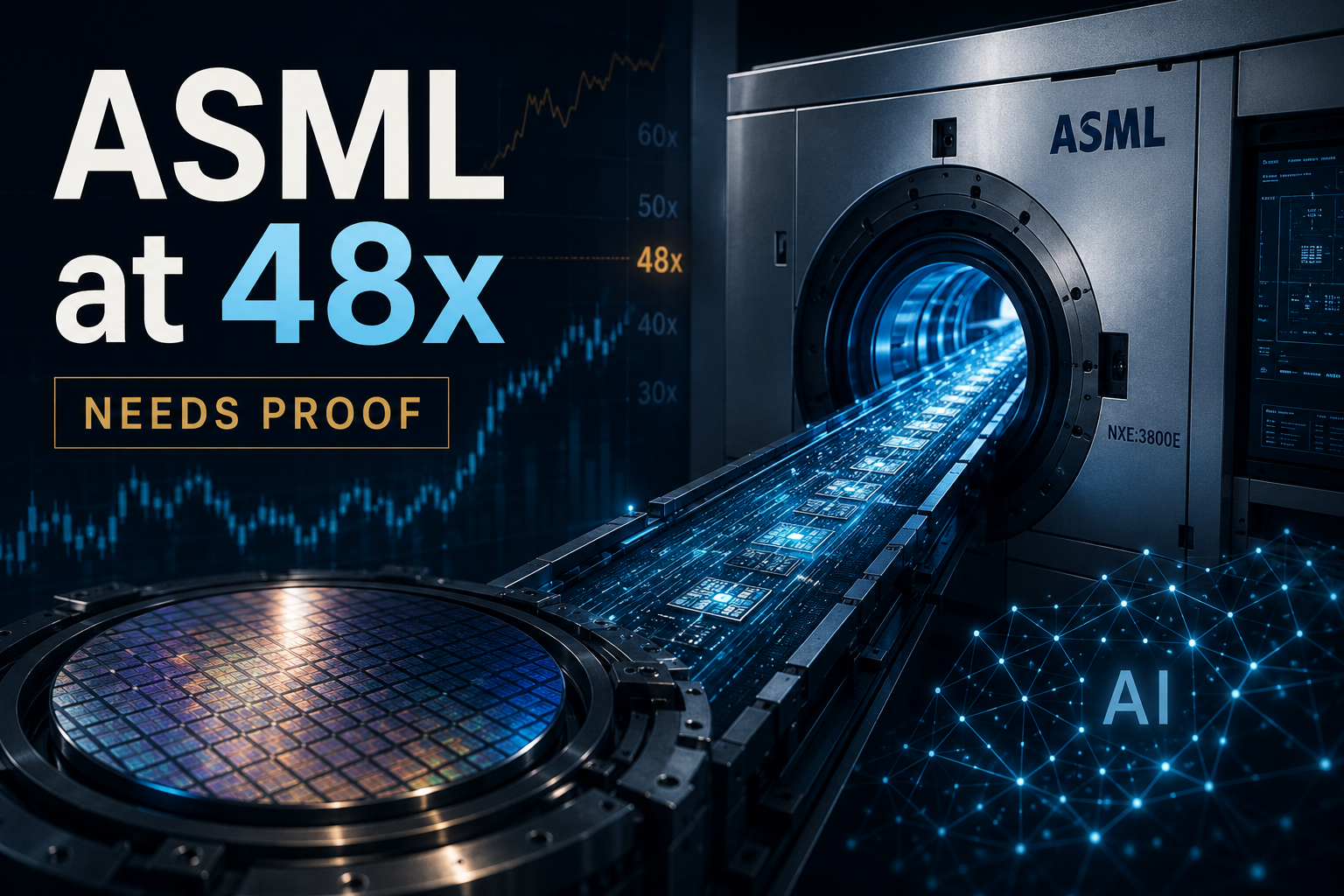
ASML stock remains an elite AI hardware exposure, but a market value near $733 billion means investors are already paying for scarcity, dominance, and long-term capacity growth.
Q1 2026 net sales reached €8.8 billion, gross margin hit 53.0%, and net income came in at €2.8 billion, confirming that lithography demand still has pricing power.
ASML now guides for 2026 sales of €36 billion to €40 billion and gross margin of 51% to 53%, setting a higher bar for future upside.
ASML is an AI capacity stock, not a direct AI demand stock. NVIDIA monetises demand for accelerators quickly, while ASML benefits when chipmakers commit to multi-year fab expansions.
The biggest risk is valuation compression. A world-class company can still disappoint investors if the entry price already assumes strong EUV orders, High-NA adoption, and margin delivery.
ASML stock now trades less like a misunderstood semiconductor equipment supplier and more like a priced-in AI bottleneck. Investors already know advanced AI chips require EUV lithography. The question is whether foundries and memory makers are turning AI demand into fresh tool orders, stronger backlog, and durable margins.
The valuation case is already visible. ASML’s ADR recently traded around $1,864, giving the company a market value of nearly $733 billion. Against 2026 sales guidance of €36 billion to €40 billion, that implies roughly 16x to 18x forward sales after converting euros into US Dollars at recent exchange rates near $1.16 per euro.
The valuation rows matter most. ASML is not priced like a cyclical equipment supplier waiting to be rediscovered. It is priced as a strategic AI infrastructure bottleneck, with investors already paying for sustained EUV demand, disciplined margins, and a credible High-NA adoption curve.
That does not make ASML uninvestable. It narrows the margin for disappointment. At this price, the stock needs order evidence, not moat recognition: firm EUV bookings, High-NA progress, and gross margin guidance holding near the top of the 51%-53% range.
The problem is not quality. The problem is price.
The fastest way to understand ASML stock is to separate AI demand from AI capacity. NVIDIA sells accelerators into immediate data-centre demand. When hyperscalers need more GPUs, that demand can show up quickly in revenue, backlog, pricing, and allocation. ASML operates deeper in the supply chain. It sells the systems that chipmakers use to expand future manufacturing capacity.
That difference changes the stock’s behaviour. AI headlines can lift sentiment in hours. Fab decisions take years. Semiconductor manufacturers must assess customer commitments, node economics, wafer demand, financing, utilisation, tool availability, and installation timing before placing large equipment orders. ASML benefits from AI, but through capital-expenditure cycles rather than direct end-market sales.
This is why ASML can be an exceptional AI company and still move differently from faster AI trades. The market is not asking whether AI needs advanced chips. It is asking whether TSMC, Samsung, Intel, SK hynix, Micron, and other customers will spend enough, soon enough, to justify ASML’s premium.
High-NA EUV is the key swing factor in ASML stock. The technology can support future chip generations, but adoption depends on whether customers see sufficient improvements in yield, cost, and production efficiency to justify the added complexity of the new process.
That makes High-NA both upside and risk. Faster adoption would reinforce ASML’s technology lead and long-term growth profile. Slower adoption would not break the business, but it could delay the next re-rating if existing EUV tools support more chip generations than expected.
Investors should watch customer qualification progress, foundry commentary, and high-volume manufacturing timelines. High-NA does not require immediate mass adoption. It needs evidence that customers are moving from technical validation to economic commitment.
ASML stock is still worth watching, but it is not a blind buy after its rerating. The company remains strategically critical to AI chip production, yet new buyers need either a better valuation or stronger proof from EUV orders, High-NA adoption, and margin delivery.
ASML is not automatically overvalued, but it is no longer cheap. A forward earnings multiple near 47x implies investors need continued order strength, progress on High-NA, and margin discipline to justify further upside. The risk is paying a premium before the next order cycle is fully visible.
Yes. ASML is an AI infrastructure stock because advanced AI chips depend on leading-edge semiconductor manufacturing. It does not design GPUs or accelerators, but its lithography systems help chipmakers produce advanced silicon for AI data centres, high-performance computing, and advanced memory.
NVIDIA sells AI accelerators into immediate demand. ASML sells lithography systems into long-term fab expansion plans. NVIDIA is closer to today’s AI spending cycle, while ASML reflects chipmakers’ willingness to build future capacity.
Investors should watch EUV demand, High-NA customer adoption, gross margin guidance, Q2 revenue commentary, and capital-spending signals from major chipmakers. These indicators will show whether AI demand is becoming real manufacturing capacity.
ASML remains one of the most important companies in the AI hardware supply chain. Its technology position is rare, its margins are strong, and its role in advanced chipmaking remains difficult to replace.
The stock, however, now demands discipline. The AI thesis is widely understood. The valuation already reflects scarcity. The next move depends on whether orders, High-NA adoption, and margin performance can continue to exceed expectations.
ASML does not need to be discovered. At a $733 billion valuation, it needs to prove the price was earned.