Published on: 2026-05-21
Updated on: 2026-05-21
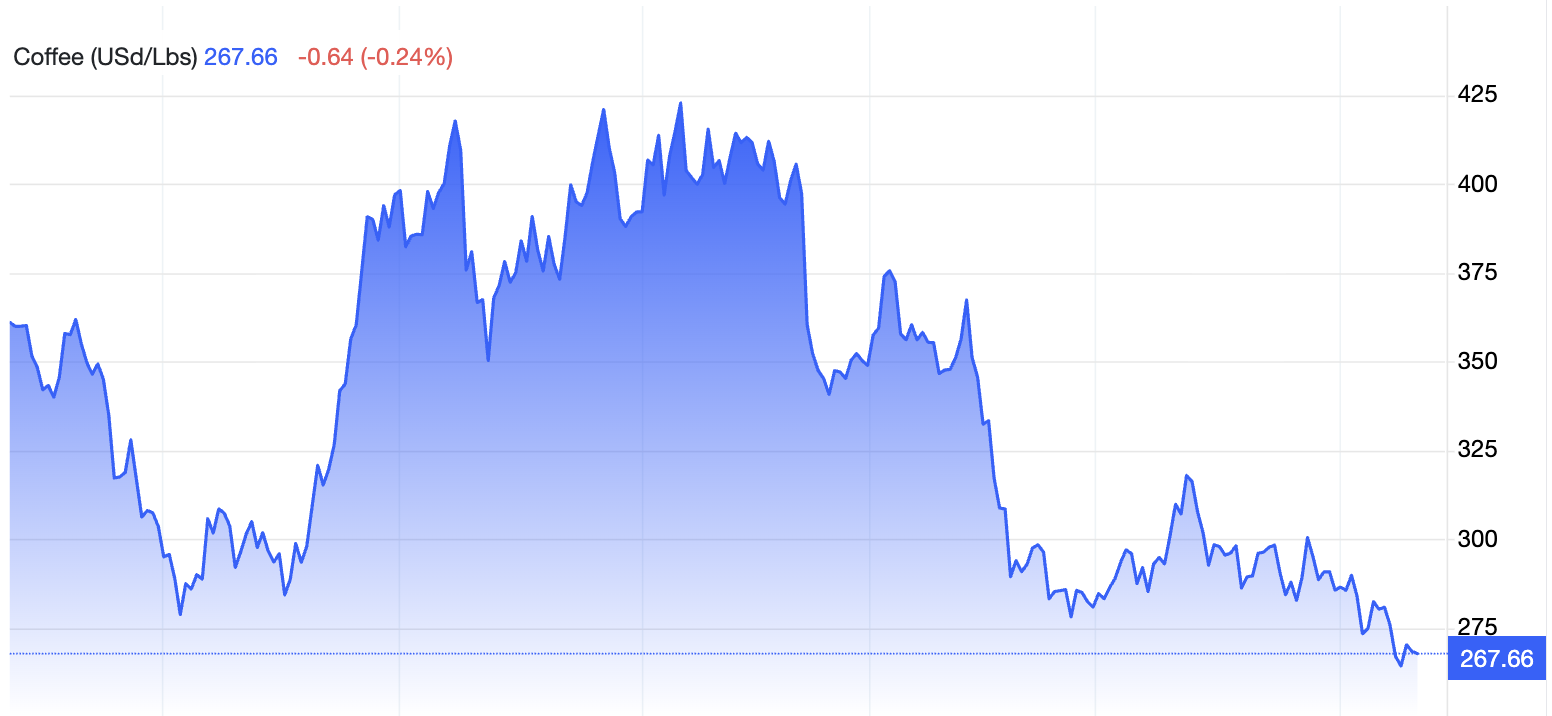
Coffee futures have fallen around 27% over the past year, closing near 268 cents/lb on May 20. That looks positive for consumers, but the pass-through has not arrived yet. U.S. ground-roast coffee reached a nominal record of $9.723/lb in April 2026, up from $9.608/lb in March, even as wholesale prices were already softening.
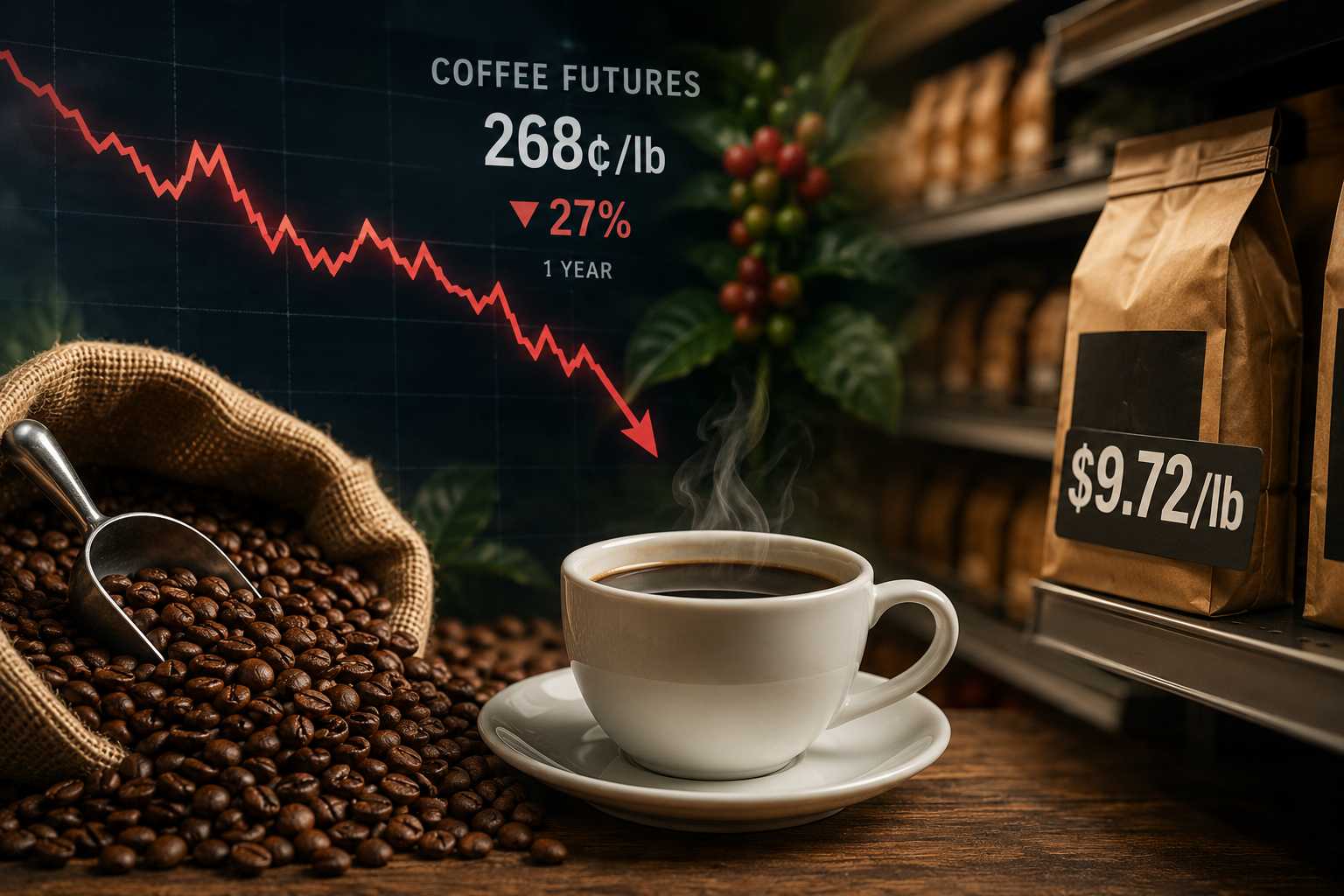
That gap between the futures market and the retail shelf is the real story in coffee. Futures price future supply expectations. Retail prices reflect contracts, inventories, labour, freight, roasting, packaging, energy and retailer margins. The two are linked, but they do not move at the same speed.
Coffee futures are falling because Brazil and Vietnam are moving toward a stronger supply cycle in 2026. Some private forecasts place Brazil’s 2026/27 crop near 75 to 76 million bags, while Vietnam’s January to April exports rose roughly 16% year on year to around 810,000 metric tons.
| Indicator | Latest Signal |
|---|---|
| Arabica futures | Near 268 cents/lb on May 20 |
| Arabica 1-year move | Down around 27% |
| Robusta futures | Around $3,328/ton |
| U.S. ground-roast coffee | $9.723/lb in April 2026 |
| Vietnam Jan-Apr exports | Around 810,000 metric tons, up roughly 16% |
| Brazil 2026/27 crop | Some private forecasts near 75-76 million bags |
| Projected global surplus | Around 10 million bags |
The coffee market spent much of 2024 and 2025 in a supply squeeze. Poor harvests in Brazil, disrupted Robusta exports from Vietnam and repeated weather risks pushed Arabica to a record near 441 cents/lb in February 2025. Roasters substituted more Robusta into blends, which lifted that market as well and eventually showed up in supermarket and café prices.
That supply story is now reversing. Brazil’s 2026/27 harvest is expected to be one of the largest on record, although official and private estimates still vary. Vietnam has also recovered, with exports rising sharply in the first four months of 2026.
When the two most important coffee producers move toward stronger supply at the same time, futures markets reprice quickly. Analysts projects the global coffee surplus could reach around 10 million bags this year, compared with under 2 million in 2025. That is the kind of shift that can turn bullish sentiment bearish in weeks.
Arabica is therefore down sharply from its highs. Robusta has also softened, trading around $3,328/ton in late May. On commodity screens, coffee looks cheaper. In retail channels, the adjustment is slower.
Futures traders deal in green coffee beans. Consumers buy roasted, packaged and distributed coffee. That difference explains why the retail price moves more slowly than the futures market.
Several costs sit between the farm and the supermarket shelf:
Shipping and port fees
Warehousing and roasting
Labour, energy and packaging
Financing, distribution and retailer margins
Forward contracts and hedges signed at earlier, higher prices
Large roasters often buy months ahead, not week by week in the spot market. If supply was locked in during the 2025 price spike, lower futures in 2026 will take time to reduce the actual cost base.
This is why retail coffee can stay expensive after futures have peaked. The issue is timing, not only margins. Shelf prices usually ease only after lower futures persist, inventories rebuild and high-cost contracts roll off.
Coffee is often discussed as one commodity, but Arabica and Robusta behave differently.
Arabica, traded in New York, is grown mainly in Brazil and Colombia. It is more delicate, more sensitive to frost and drought, and more closely tied to specialty coffee and premium ground-roast products. When Brazilian weather turns adverse, Arabica usually reacts first.
Robusta, traded in London, is grown mainly in Vietnam, Indonesia and parts of Africa. It is more resilient, higher in caffeine and more commonly used in instant coffee and espresso blends. During the 2024 and 2025 shortage, Robusta became especially important because roasters used it as a substitute when Arabica became expensive.
Both markets are now softer, but they may not normalise at the same pace. Robusta inventories in certified warehouses have been unusually low, which can support prices even when supply forecasts improve. A paper surplus does not always mean immediately available physical coffee in the right location.
Blended products, including many commercially sold coffees, depend on both markets. Even if one variety falls faster, the blend cost depends on the full input mix.
Supply and demand are not the only forces shaping coffee costs. Regulation is also becoming part of the price structure.
The EU Deforestation Regulation is scheduled to apply from 30 December 2026 for large and medium operators, with smaller operators receiving a later deadline. Coffee sold into, sold from or exported through the EU will need to meet deforestation-free and traceability requirements.
This is a meaningful change for a crop often produced by smallholder farmers with limited record-keeping systems. Traceability, plot-level documentation, verification and compliance infrastructure carry costs. Those costs may not be fully visible in futures prices, but they can influence physical premiums and retail pricing.
A two-tier market could develop. Coffee with strong traceability credentials may trade at a premium, while non-compliant supply may face restricted access. Even if global production rises, compliant supply for regulated markets may remain tighter than headline crop numbers suggest.
Lower futures are only the first step. For retail coffee prices to ease, several conditions need to line up:
Brazil’s harvest must arrive smoothly, without major weather disruption or logistics delays.
Inventories need to rebuild, so the projected surplus becomes available physical coffee, not just a forecast.
Roasters must work through high-cost 2025 contracts and replace them with cheaper supply.
Retailers need margin room or competitive pressure before passing lower wholesale costs to consumers.
Currency also matters. A weaker Brazilian Real can encourage producer selling because dollar-priced coffee converts into more local currency. A stronger Real can slow selling by reducing local-currency returns.
For households, relief is more likely delayed than absent. If lower futures hold through the second half of 2026, retail prices may stabilise, but a quick return to pre-2024 levels is unlikely while labour, freight, packaging and compliance costs remain elevated.
For consumers, coffee remains a visible inflation item. It is not the largest component of household spending, but it is purchased frequently enough for price increases to be noticed.
For cafés and food-service operators, the economics are more complex. Independent cafés face wages, rent, utilities and equipment costs in addition to beans. Even if wholesale coffee becomes cheaper, menu prices may not fall because beans are only part of the cost base.
For coffee-linked companies, lower futures are eventually supportive for input costs. The benefit, however, depends on procurement contracts, hedging positions, inventory timing and pricing power. Margin relief is likely to appear gradually, not immediately.
Coffee’s 2026 market is moving from shortage toward supply recovery. Futures have already priced much of that shift as Brazil and Vietnam point to stronger output and surplus forecasts replace the deficit fears that drove the previous rally.
Consumers are still paying for the earlier shock. Retail coffee prices reflect old contracts, expensive inventories, labour, freight, energy, packaging, compliance costs and retailer margins.
Coffee futures fall first. Retail prices follow later, and usually more slowly than consumers expect.