Published on: 2026-05-13
Updated on: 2026-05-13
CSCO stock is not trading on whether Cisco has AI demand. The company already disclosed $2.1B in hyperscaler AI infrastructure orders; the test is whether that demand protects profitability. (Cisco Investor Relations)
Gross margin is the swing number. Cisco guided Q3 non-GAAP gross margin to 65.5%–66.5%, below Q2’s 67.5%.
The nearly 8% options-implied move is volatility, not direction. The earnings mix decides whether CSCO stock breaks higher or fades. (Investopedia)
A routine EPS beat can still fail. If margins land near the low end of guidance, Cisco may show demand without operating leverage.
The $100 opening level is the first confirmation signal. A hold supports the pre-earnings bid; a failure points to event positioning rather than conviction.
Cisco reports fiscal third-quarter earnings after the close on May 13, with the call scheduled for 4:30 PM ET. CSCO stock is near its highs, and the options market is pricing a large post-results swing.
The misread is treating Cisco’s AI order book as the answer. That order book is the setup; the release has to show whether AI infrastructure demand still supports Cisco’s margin structure or starts to look like lower-margin hardware volume.
Cisco’s last report gave bulls a strong demand case. Q2 revenue rose 10% year over year to $15.3B, product orders increased 18%, and hyperscaler AI infrastructure orders reached $2.1B.
| Cisco Metric | Latest Figure | Market Consequence |
|---|---|---|
| AI infrastructure orders | $2.1B from hyperscalers | The bullish headline number |
| Q2 non-GAAP gross margin | 67.5% | Profitability already slipped YoY |
| Q3 non-GAAP gross margin guide | 65.5%–66.5% | The real earnings hurdle |
That AI number is useful context, but stale as a trading edge. The pressure point sits below revenue.
Cisco’s Q2 non-GAAP gross margin was 67.5%, down from 68.7% a year earlier. Product gross margin fell to 66.4% from 67.7%. For Q3, Cisco guided non-GAAP gross margin to 65.5%–66.5%, below the prior quarter’s level.
Stronger orders lose value if each incremental dollar earns less.

The risk is not that Cisco misses the AI story. The risk is that Cisco clears the EPS bar while margin lands near the bottom of guidance.
Cisco guided Q3 revenue to $15.4B–$15.6B and non-GAAP EPS to $1.02–$1.04, while gross margin guidance remained below Q2’s level. A result near the top of the EPS range, with gross margin near 65.5%, would suggest growth is being absorbed by input costs, product mix, tariffs, pricing pressure, or integration costs rather than flowing cleanly into earnings.
That is the report bulls cannot afford: strong demand, acceptable EPS, and no margin leverage.
The options market is pricing a nearly 8% move in either direction by the end of the week. From recent levels, that implies a possible move toward roughly $107 on the upside or $91 on the downside.
That range measures expected movement, not conviction. Traders are paying for a large reaction because Cisco is near its highs, AI hardware demand is in focus, and the earnings bar has narrowed around profitability.
The direction likely comes from the margin bridge.
If Cisco beats EPS and raises full-year revenue guidance while keeping gross margin soft, sellers can treat the raise as low-quality growth.
If Cisco holds gross margin near or above the top of guidance and raises its full-year outlook, the AI trade gains earnings quality rather than just order momentum.
EPS is the headline. Gross margin is the confirmation.
Cisco’s post-earnings history looks supportive only at the surface. Over the past five years, Cisco recorded positive one-day returns after 12 of 20 earnings events, a 60% hit rate. Over the past three years, the positive rate has fallen to 50%, turning the shorter-term pattern into a coin flip.
That weaker recent pattern raises the hurdle for a stock already priced for a better story. One Trefis valuation model placed Cisco’s market price well above its estimated value, underscoring the stock's limited tolerance for a low-quality report. (Trefis)
Cisco needs a beat that does not come with margin damage.
The earnings reaction depends less on whether Cisco beats EPS and more on what the beat looks like below the revenue line.
| Earnings Scenario | Likely Market Read | CSCO Stock Implication |
|---|---|---|
| EPS beats, gross margin near 65.5% | Demand is intact, but earnings quality is weak | Fade risk rises despite the headline beat |
| Gross margin near or above 66.5% | AI orders look more scalable | Rally becomes harder to fade |
| Revenue guidance rises, margin profile does not | Growth looks low quality | Sellers can challenge the AI rerating |
| Guidance rises with margin stability | Order momentum becomes operating leverage | Stock can defend the pre-earnings bid |
| Tariffs, memory costs, or integration pressure persist | Cost base absorbs the AI benefit | AI order number loses power |
The clean bullish setup is not a beat alone; it shows Cisco can grow AI infrastructure demand without giving back margin.
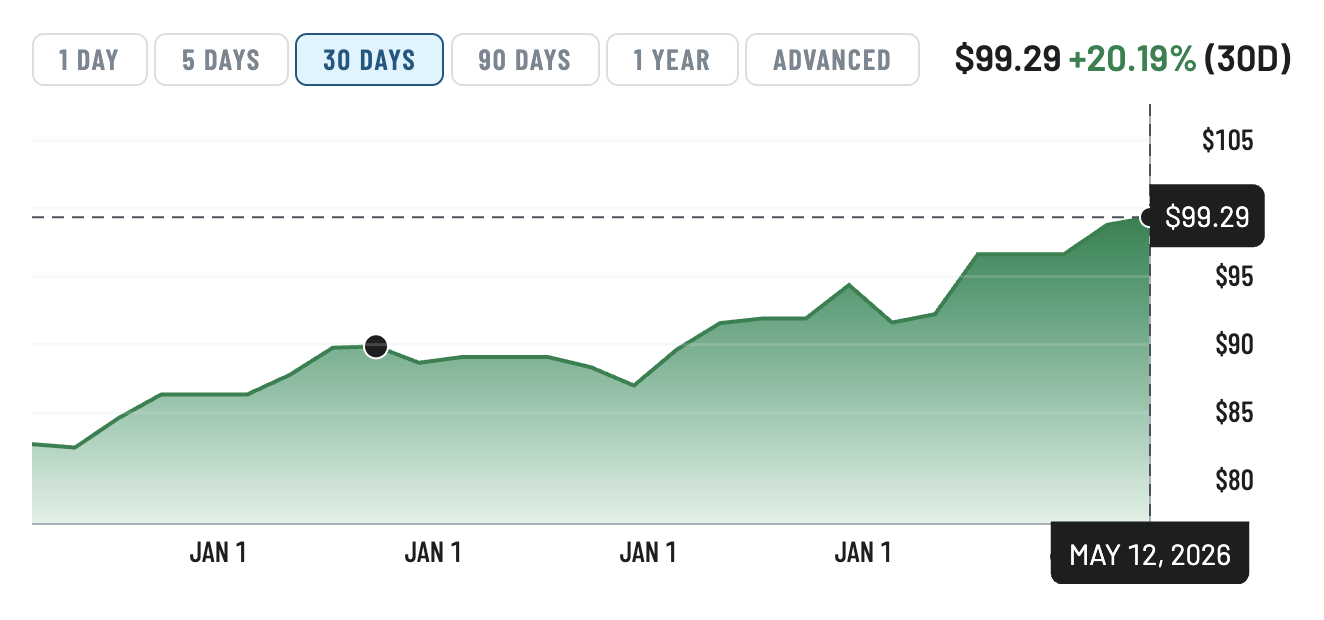
The tactical level is $100.
Cisco recently traded around $98.73, above its 20-day, 50-day, and 200-day moving averages. Technical coverage also flagged overbought signals, upside resistance risk above $102.08, and downside exposure below $96.50.
A sustained hold above $100 for the first 15 to 30 minutes of regular trading would signal that buyers are defending the pre-earnings bid. That would not guarantee a positive post-close reaction, but it would confirm that the market is willing to carry exposure into the print.
A failed push through $100 would change the character of the trade. The stock would still have earnings optionality, but the pre-earnings strength would look more like event-driven positioning than institutional accumulation.
The downside zone is roughly $96.50–$98.00. A break into that range before the results would show buyers reducing exposure before the release. A post-earnings break below that zone would signal that the margin story has beaten the AI-order story.
CSCO stock is moving into Cisco’s fiscal Q3 earnings release, with options pricing a large post-results swing. The deeper driver is not the existence of AI demand. The market reaction now depends on whether those orders support gross margin.
Non-GAAP gross margin is the key number. Cisco guided Q3 non-GAAP gross margin to 65.5%–66.5%, below Q2’s 67.5%. A result near the low end would weaken the quality of any EPS beat.
AI orders support the demand case, but they do not settle the earnings question. The rally needs proof that AI-related demand can produce margin stability, not just higher revenue.
If Cisco’s AI demand is already priced into CSCO stock, will the market reward another headline beat, or wait for proof that gross margin has stopped absorbing the cost of that growth?