Published on: 2026-04-16
Updated on: 2026-04-16
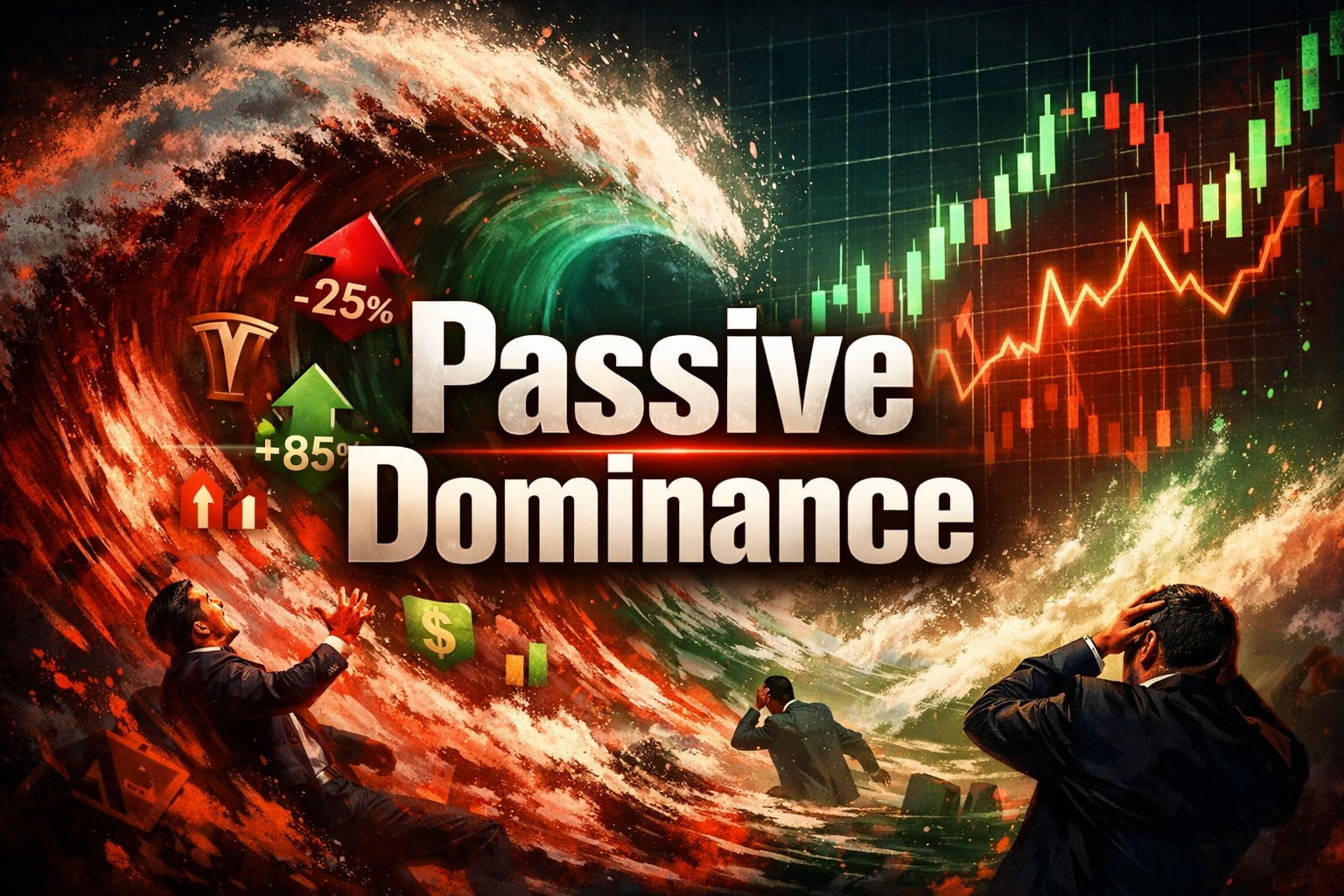
Passive dominance in trading refers to a structural shift in financial markets in which index-tracking funds, such as ETFs and passive mutual funds, control a significant share of trading volume and asset ownership. In this environment, price movements are increasingly driven by capital flows into and out of indices rather than company-specific fundamentals.

Passive dominance shifts price discovery from fundamentals to fund flows.
Stocks increasingly move together due to index-based buying and selling.
Volatility can spike as passive flows enter and exit markets simultaneously.
Traditional “undervalued stock picking” becomes less effective.
Monitoring ETF flows is now a critical skill for modern traders.
Passive dominance is a market condition where passive investment vehicles, such as index funds and ETFs, account for a large and growing share of assets and trading activity. Unlike active investing, where portfolio managers make decisions based on valuation, earnings, and risk, passive investing allocates capital mechanically in accordance with an index’s rules and weightings.
This can create a powerful market dynamic: in some periods, capital flows and index rules can have a stronger short-term influence on prices than company-specific fundamentals.
Over the past decade, passive investing has grown rapidly because of low costs, transparency, and broad diversification. Recent industry data shows how large this shift has become. At year-end 2024, index mutual funds and index ETFs together held $16.2 trillion and accounted for 51% of assets in US long-term funds, up from 19% in 2010.
ETF trading activity has also expanded sharply, with SIFMA reporting average daily ETF volume of 3.5 billion shares in 2025. \n\nLarge ETFs such as the SPDR S&P 500 ETF Trust (SPY) and Vanguard Total Stock Market ETF (VTI) channel capital across many constituent stocks through index-based rules rather than bottom-up valuation decisions. When money enters these funds, it is generally deployed according to index weights, which can reinforce moves in the largest constituents.
This does not mean fundamentals no longer matter. It means that index-based allocation now plays a much larger role in how prices move, especially over short- and medium-term horizons.
Passive funds operate under strict rules. If a stock’s weight in an index rises, a fund tracking that index will usually need more exposure to it. If new money enters the fund, that capital is typically deployed in proportion to index weights.
This can create rule-based buying:
When investors buy ETF units, demand often flows through to the underlying basket.
The largest companies usually receive the most capital because they carry the largest weights in market-cap-weighted indices.
During outflows, the process can work in reverse:
Funds may need to reduce exposure across many holdings at the same time.
Even fundamentally strong companies can come under pressure when selling is broad and index-driven.
One of the most important consequences of passive dominance is the widening gap between price and intrinsic value.
For example:
Mega-cap stocks like Apple Inc. (AAPL) or Microsoft Corporation (MSFT) often receive disproportionate inflows simply because they dominate index weightings.
Smaller or excluded companies may remain undervalued due to a lack of passive exposure.
This phenomenon is closely tied to the Inelastic Markets Hypothesis, which suggests that even small capital flows can have an outsized impact on prices when supply is relatively fixed.
Stocks now move more in unison. When money flows into index funds, most stocks rise together. When it exists, they fall together.
This reduces diversification benefits and makes portfolio risk harder to manage.
Finding undervalued stocks is more difficult because:
Capital is allocated based on size, not value.
“Cheap” stocks can stay cheap for longer.
This challenges traditional strategies rooted in fundamental analysis.
Passive markets often appear highly liquid, until they are not.
During bullish periods: Continuous inflows create smooth upward trends.
During sell-offs: Liquidity can evaporate quickly and ETFs may amplify downside pressure through forced selling.
This dynamic becomes particularly dangerous during macro stress events, such as stagflationary shocks or recession fears, where broad-based selling can accelerate declines.
Because flows are synchronised, markets can shift rapidly between extremes:
Strong rallies fueled by inflows
Sharp corrections driven by redemptions
This leads to more “all-or-nothing” price action.
Modern traders must monitor:
ETF inflows and outflows
Fund positioning
Index rebalancing schedules
For example, rising inflows into broad-market ETFs often signal continued upward momentum.
When a stock is added to a major index:
Passive funds are forced to buy it.
This often leads to short-term price increases.
Conversely, stocks removed from indices may experience selling pressure.
Understanding how capital flows through markets is now as important as analysing earnings reports.
Key signals include:
Sector rotation within indices
Changes in index composition
Institutional allocation trends
Passive dominance amplifies macro trends. For instance:
Interest rate cuts can trigger broad inflows into equities.
Risk-off sentiment can lead to synchronised market sell-offs.
Traders who align with these flows often outperform those relying solely on stock-specific analysis.
Consider a scenario where large inflows enter the SPDR S&P 500 ETF Trust (SPY):
The ETF receives billions in capital.
It allocates most of that capital to its largest holdings.
Stocks like Apple Inc. (AAPL) rise disproportionately.
Smaller constituents lag behind.
This creates a feedback loop:
Rising prices increase index weights.
Higher weights attract more capital.
Prices continue to rise.
Passive dominance occurs when index funds and ETFs control a large share of market activity. Prices are increasingly driven by fund flows rather than company fundamentals, leading to synchronised movements across stocks.
Not necessarily. Passive investing has lowered costs and made diversified market exposure easier for many investors. However, if a large share of capital follows the same index rules, price discovery can weaken at the margin and market moves can become more correlated during stress periods.
Stocks move together because passive funds buy and sell entire baskets of securities simultaneously. This creates high correlation, especially during periods of strong inflows or outflows.
Yes, but it is more challenging. Traders must adapt by focusing on flows, macro trends, and structural inefficiencies rather than relying solely on traditional valuation-based strategies.
The index inclusion effect refers to price movements caused by stocks being added to or removed from major indices. Passive funds must adjust their holdings, creating predictable buying or selling pressure.
Passive dominance represents a structural change in modern financial markets. As more capital moves through index funds and ETFs, price action can become more mechanical, more correlated, and more sensitive to broad fund flows. \n\nFor retail traders, this means understanding liquidity, fund flows, index construction, and market structure alongside company fundamentals. Traders who can connect macro context with passive-flow behaviour may be better prepared to navigate today’s market environment.
Disclaimer: This material is for general information purposes only and is not intended as (and should not be considered to be) financial, investment or other advice on which reliance should be placed. No opinion given in the material constitutes a recommendation by EBC or the author that any particular investment, security, transaction or investment strategy is suitable for any specific person.