Published on: 2026-08-12
Updated on: 2026-08-12
An option can lose value even when the underlying asset moves in the expected direction. Its price is affected by the underlying price, time remaining, implied volatility and interest rates, and these forces can work against each other. Within options trading, the Greeks measure an option’s sensitivity to each of these pricing forces.
Options Greeks measure different sources of option-price risk rather than predict market direction. Delta tracks sensitivity to the underlying price, Gamma tracks changes in Delta, Theta measures time decay, Vega measures implied-volatility sensitivity and Rho measures interest-rate sensitivity.
Greek values come from option-pricing models and change with market conditions. Inputs such as the underlying price, strike, time to expiration, implied volatility and interest rates determine the values shown on many options chains.
The Greeks work together, so being right about direction may still produce a weak return. A favourable move can help through Delta and Gamma while Theta reduces value over time and falling implied volatility hurts through Vega.
The dominant Greek depends on the position. Delta and Gamma are central to directional exposure, Gamma and Theta become especially important in short-dated options, Vega matters when volatility changes sharply, while Rho becomes more relevant in longer-dated contracts.
Options Greeks are measurements that estimate how an option’s theoretical value may change when a pricing input changes. They do not predict what the market will do. Instead, they show where an option’s risk comes from.
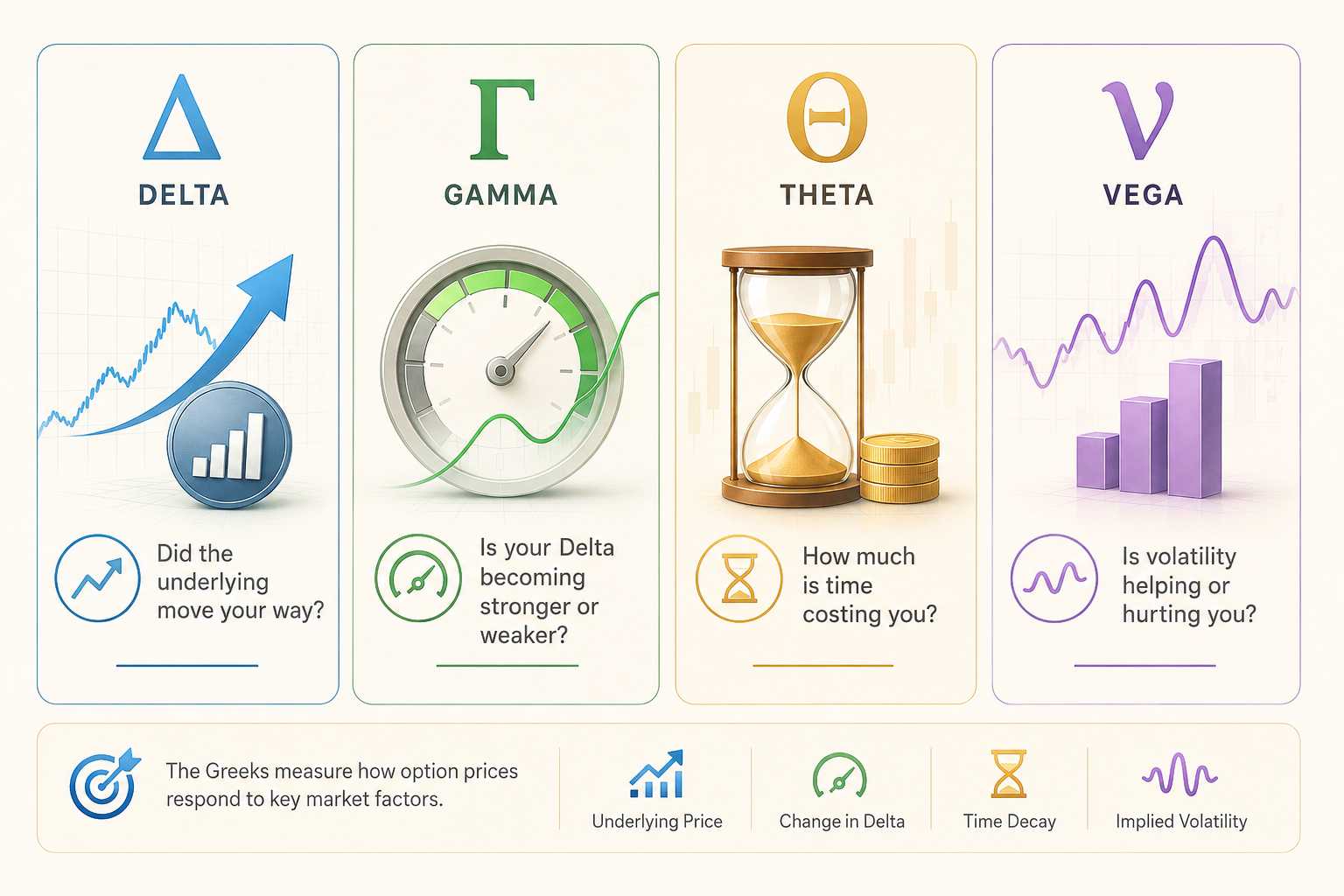
| Greek | Measures sensitivity to | What it tells you |
|---|---|---|
| Delta | Underlying price | How much the option may move when the underlying moves |
| Gamma | Changes in Delta | How quickly directional sensitivity can change |
| Theta | Time | How passing time affects the option |
| Vega | Implied volatility | How volatility changes may affect the premium |
| Rho | Interest rates | How rate changes may affect the option |
The Greeks work together rather than independently. A favourable price move may help through Delta while falling implied volatility and time decay reduce some of that gain.
They also change continuously. Delta, Gamma, Theta and Vega can all move as the underlying price changes, implied volatility shifts and expiration approaches.
Greek values are normally calculated by option-pricing models such as Black-Scholes using current information about the contract and market.
The main inputs include:
underlying price;
strike price;
time until expiration;
option price;
implied volatility;
interest rates; and
expected dividends where relevant.
Many trading platforms display the resulting Greeks directly in the options chain.
For example, a contract might show Delta of 0.50, Gamma of 0.08, Theta of -0.05 and Vega of 0.12. These are not numbers chosen by traders or read from a price chart. They are model-based estimates calculated from the option’s current conditions.
Implied volatility is slightly different because it is usually derived from the option’s market price. The market price therefore helps determine implied volatility, which then feeds into the calculation of the Greeks.
As market conditions change, the values are recalculated. A Delta of 0.50 can later become 0.65 even though the trader still holds the same contract.
Delta estimates how much an option’s value may change when the underlying moves by one unit.
Call Delta generally ranges from positive (+) 0 to positive (+) 1, while put Delta ranges from negative (-) 1 to negative (-) 0.
Suppose a call has a Delta of 0.50. If the underlying rises by $1, the option may gain roughly $0.50 per share.
For a standard US equity option representing 100 shares:
$0.50 × 100 = approximately $50 per contract
Moneyness affects Delta. Deep in-the-money calls tend to have Delta closer to positive (+) 1, while far out-of-the-money calls usually have Delta closer to zero.
Delta is also sometimes used as a rough approximation of the probability that an option will expire in the money. A Delta of 0.30 may therefore be loosely interpreted as about a 30% probability, although Delta is primarily a sensitivity measure rather than a precise probability forecast.
Gamma measures how much Delta may change when the underlying moves by one unit.
Suppose an option has:
Delta: 0.50
Gamma: 0.08
If the underlying rises by $1, Delta may move from approximately 0.50 to 0.58.
The option has therefore become more sensitive to the next price move.
Gamma tends to be highest around at-the-money strikes and can become especially large close to expiration. This helps explain why short-dated options can react sharply to relatively small movements in the underlying.
High Gamma works in both directions. A favourable move can increase Delta rapidly, while an adverse move can reduce directional exposure just as quickly.
Gamma becomes especially relevant when analysing short-dated contracts, hedging activity and broader concepts such as Gamma Exposure (GEX) and the Gamma Flip.
Theta measures how an option’s theoretical value may change as one day passes.
If an option has Theta of -0.05, time decay represents approximately:
negative (-)$0.05 per share per day
For a standard 100-share contract:
-$0.05 × 100 = approximately -$5 per day
Long calls and puts generally have negative (-) Theta because each passing day leaves less time for a favourable move. Short options generally have positive (+) Theta.
Theta is not constant. Time decay usually becomes more important as expiration approaches, particularly around at-the-money strikes. EBC’s guide to Theta in options examines time decay and its behaviour as expiration approaches in more detail.
This is why getting the direction right may still produce a poor result. If the expected move develops too slowly, time decay can absorb part of the gain.
Vega measures how much an option’s theoretical value may change when implied volatility moves by one percentage point.
Suppose Vega is 0.12.
If implied volatility rises from 25% to 26%, the option may gain approximately:
positive (+)$0.12 per share
For a 100-share contract, that is roughly +$12.
If implied volatility instead falls from 25% to 23%, the two-percentage-point decline implies approximately:
0.12 × negative (-)2 = negative (-)$0.24 per share
or roughly -$24 per contract.
A one-point volatility move means, for example, IV changing from 25% to 26%, rather than from 25% to 25.25%.
Long calls and puts generally have positive (+) Vega because higher implied volatility raises the value of having exposure to a wider range of possible future prices. Short options generally have negative (-) Vega.
Vega becomes particularly important when volatility is elevated or expected to change sharply. After a major scheduled event, implied volatility can fall rapidly, reducing option premiums even when the underlying moves in the expected direction. This sharp decline in option premium after volatility falls is commonly known as an IV crush.
Rho measures how an option’s theoretical value may respond to a one-percentage-point change in interest rates.
Calls generally have positive (+) Rho, while puts generally have negative (-) Rho.
Rho is usually a secondary concern for short-dated options because rate changes have little time to affect their value. It becomes more relevant for contracts with many months or years remaining until expiration.
Buying or selling an option changes the direction of its major Greek exposures.
| Position | Delta | Gamma | Theta | Vega |
|---|---|---|---|---|
| Long call | Positive (+) | Positive (+) | Negative (-) | Positive (+) |
| Long put | Negative (-) | Positive (+) | Negative (-) | Positive (+) |
| Short call | Negative (-) | Negative (-) | Positive (+) | Negative (-) |
| Short put | Positive (+) | Negative (-) | Positive (+) | Negative (-) |
A long call, for example, generally benefits from a rising underlying price and higher implied volatility, while time decay works against it. A short call carries the opposite exposure.
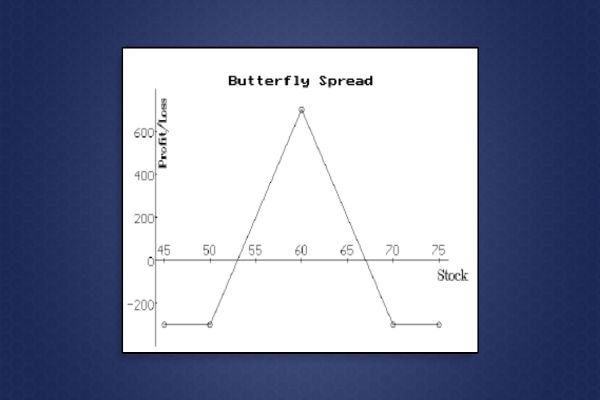
In option spreads, the Greeks from each leg combine to create the overall Delta, Gamma, Theta and Vega of the position.
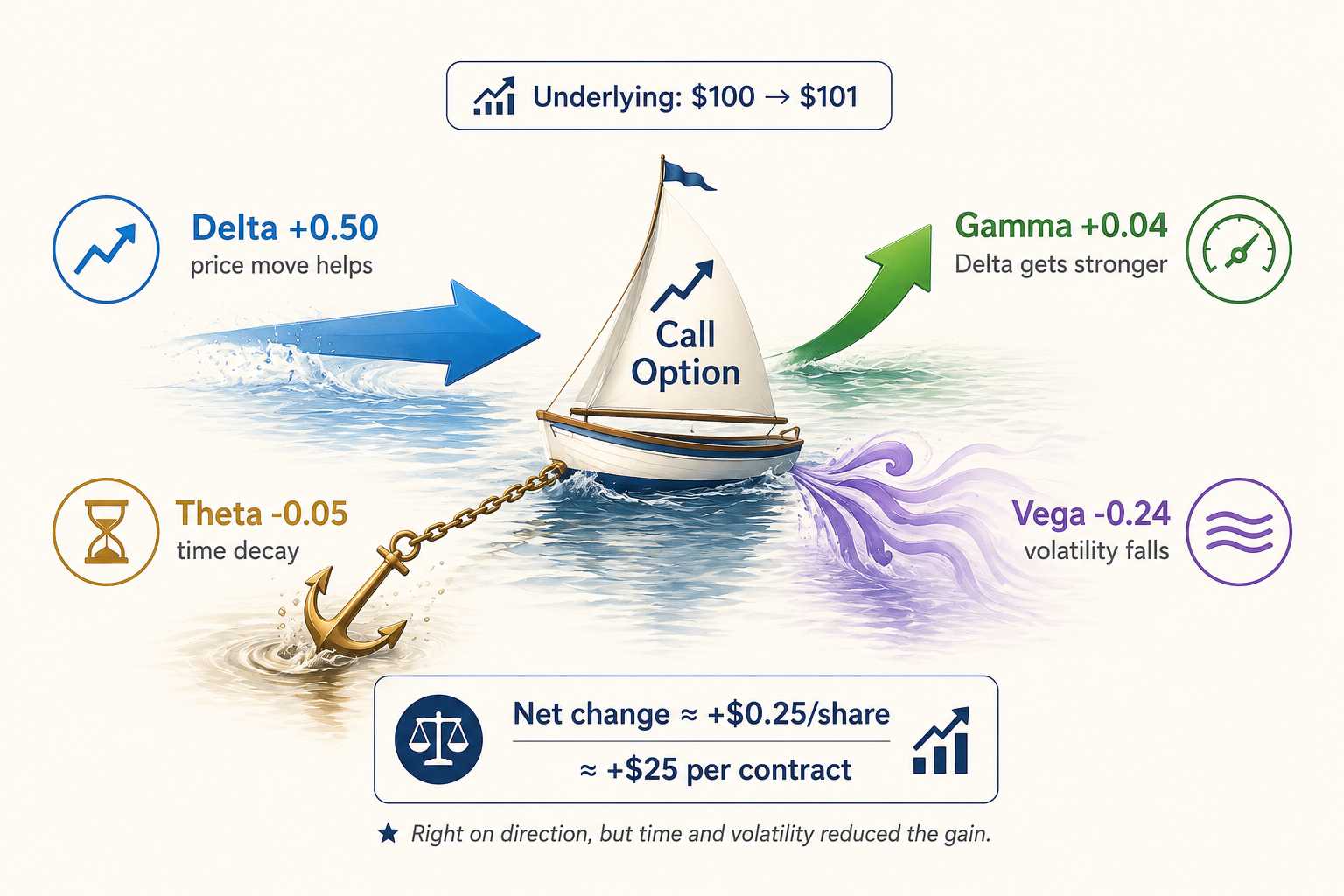
Consider an at-the-money call on an underlying trading at $100 with 30 days until expiration.
Assume:
Delta: 0.50
Gamma: 0.08
Theta: -0.05
Vega: 0.12
Over roughly one day:
The underlying rises by $1.
One day passes.
Implied volatility falls by two percentage points.
Delta initially contributes about:
+$0.50
Because Gamma is 0.08, Delta rises as the underlying moves. A simplified estimate of the Gamma contribution across the $1 move is:
+$0.04
Theta costs approximately:
-$0.05
The two-point decline in implied volatility contributes:
0.12 × negative (-)2 = -$0.24
The simplified combined change is therefore:
+$0.50 + $0.04 - $0.05 - $0.24 = approximately +$0.25 per share
For a standard 100-share contract:
approximately +$25
The underlying moved in the expected direction, yet the option gained much less than Delta alone suggested. Gamma added to the gain, while Theta and falling implied volatility removed a large part of it.
The calculation is intentionally simplified because the Greeks themselves change throughout the move. Its purpose is to show why an option cannot be judged on direction alone.
There is no single most important Greek. The dominant exposure depends on the position.
Directional positions: Delta and Gamma
Short-dated options: Gamma and Theta
Volatility-sensitive positions: Vega
Long-dated options: Delta and Vega, with Rho becoming more relevant
Near expiration, an at-the-money option can have both high Gamma and aggressive Theta decay. A longer-dated option may react less sharply to a small immediate price move while carrying greater Vega exposure.
The useful question is which Greek represents the largest risk to the position under current conditions.
Greeks measure sensitivity rather than predict future market behaviour.
Delta cannot tell whether the underlying will rise. Vega cannot predict whether implied volatility will increase or collapse. Theta cannot determine whether enough time remains for a trade to become profitable.
They also do not capture every practical trading factor. Bid-ask spreads, liquidity, commissions, execution prices and sudden market moves can all affect the realised result.
Greek values are model-based estimates, so they should be treated as tools for understanding risk rather than guaranteed changes in an option’s market price.
Delta measures directional sensitivity, Gamma shows how quickly that sensitivity can change, Theta captures the effect of time, Vega measures exposure to implied volatility and Rho measures sensitivity to interest rates.
Their usefulness comes from reading them together. An option can benefit from Delta while losing value through Theta or Vega, and Gamma can change the size of that directional exposure as the underlying moves.
Options Greeks therefore give traders a clearer view of what is driving an option’s value, where its main risks sit and how those risks can change before expiration.