Published on: 2026-04-07
Updated on: 2026-04-07
Markout is a critical yet often overlooked concept in trading that reveals whether your entries are truly effective or simply fortunate. In today’s fast-moving, algorithm-driven markets, where execution speed and efficiency are key, understanding how prices behave immediately after a trade can provide a meaningful edge.
Focusing on post-trade price movement, markout helps traders evaluate timing, refine execution, and improve overall strategy performance.
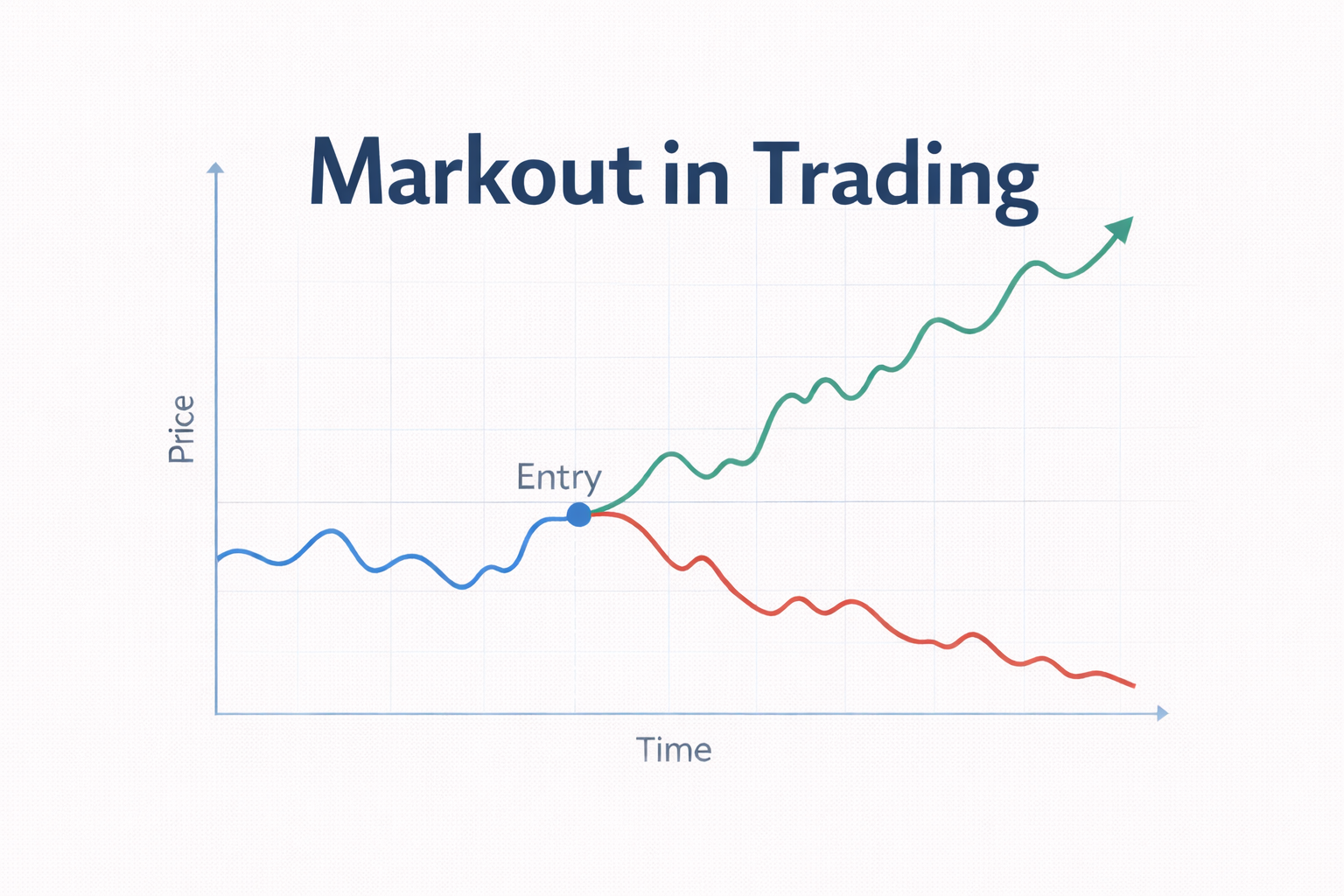
Markout measures how the price moves after a trade relative to the entry price.
It evaluates entry quality and timing rather than final profitability.
Positive markout suggests favourable execution, while negative markout signals poor timing.
It helps distinguish repeatable skills from outcomes driven by luck.
Consistent markout analysis can significantly improve trading performance.
Markout refers to the difference between the price at which a trade is executed and the market price at a specified future date. It is a time-based metric that measures how the market reacts immediately after a position is entered.
In simple terms, it answers the question: “Did the market move in my favour after I placed the trade?”
This makes markout fundamentally different from traditional performance metrics. While profit and loss reflect the final outcome of a trade, markout isolates the quality of the entry, allowing traders to assess whether they are consistently entering positions at efficient prices.
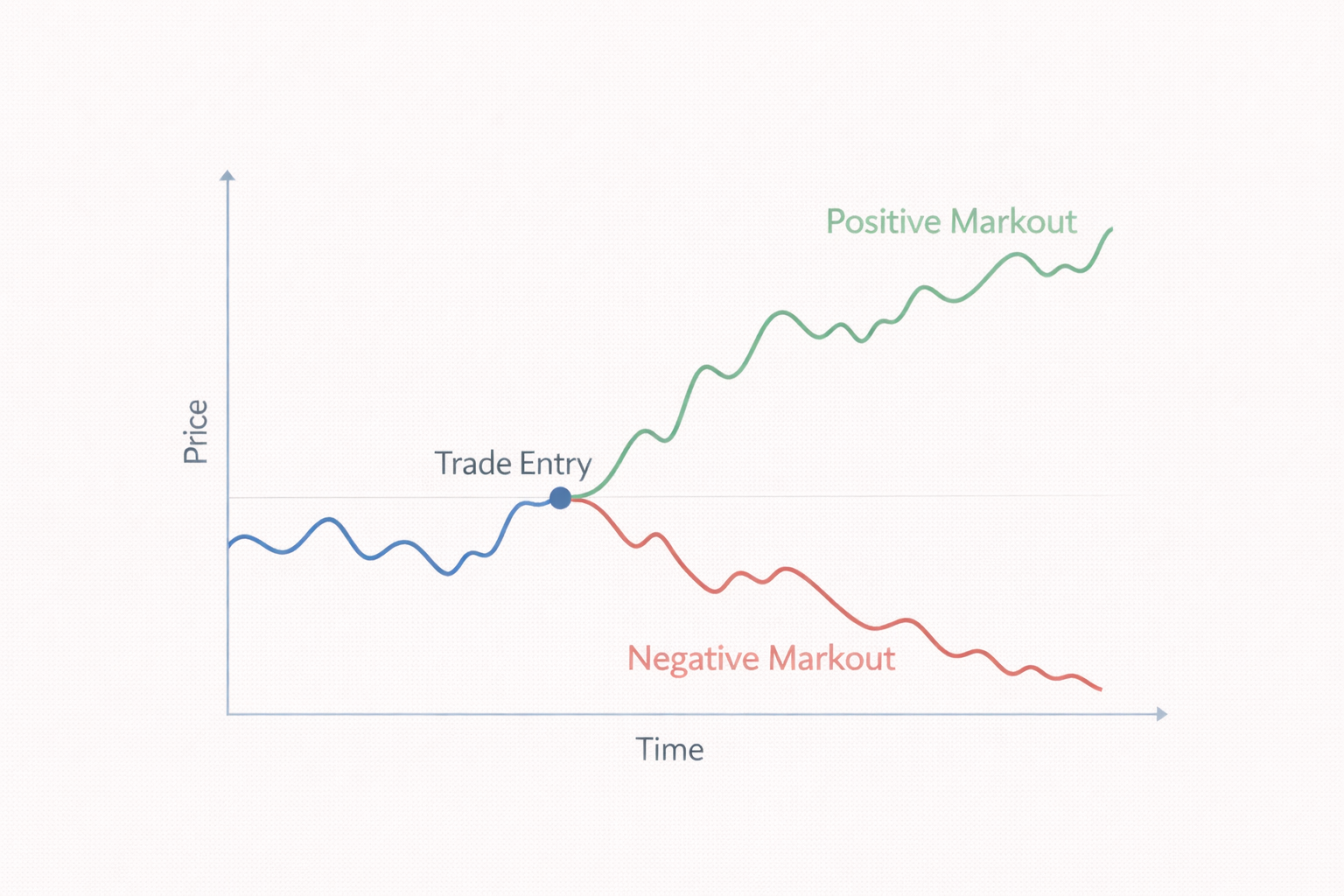
The basic formula for markout is:
Markout = Future Price − Execution Price
For long positions:
A positive value indicates the price increased after entry.
A negative value indicates the price declined.
For short positions, the interpretation is reversed.
In professional trading environments, markout is often calculated using the mid-price (the midpoint between the bid and ask) rather than the last traded price. This helps reduce distortions caused by bid-ask spread fluctuations and provides a more accurate view of execution quality.
A trader buys shares of an ETF at $200.00. After five minutes, the price rises to $201.10.
5-minute markout: +1.10
This indicates that the entry aligned well with the short-term market direction.
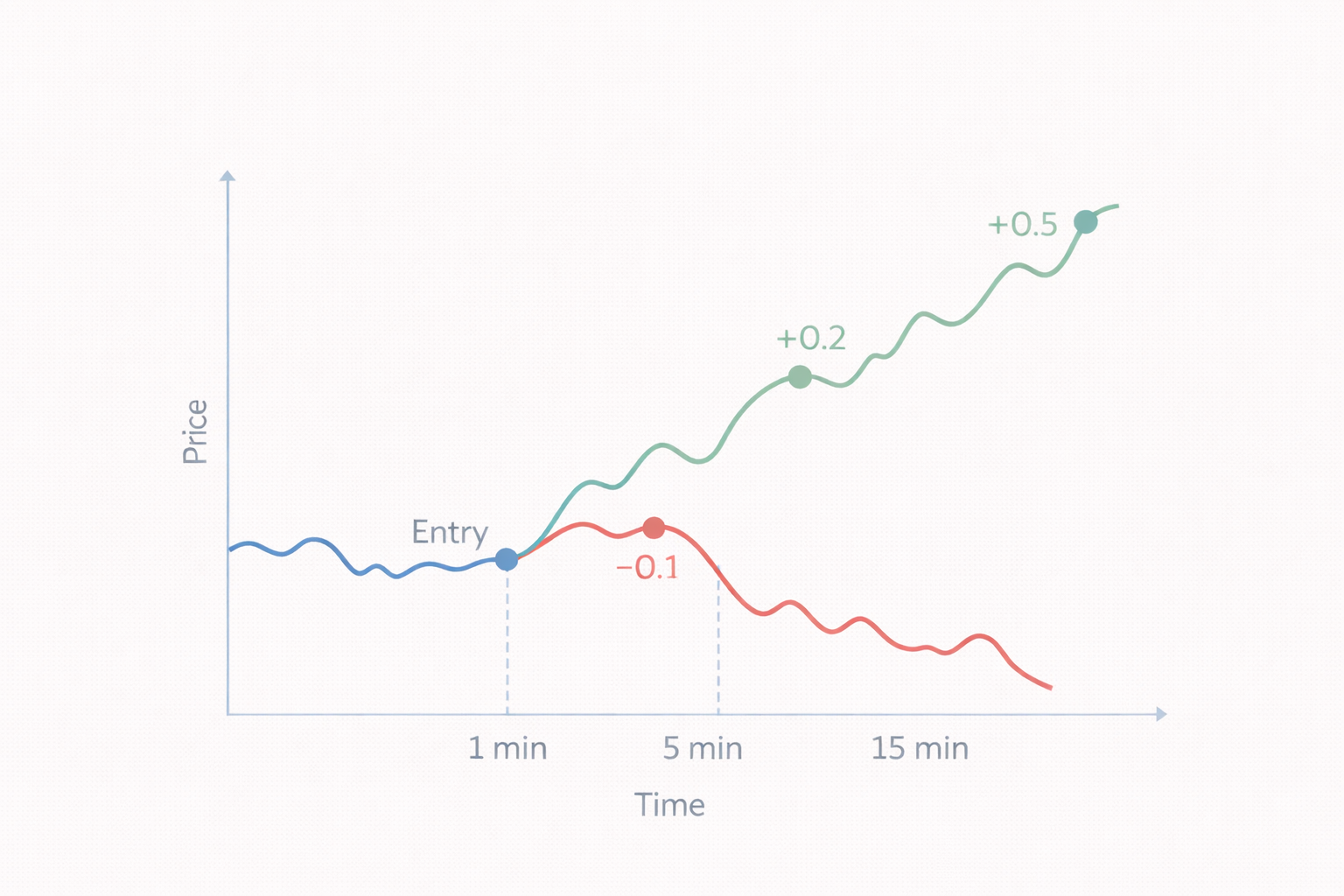
Markout must always be evaluated over a defined time interval. The chosen timeframe should align with the trader’s strategy.
Seconds to minutes: Used by scalpers and high-frequency traders to assess execution efficiency
Minutes to hours: Common for intraday traders evaluating timing
Hours to days: Occasionally used by swing traders to validate entries
Shorter intervals are more sensitive to execution quality, while longer intervals reflect broader market direction.
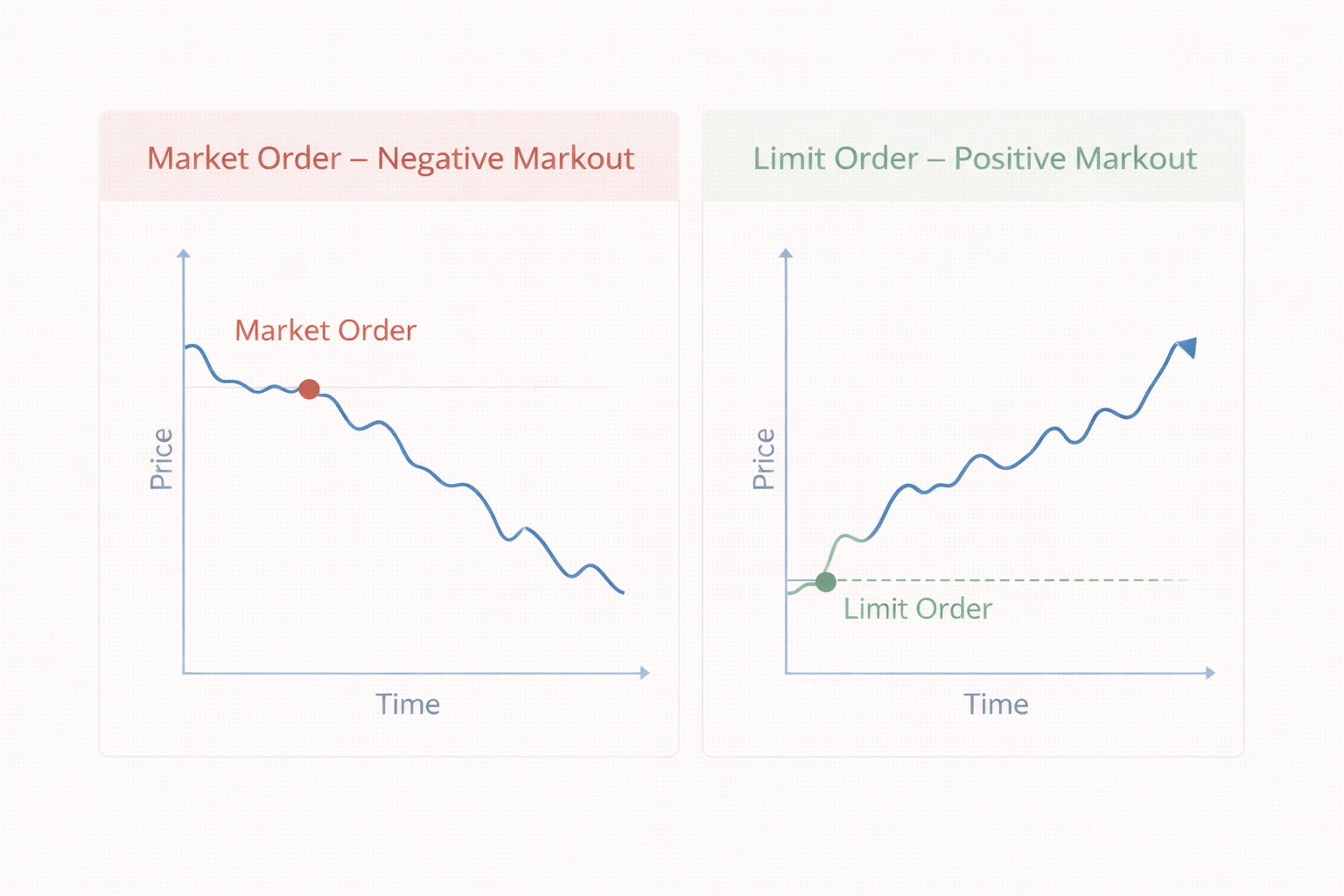
A trader executes a market buy order at $100.00. Within one minute, the price drops to $99.70.
Markout: −0.30
This suggests the trader entered aggressively and paid a higher price, with immediate selling pressure pushing the market lower.
A trader places a limit buy order at $49.90 while the ask price is $50.00. The order is filled, and the price rises to $50.30 shortly after.
Markout: +0.40
This reflects efficient entry and improved price execution.
A trader buys at $75.20 after a breakout above the resistance level. The price quickly reverses to $74.60.
Markout: −0.60
This highlights the risk of entering late into momentum moves and being caught in a false breakout.
A trader buys an index ETF immediately after a major economic announcement at $300.00. Within minutes, the price retraces to $298.80.
Markout: −1.20
This indicates a delayed reaction, where the initial move had already been priced in.
Markout becomes most meaningful when analysed across multiple trades rather than in isolation.
Consistently positive markouts: Strong timing and effective entries
Consistently negative markouts: Poor timing or reactive trading behaviour
Mixed results: Strategy may depend on specific market conditions
A single trade may be influenced by randomness, but repeated patterns reveal whether a trader has a sustainable edge.
Markout and profit serve different but complementary roles in evaluating trading performance.
A trade can show a positive markout but still result in a loss due to poor exit decisions. Conversely, a trade with a negative markout may eventually become profitable if market conditions reverse. Therefore, markout should be used alongside other performance metrics rather than in isolation.
Markout is a practical tool that helps traders evaluate not only outcomes but also the quality of their decision-making process.
Markout provides immediate feedback on whether trades are being entered efficiently. Persistent negative markouts may indicate overuse of market orders or poor price discipline, prompting adjustments in execution methods.
A trade that becomes profitable after initially moving against the trader may reflect favourable market conditions rather than precise timing. Markout helps identify whether performance is driven by repeatable skill or random outcomes.
Traders who enter positions after significant price movements often experience negative mark-to-market losses. This indicates a tendency to chase the market rather than anticipate it, which can be corrected through improved strategy design.
Consistently negative markouts may suggest that a trader is entering positions just before the market moves against them. This can occur when other participants have better information or faster execution.
To effectively use markout, traders should adopt a structured, data-driven approach rather than relying on occasional observations.
Build a Trade Tracking System: Record each trade with entry price, time, direction, and order type. This creates a dataset that can be analysed for patterns and performance insights over time.
Measure Across Multiple Time Intervals: Calculate markouts at different timeframes, such as 1 minute, 5 minutes, and 15 minutes. This reveals whether a strategy performs well immediately or requires more time to develop.
Improve Stop-Loss Placement: Use markout data to understand typical price movement after entry. If a trade deviates significantly from expected behaviour, it may signal an invalid setup and justify an early exit.
Analyse Market Conditions: Evaluate markouts across different market conditions, including high volatility, trending markets, and news events. This helps determine when a strategy performs best.
Combine with Other Metrics: Markout should be used alongside metrics such as win rate, risk-reward ratio, and drawdown to provide a comprehensive assessment of trading performance.
While markout is a powerful tool, it should be used with awareness of its limitations.
It focuses only on entry quality and does not account for exit performance.
Results can vary significantly depending on the chosen time interval.
Short-term price movements may be influenced by noise or temporary volatility.
It does not guarantee profitability, even if consistently positive.
Understanding these limitations ensures that markout is used as part of a balanced analytical framework.
Markout measures the difference between a trade’s execution price and the market price at a later point in time. It is used to evaluate entry quality by showing whether the market moved in the trader’s favour immediately after the trade was executed.
Markout focuses on short-term price movement after entering a trade, while profit and loss reflect the overall financial outcome after the position is closed. A trade can have a positive markout but still result in a loss due to poor exit timing or changing market conditions.
A negative markout indicates that the market moved against the trader shortly after execution. This often suggests poor timing, entering trades too late, or reacting to price movements that have already occurred rather than anticipating future direction in the market.
Markout is widely used by institutional traders, quantitative analysts, and market makers to evaluate execution efficiency and trading performance. Retail traders can also apply it to improve entry timing and gain deeper insight into how their strategies perform in real market conditions.
Although markout is primarily designed for short-term analysis, it can still provide value for long-term investors. It helps assess whether an entry was well-timed, offering additional insight into execution efficiency even when holding positions over extended periods.
Markout is a valuable metric that helps traders understand what happens immediately after a trade is executed. Focusing on entry quality rather than just final outcomes provides insights into timing, execution efficiency, and strategy effectiveness.
When combined with other performance metrics, markout enables traders to refine their approach, improve consistency, and make more informed decisions in increasingly competitive markets.
Disclaimer: This material is for general information purposes only and is not intended as (and should not be considered to be) financial, investment or other advice on which reliance should be placed. No opinion given in the material constitutes a recommendation by EBC or the author that any particular investment, security, transaction or investment strategy is suitable for any specific person.