Published on: 2026-05-20
KPI Green Energy share price moved into focus this week after the Gujarat-based renewable energy company secured another battery storage order and delivered strong FY26 earnings. Listed as NSE: KPIGREEN and BSE scrip code 542323, the company is drawing investor attention as it expands from solar project execution into battery storage, hybrid energy and asset-backed renewable infrastructure.
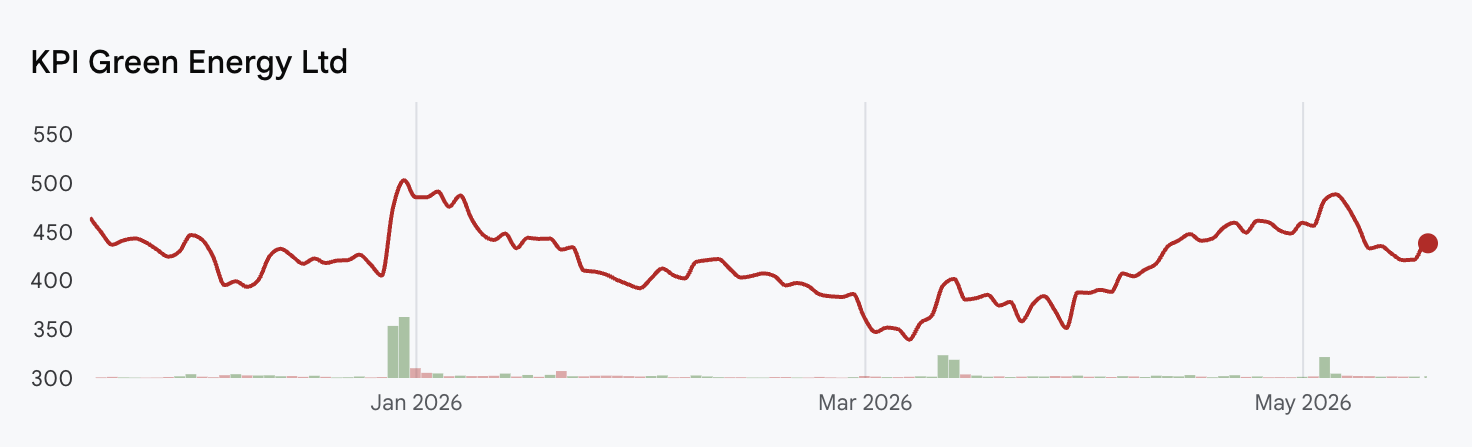
The immediate trigger was a new agreement signed by subsidiary Sun Drops Energia with Gujarat Urja Vikas Nigam Limited for a 120 MW / 240 MWh standalone battery energy storage system project. KPI Green Energy shares rose after the announcement, with the BSE-listed counter touching an intraday high of ₹440.65 on May 19 before trading around ₹437.30 at noon.
The share price has recently traded in the ₹430 to ₹440 range, keeping attention on whether project execution can support investor confidence after a volatile year for renewable energy shares.
KPI Green Energy has secured a 120 MW / 240 MWh battery storage agreement with GUVNL, lifting its standalone BESS portfolio to 565 MW / 1,130 MWh.
FY26 results showed strong growth, with net profit rising 57% to ₹509 crore and revenue increasing 56% to ₹2,742 crore.
The company’s operational and development portfolio now stands at 6.26 GW, strengthening its position in India’s renewable energy market.
KPI Green Energy share price is trading near the ₹430 to ₹440 range, with investors watching whether recent project wins can support further momentum.
Execution, funding discipline and Gujarat grid readiness remain the key factors that could shape the next phase of investor sentiment.
The latest Battery Energy Storage Purchase Agreement is important because it extends KPI Green Energy’s storage business beyond solar generation. The project will be developed, owned and operated by Sun Drops Energia at two Gujarat locations: 65 MW / 130 MWh near the 220 kV Gariyadhar AIS Substation and 55 MW / 110 MWh near the 220 kV Otha AIS Substation.
With this agreement, KPI Green Energy’s cumulative executed standalone BESS portfolio has increased to 565 MW / 1,130 MWh. The new project follows an earlier 445 MW / 890 MWh agreement with GUVNL, signalling that storage is becoming a meaningful business line rather than a one-off contract.
That matters for India’s renewable sector. Battery storage can help stabilise grids as solar and wind capacity expands, especially in states such as Gujarat where renewable capacity addition is accelerating. For KPI Green Energy, the storage portfolio may improve long-term revenue visibility if execution remains disciplined and contracted capacity is delivered on schedule.
KPI Green Energy’s earnings added another layer to the investment story. For the fourth quarter of FY26, the company reported consolidated net profit of ₹155 crore, up 46% year on year, while revenue from operations rose 40% to ₹810 crore. EBITDA increased 80% to ₹305 crore, with EBITDA margin improving to 36.6% from 28.3% a year earlier.
For the full year, total revenue rose 56% to ₹2,742 crore, while profit after tax climbed 57% to ₹509 crore. The growth reflects stronger execution across renewable energy projects and higher contribution from key business verticals.
| KPI Green Energy FY26 Snapshot | Figure |
|---|---|
| FY26 total revenue | ₹2,742 crore |
| FY26 profit after tax | ₹509 crore |
| Q4 FY26 revenue | ₹810 crore |
| Q4 FY26 net profit | ₹155 crore |
| Q4 FY26 EBITDA | ₹305 crore |
| Q4 FY26 EBITDA margin | 36.6% |
| Total portfolio | 6.26 GW |
| BESS portfolio after latest agreement | 565 MW / 1,130 MWh |
The company also recommended a total dividend of ₹0.40 per share, comprising a final dividend of ₹0.25 and a special dividend of ₹0.15. The special dividend followed the successful energisation of its 1 GW IPP project, marking a symbolic milestone in the company’s transition toward an asset-backed renewable energy model.
KPI Green Energy is the renewable energy vertical of KP Group and develops, owns and operates projects under the Solarism brand. Its business spans Independent Power Producer projects, Captive Power Producer solutions, BESS, solar and hybrid energy.
The company’s website shows a 6.26 GW total portfolio, 3.59 GW cumulative power evacuation, and a group ambition of reaching 10 GW by 2030. It also highlights the Khavda project as a major growth platform, with 240 MWp for GUVNL completed, while 405 MWp for Coal India and 246 MWp for SJVN are at advanced stages of execution.
This pipeline is the core reason investors continue to track the KPI Green Energy share price closely. The company is no longer being valued only as a solar EPC-linked player. Its expansion into IPP assets, battery storage and hybrid infrastructure gives the market a broader framework for assessing future cash flows.
The KPI Green Energy share price has been volatile despite strong operating growth. Market data shows the share closed at ₹438.00 on May 19, with the day’s range between ₹421.30 and ₹443.00. The 52-week range stood between ₹335.65 and ₹563.00, placing the current share price well below its peak but above the lower end of the yearly band.
Technically, the near-term focus is on whether the share can hold above the ₹420 to ₹430 zone after the latest news-driven move. A sustained move above the recent high near ₹443 would improve short-term sentiment, while weakness below ₹420 may bring attention back to broader support levels near the lower end of its recent trading range.
Execution remains the central risk. Battery storage projects require timely land, grid connectivity, equipment procurement and commissioning. Any delay can affect cash-flow timing and investor confidence.
The second risk is balance-sheet intensity. Renewable infrastructure companies often need recurring capital for expansion, which can create pressure through debt, equity dilution or working capital cycles. KPI Green Energy’s growth profile is strong, but the market will continue to assess whether returns remain attractive as the portfolio scales.
Policy and grid-readiness risk also matter. Gujarat is a favourable renewable market, but rapid renewable and storage expansion still depends on transmission availability, discom counterparty strength and timely regulatory support.
KPI Green Energy’s latest BESS agreement with GUVNL has strengthened the company’s position in India’s renewable storage market, while FY26 results show that project execution is translating into revenue and profit growth. The share price reaction reflects this stronger operating backdrop, but investor attention will now shift from announcements to delivery.
For the KPI Green Energy share price to sustain momentum, the company must convert its expanding portfolio into predictable cash flows, manage funding needs carefully and execute storage and solar projects without material delays.
KPI Green Energy Investor Relations: https://www.kpigreenenergy.com/investors
BSE India: KPI Green Energy Corporate Announcements: https://www.bseindia.com/stock-share-price/kpi-green-energy-ltd/kpigreen/542323/corp-announcements/
NSE India: KPIGREEN Corporate Filings: https://www.nseindia.com/companies-listing/corporate-filings-announcements?symbol=KPIGREEN&tabIndex=equity