Published on: 2026-05-20
Updated on: 2026-05-20
At 165x earnings and roughly 31x annualized Q2 revenue guidance, ALAB is not priced like a conventional semiconductor stock. It is priced as a future AI infrastructure winner, before Astera has fully proven product breadth and customer diversification.
The premium has real support. Astera Labs reported Q1 revenue of $308.4 million, up 93% YoY, with 76.3% GAAP gross margin and Q2 revenue guidance of $355 million to $365 million. (Astera Labs Q1 2026 Results)
Customer concentration is the pressure point. Five reported customers accounted for 90% of Q1 revenue, underscoring the importance of diversification to ALAB's multiple.
The next test is measurable execution. Q2 revenue above $365 million, resilient margins, Scorpio X traction and lower concentration would support the premium; weak evidence would pressure the stock.
ALAB stock is no longer a debate about AI exposure. The stock has already received that credit. The harder question is whether Astera Labs can turn a concentrated AI connectivity surge into a broader revenue base before its 165x earnings multiple becomes too heavy to defend.
ALAB is too expensive for conventional semiconductor value investors. It is defensible only if Astera Labs becomes a broader AI connectivity platform. That is the valuation split.
| Valuation Lens | Current Read | What It Means for ALAB Stock |
|---|---|---|
| Share price | $244.26 | The rally already prices in strong execution |
| Market value | $44.25B | Astera is valued as a scarce AI infrastructure asset |
| P/E ratio | 165x | Earnings misses would carry a high penalty |
| Q1 annualized revenue multiple | ~36x | Current revenue alone cannot carry the valuation |
| Q2-guidance annualized revenue multiple | ~31x | Sustained hypergrowth remains embedded |
| Q1 GAAP gross margin | 76.3% | Pricing power remains central to the bull case |
| Q2 revenue guide | $355M to $365M | The next quarter is already a valuation checkpoint |
At 165x earnings, the stock already assumes strong execution across product ramps, margins and customer expansion. A delayed Scorpio X ramp, weaker gross margin or concentrated demand would hit the multiple before it changed the long-term AI story.
Astera’s Q1 numbers support the premium. Revenue grew 14% sequentially and 93% year over year to $308.4 million. GAAP operating income reached $61.8 million, while non-GAAP operating margin stood at 36.2%. These results show Astera is already converting AI infrastructure demand into revenue, margin and cash flow.
In short, ALAB stock is expensive, but not automatically overvalued. The premium holds only if growth broadens beyond today’s largest channels and new products begin showing up in earnings, not just roadmaps.
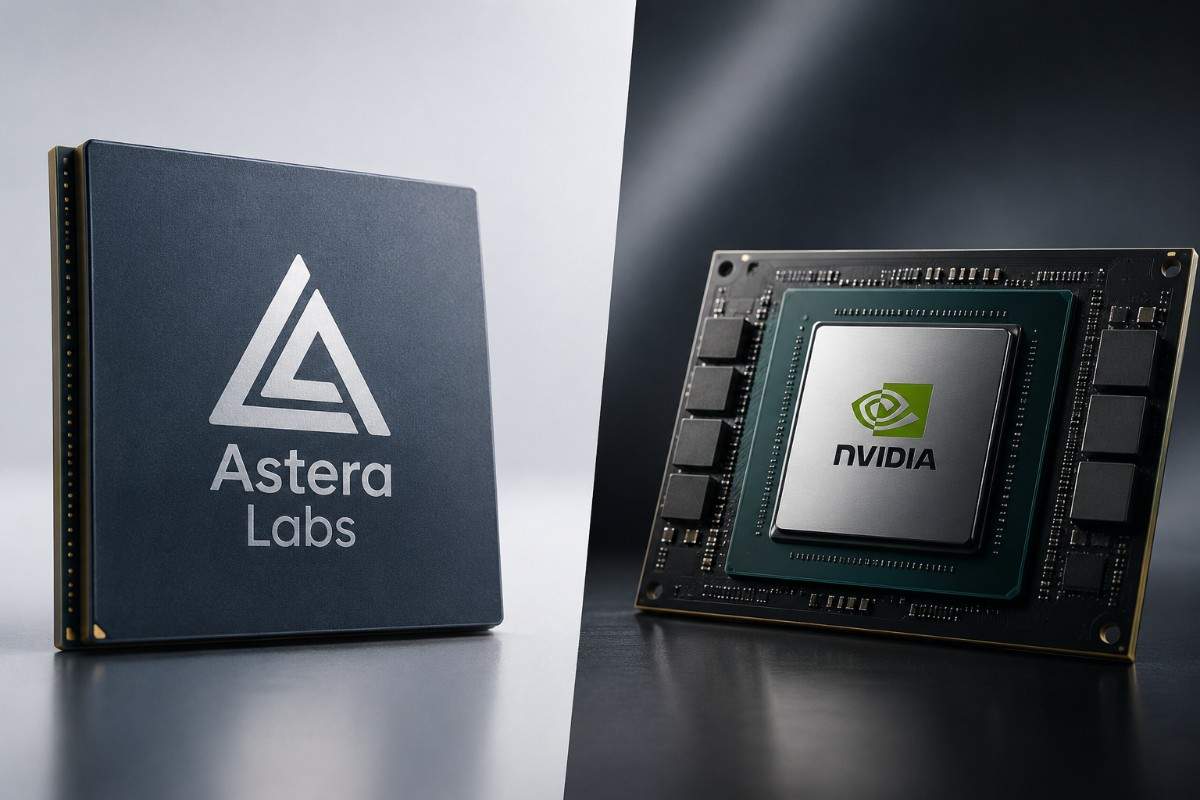
Astera Labs is an AI connectivity pure-play, not a GPU company. Nvidia dominates the accelerator layer. Astera is trying to capture the connective layer around accelerators, custom ASICs, memory, switches and servers.
Put plainly, Astera does not make the AI brain. It builds part of the nervous system that helps expensive AI hardware work together.
That role gains value as AI clusters become larger, more customized and more inference-heavy. More accelerators create more data traffic. More custom chips create more compatibility problems. More inference workloads raise the cost of latency, idle compute and inefficient networking.
Astera’s Intelligent Connectivity Platform spans CXL, Ethernet, NVLink Fusion, PCIe and UALink technologies, integrated with its COSMOS software suite. The investment case is not about a single hot AI product. It is the possibility that Astera can sell into several points of the AI connectivity layer as data-center architecture becomes more complex.
That is why ALAB trades differently from a standard semiconductor supplier. The valuation reflects content expansion across AI racks, not just chip unit growth.
ALAB’s latest jump did not happen in isolation. It came after a series of 2026 signals that pushed the market beyond the latest earnings beat and toward the next product cycle: Q1 growth, Scorpio X, optical networking and deeper exposure to custom AI infrastructure.
Astera’s May 19 appearance at the J.P. Morgan 2026 Global Technology, Media and Communications Conference gave the market a clearer way to connect those signals. The presentation followed Q1 results and the launch of Scorpio X-Series, a 320-lane AI fabric switch.
Scorpio X carried the most weight because management pointed to a clearer ramp timeline and a larger role in the product mix by year-end. Optical products and Nvidia NVLink Fusion exposure added a longer-dated layer to the story.
That shift raises the bar for the next two quarters. A short-term rally can fade with the news cycle. A 2026 valuation reset needs revenue evidence, margin discipline and signs that new products are widening Astera’s customer base.
The biggest risk is concentrated demand.
Astera’s Q1 filing shows that five customers accounted for 90% of quarterly revenue. Some listed customers may be manufacturing partners purchasing on behalf of end customers, so the figure does not perfectly align with final AI buyers. The caveat changes how the number should be read, but not the market consequence: ALAB still depends on a small number of large customer channels.
That concentration can help a young AI infrastructure supplier scale quickly. Large buyers can accelerate qualification, deepen technical integration and pull products into future architecture decisions.
It can also cut the other way when deployment timing shifts. A hyperscale buyer can delay orders, move volume, change architecture or demand better economics. That risk is sharper in AI connectivity, as Astera’s products require deep qualification within each customer’s specific AI architecture.
If a major customer shifts toward a different interconnect approach, such as CXL, NVLink or UALink, Astera may not lose only near-term revenue. It may also take time in the qualification pipeline before a new design can move into volume production.
The Amazon-linked warrant sharpens the point. Amazon’s arrangement allows the purchase of up to 3.26 million Astera shares at $142.82, tied to up to $6.5 billion of product purchases. The deal signals deep customer alignment, but it also shows how much leverage a major hyperscale buyer can hold when its volume becomes central to growth.
ALAB does not need another headline to prove that Astera is tied to AI. The next test is whether new products can turn today’s concentrated demand into broader revenue.
| Proof Point | Supports the 165x Premium | Pressures the Multiple |
|---|---|---|
| Q2 revenue above $365M | Growth is still beating guidance | In-line growth may already be priced |
| Gross margin near 73% | New product ramps are not hurting pricing power | Margin pressure weakens the premium |
| Scorpio X revenue traction | The roadmap is turning into earnings | The rally stays tied to future expectations |
| Lower top-customer concentration | Revenue becomes broader and more durable | Hyperscale timing remains the main risk |
| Optical revenue visibility | The market can price a larger opportunity | Optical stays a future story priced too early |
The best setup for ALAB is not one strong quarter in isolation. It is a sequence: revenue clears guidance, margins stay near target, Scorpio X starts contributing, and customer concentration begins to ease.
If those signals arrive together, the 165x multiple starts to look earned. If growth stays concentrated while newer products remain mostly roadmap stories, Astera can remain an excellent company while ALAB becomes a stock priced ahead of its evidence.
ALAB looks expensive on current earnings. Overvaluation depends on whether Astera can turn its AI connectivity roadmap into broader revenue, not just faster growth from a few large customers.
Q2 revenue above $365 million, stable margins, visible Scorpio X revenue and lower customer concentration would make the multiple easier to defend.
Amazon’s arrangement allows the purchase of up to 3.26 million Astera shares at $142.82, tied to up to $6.5 billion of product purchases. The deal signals deep customer alignment, but it also shows the leverage large hyperscale buyers can hold when their volume becomes central to ALAB’s growth path.
The bull case weakens if growth remains concentrated, Scorpio X ramps slowly, margins fall during product launches, or optical revenue stays too far in the future.
ALAB’s 165x earnings multiple is already on the screen. The harder test comes over the next two quarters: whether Astera can show enough product breadth, margin discipline and customer diversification to make that valuation look earned rather than borrowed from the future.