Published on: 2026-05-04
USD/IDR technical analysis has become a critical focus as the rupiah trades near record-weak territory, with the pair holding above 17,300 and testing the psychological 17,400 zone. The move signals a structural repricing of Indonesia’s currency risk as global volatility, oil sensitivity, tariff uncertainty and intervention expectations converge.
USD/IDR traded near 17,342.20 on May 4, 2026, leaving the rupiah down 1.85% over one month and 5.55% over 12 months. The pair remains within striking distance of the April record high at 17,393, keeping 17,400 as the decisive level for Dollar bulls.
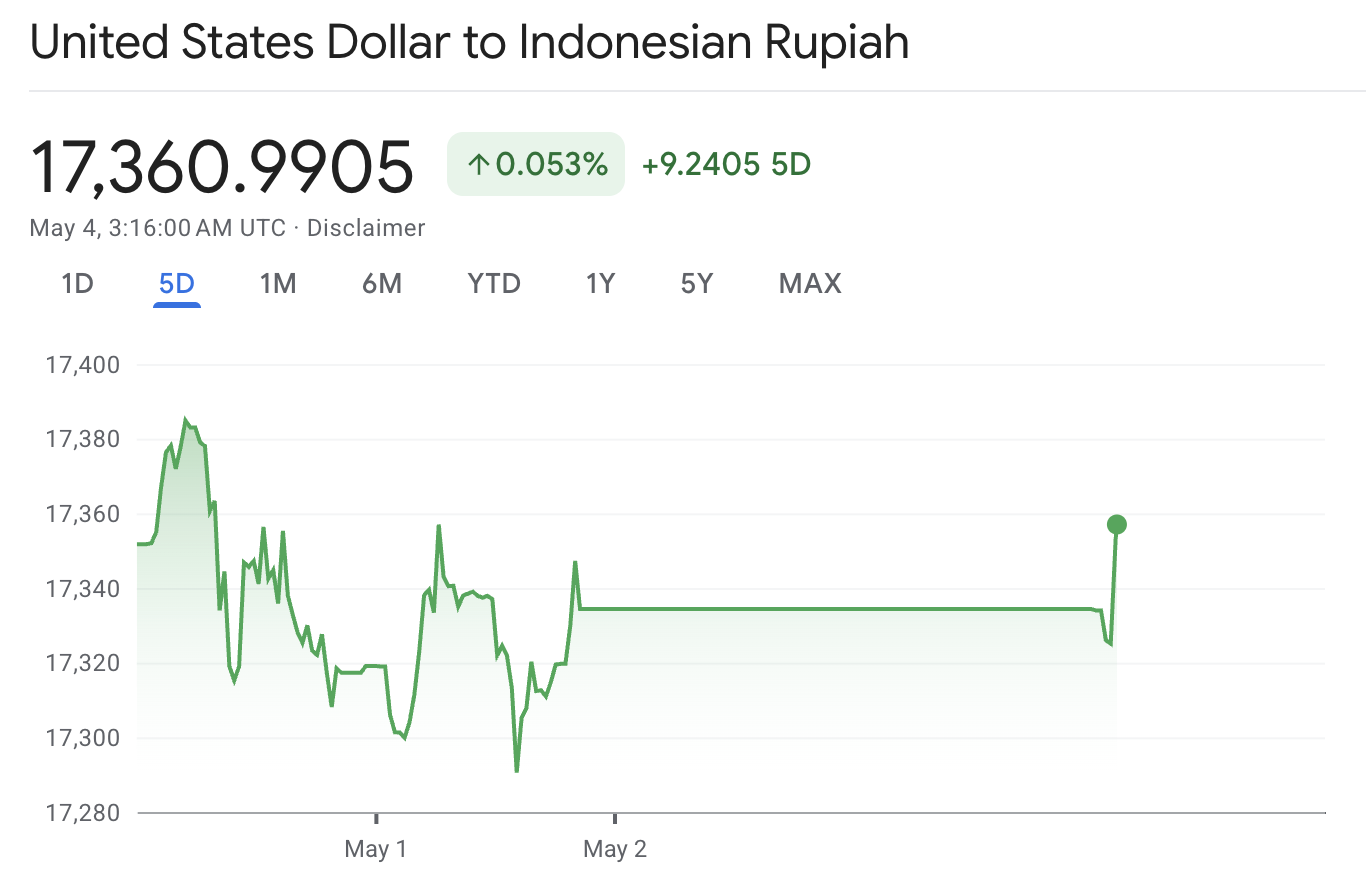
USD/IDR remains bullish while price holds above the 17,000 breakout base.
The 17,393–17,400 zone is the decisive resistance area for Dollar bulls.
A sustained breakout above 17,400 would expose the 17,500 psychological target.
RSI remains constructive, though stretched momentum signals consolidation risk.
Bank Indonesia intervention and tariff uncertainty remain key catalysts for volatility.
USD/IDR has shifted from gradual depreciation into a higher trading range. The break above 17,000 carried technical importance because it cleared a psychological ceiling that had previously acted as a reference point for rupiah stability. Since then, pullbacks have remained shallow, suggesting buyers continue to defend elevated levels.
The pair now trades close to the April record high of 17,393. A daily close above that level would confirm renewed upside pressure and expose the next liquidity pocket around 17,500. Failure to clear 17,400, however, would raise the risk of consolidation as short-term traders lock in gains.
| Indicator | Current Signal | Technical Interpretation |
|---|---|---|
| RSI 14 | 57.66 | Bullish momentum remains intact without classic overbought stress. |
| MACD | Buy | Positive trend confirmation supports continuation above 17,300. |
| EMA 20 | 17,324.4 | Price remains above short-term dynamic support. |
| EMA 50 | 17,314.4 | Medium-term structure remains Dollar-positive. |
| EMA 200 | 17,257.3 | Long-term bias remains bullish while price holds above this level. |
| Support | 17,325, 17,300, 17,000 | These levels frame immediate demand, short-term invalidation and breakout support. |
| Resistance | 17,393, 17,400, 17,500 | Record high and round-number levels define the upside test. |
| Trend | Bullish | Moving averages show broad upside alignment. |
| Momentum | Strong, but stretched | Stochastic readings near overbought territory warn against chasing late entries. |
Technical indicators are based on daily USD/IDR readings as of May 4, 2026. The technical setup favours Dollar strength, but the signal is not without risk. RSI confirms momentum, while overbought stochastic readings suggest the pair may require consolidation before a sustained break above 17,400.
| Level | Type | Market Meaning |
|---|---|---|
| 17,500 | Resistance | Next psychological target after a record breakout |
| 17,400 | Resistance | Immediate breakout trigger |
| 17,393 | Resistance | April 2026 all-time high |
| 17,325 | Pivot | Short-term balance area |
| 17,300 | Support | Near-term floor for bullish continuation |
| 17,000 | Key support | Breakout base and broader trend invalidation zone |
A close below 17,300 would weaken short-term momentum. A move below 17,000 would carry greater technical weight because it would return the pair below the breakout shelf and suggest that rupiah stabilisation efforts are gaining traction.
Bank Indonesia held the BI-Rate at 4.75%, with the Deposit Facility rate at 3.75% and Lending Facility rate at 5.50%. The policy stance remains focused on exchange-rate stability, inflation control and mitigation of global spillovers.
The central bank is also using offshore NDF intervention, domestic spot intervention and DNDF transactions to stabilise the rupiah. That means USD/IDR is not a purely chart-driven market. Technical breakouts can still face abrupt reversals when policy operations absorb Dollar demand.
Tariff risk remains relevant to USD/IDR because it affects global trade confidence, export demand and emerging-market capital flows. Bank Indonesia noted that the 2026 global growth outlook has weakened despite a reduction in US reciprocal tariffs, while inflation pressure has increased and global monetary easing space has narrowed.
For USD/IDR, that matters technically. A weaker trade backdrop and stronger Dollar liquidity reduce the probability of a clean rupiah recovery below the 17,000 breakout base. As long as the pair holds above 17,300, tariff-related uncertainty reinforces the bullish structure rather than replacing it as the main driver.
The bullish scenario requires a sustained daily close above 17,393 to 17,400. That would confirm a record-area breakout and open the path toward 17,500. If price holds above the 20-day and 50-day EMAs after the breakout, the move would show trend continuation rather than a brief liquidity sweep.
A stronger breakout would likely require broad Dollar support, renewed regional FX weakness or higher oil-linked pressure on Indonesia’s external balance.
The bearish scenario begins with rejection near 17,400 and a return below 17,300. That would signal momentum exhaustion and increase the probability of range trading.
A deeper break below 17,000 would be the key technical reversal signal. It would show that buyers failed to defend the breakout base and that intervention, portfolio inflows or broader Dollar softness had shifted the balance back toward the rupiah.
USD/IDR is near record highs because rupiah weakness has combined with Dollar demand, global risk pressure and concern over external stability. The move above 17,000 changed the chart structure and placed the pair close to its April 2026 all-time high.
USD/IDR remains technically bullish while price holds above 17,000. Moving averages and momentum indicators support the upside bias, although overbought stochastic readings suggest the pair may consolidate before extending higher.
The key resistance is 17,393 to 17,400. A sustained close above this zone would confirm a breakout and bring 17,500 into focus.
Bank Indonesia can slow volatility through rate policy, spot intervention, offshore NDF activity and DNDF transactions. These tools can limit disorderly moves, but they may not fully reverse rupiah weakness if global Dollar demand remains strong.
USD/IDR remains in a bullish technical structure as the rupiah trades near record-weak levels. The pair’s ability to hold above 17,300 keeps Dollar momentum intact, while the 17,393 to 17,400 resistance band is the decisive breakout zone. A close above that range would favour continuation toward 17,500. A failure below 17,300 would point to consolidation, but the broader trend remains Dollar-positive unless price loses the 17,000 breakout base.