Published on: 2026-03-04
Updated on: 2026-03-04
This is the first article in EBC’s Central Banks and Forex series.
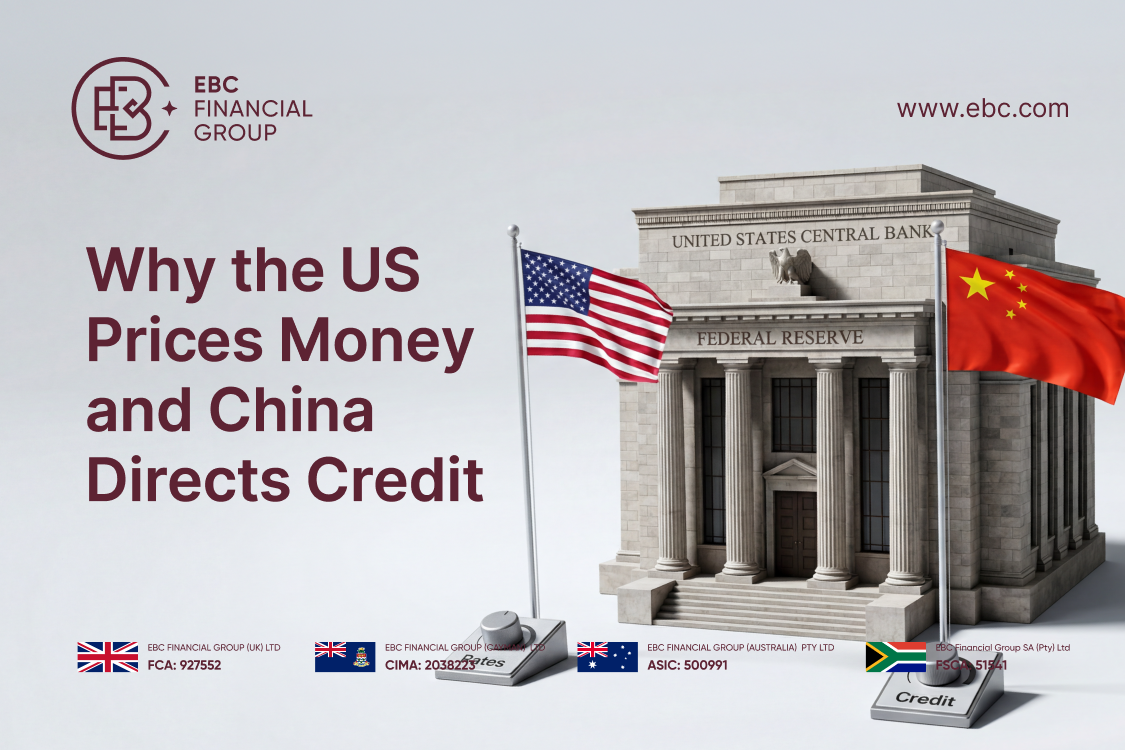
As of early 2026, a distinct policy divergence is evident. China’s central bank has committed to maintaining a “moderately loose” monetary policy and is prepared to employ reserve requirement and interest rate cuts to ensure ample liquidity. In contrast, the US Federal Reserve continues to anchor global pricing through its policy rate corridor and communication strategies, even when domestic developments dominate headlines.
This divergence extends beyond the direction of future interest rates. It reflects fundamental differences in institutional structure, policy objectives, and the selection of monetary tools. For market participants monitoring foreign exchange, interest rates, gold, or global risk sentiment, the Federal Reserve and the People’s Bank of China (PBOC) influence markets through distinct channels.
The Federal Reserve is structured to formulate monetary policy with a degree of independence from government, balanced by public accountability. In 1977, Congress amended the Federal Reserve Act to require the Fed to pursue maximum employment, stable prices, and moderate long-term interest rates. While commonly referred to as the “dual mandate,” the third objective becomes significant when long-term yields diverge from expectations.
A critical consideration for markets is that Federal Reserve governors are protected from removal due to policy disagreements. This “for cause” protection is substantive, having been tested in public legal and political disputes. The Federal Reserve has underscored that the statute permits removal only for cause.
China’s central bank, The People’s Bank of China (PBOC) functions within a party-state framework. Legally, it formulates and implements monetary policy under the direction of the State Council. Politically, China has increased party oversight of the financial system through entities such as the Central Financial Commission, which state media describe as enhancing unified leadership over financial activities.
This distinction is significant because markets perceive the PBOC less as an independent technocratic institution and more as an integrated component of a broader policy apparatus. Personnel changes can therefore be highly consequential. For example, in 2023, Pan Gongsheng’s appointment as both party chief and anticipated governor of the PBOC reduced ambiguity regarding institutional leadership.
The Federal Reserve’s incentives are intentionally narrow. Its credibility is closely linked to inflation and employment outcomes, and it is generally willing to accept short-term economic costs to uphold its mandate.
The PBOC’s incentives are broader in scope. While it remains concerned with price stability, it must also support economic growth, manage financial risks, and align with national priorities beyond traditional inflation and employment objectives. Consequently, PBOC statements often emphasise policy coordination rather than solely providing a rate outlook.
This distinction is evident in the PBOC’s 2026 communications. Following its annual work conference, the PBOC announced it would maintain a “moderately loose” policy stance and utilise tools such as the reserve requirement ratio (RRR) and interest rate cuts to ensure sufficient liquidity. In January 2026, it also reduced rates on certain sector-specific policy instruments and signalled increased support for strategic sectors, including technological innovation, green development, and financial inclusion.
Policy transmission in the US still begins with the federal funds target range. In today’s operating framework, it largely implements that range through administered rates, such as the interest rate on reserve balances, as well as facilities that help keep money-market rates aligned.
This channel is significant for traders because it is broad-based. When the Federal Reserve tightens policy, the US dollar typically appreciates, global liquidity contracts, and the required return for risk assets increases. Even when policy changes are well communicated, the dollar and global carry trades often respond to the anticipated trajectory reflected in market pricing.
China’s central bank can adjust or guide benchmark interest rates, but it also employs a broader array of instruments to influence the allocation of credit within the economy.
Unlike many major central banks, the PBOC actively adjusts reserve requirements and has developed a differentiated framework. In 2019, the PBOC described a reserve requirement system with “three levels and two preferential treatments,” which effectively reduced requirements for certain smaller and rural financial institutions.
For market participants, a reduction in the reserve requirement ratio (RRR) represents more than simple monetary easing. It can also indicate which segments of the domestic economy policymakers aim to stabilise, given that the banking system remains the primary transmission channel.
Research indicates that changes in the RRR can alter the composition of credit, not merely its volume, by influencing incentives across bank balance sheets and credit channels. However, this effect is context-dependent and varies with the regulatory environment and bank behaviour.
China’s structural monetary policy tools are significant in scale. According to PBOC data, the outstanding balance of these instruments reached 3.9 trillion yuan by the end of September 2025.
In practice, these tools include lending and re-lending facilities designed to incentivise banks to support priority sectors. The PBOC characterises this as targeted support for areas such as technology, green development, and service consumption. The central bank also issues notices to extend specific structural tools, including the carbon emission reduction facility.
The key consideration for traders is that the PBOC can implement monetary easing through targeted instruments, which may not resemble a conventional broad-based rate-cut cycle. A supportive policy stance can be observed in the adjustment of targeted tool rates and quotas, even when the headline policy rate remains unchanged.
The Federal Reserve’s communication framework is designed to shape market expectations. Market participants closely monitor official statements, the chair’s press conferences, the dot plot, speeches, and implementation notes. This consistent communication cadence facilitates continuous adjustment in market pricing.
The PBOC communicates primarily through work conferences, official statements, and policy committee language, frequently emphasising alignment with national priorities. Recent official communications have consistently highlighted the importance of structural tools and support for “major strategies, key areas and weak links.”
A concise way to articulate this difference is through the concept of transparency. The IMF’s Central Bank Transparency Code defines transparency as encompassing governance, policy, operations, outcomes, and official relations with government. The Federal Reserve aligns closely with this model. In contrast, the PBOC’s communications, while accessible, convey more explicit state intent and less of the internal policy debate typically observed in Federal Reserve communications.
The following summarises the typical channels through which each central bank influences markets. While not guarantees, these patterns are commonly observed by traders.
The Fed sets the global hurdle rate
When the Federal Reserve adopts a restrictive stance, global financial conditions typically tighten. The US dollar remains supported, and emerging market funding conditions often become less favourable. As a result, global assets frequently respond to US economic data releases, even when local developments are prominent.
The PBOC is more likely to move commodity and Asia risk through growth expectations
PBOC monetary easing typically does not transmit globally through straightforward capital-market arbitrage, unlike Federal Reserve actions. Instead, its effects are often first reflected in expectations regarding Chinese demand, sectoral activity, regional risk sentiment in Asia, and official signals concerning currency management.
Divergence creates FX pressure even when nobody wants to talk about it
When the Federal Reserve maintains a tight policy stance while the PBOC eases or supports growth, interest-rate differentials may exert downward pressure on the renminbi, influencing broader Asian foreign exchange sentiment. Consequently, Chinese policy announcements can significantly impact regional FX markets, even when the measures appear narrowly targeted.
A concise, repeatable checklist for market monitoring includes the following considerations:
What does pricing imply about the path, not the next meeting
Is the front end moving, or is the long end doing the work?
Are administered rates and liquidity tools changing in a way that tightens conditions
Is the stance supportive in the language of the annual work conference?
Are structural tools being expanded, repriced, or extended
Is the message about stabilising demand, stabilising finance, or directing credit
In global markets, the Fed is the world’s main price setter for money. The PBOC is one of the world’s largest allocators of credit. In 2026, traders will continue to experience moments when these two machines point in different directions. When that happens, the cleanest read is not “who is dovish.” It is which transmission channel is dominant that week: dollar liquidity, long-end yields, China demand expectations, or policy-directed credit.
Next in the series: Why a Strong Euro Could Spell Bad News for Europe
Disclaimer & Citation
This material is for information only and does not constitute a recommendation or advice from EBC Financial Group and all its entities (“EBC”). Trading Forex and Contracts for Difference (CFDs) on margin carries a high level of risk and may not be suitable for all investors. Losses can exceed your deposits. Before trading, you should carefully consider your trading objectives, level of experience, and risk appetite, and consult an independent financial adviser if necessary. Statistics or past investment performance are not a guarantee of future performance. EBC is not liable for any damages arising from reliance on this information.