Published on: 2026-04-30
Updated on: 2026-04-30
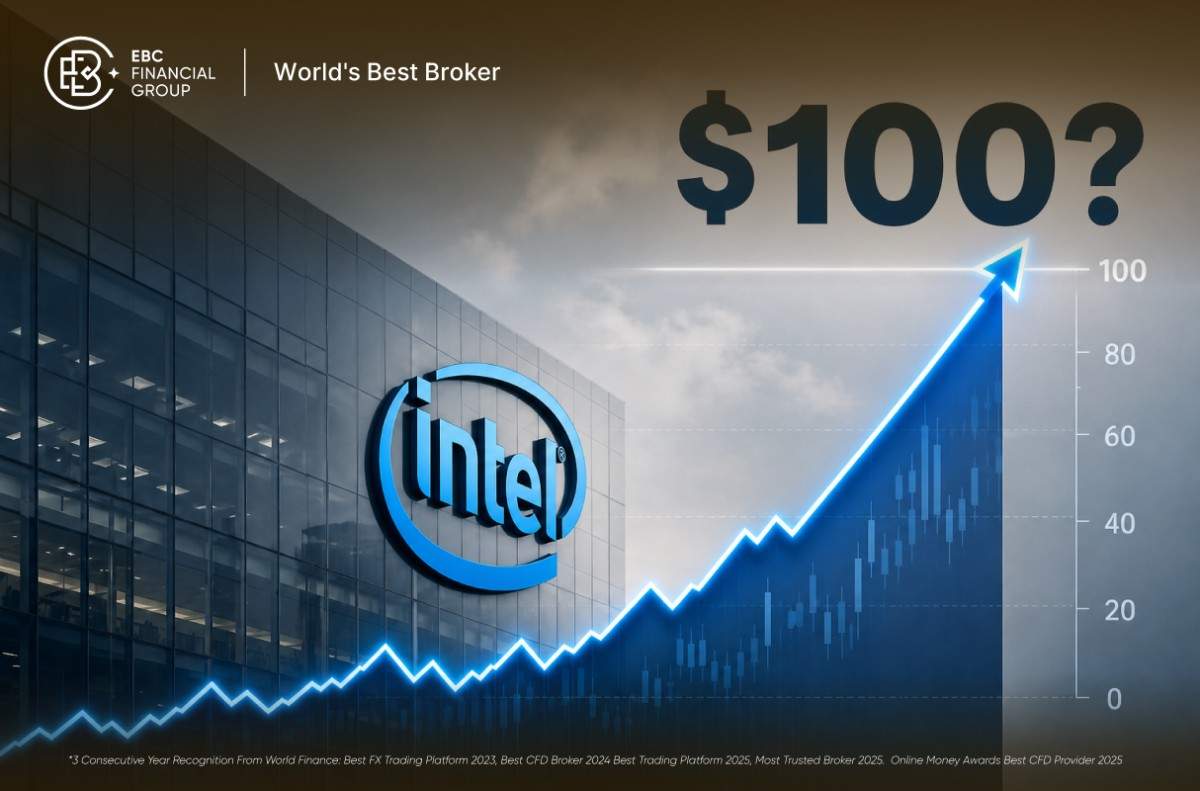
Intel stock can reach $100 soon. The harder question is whether it can stay there.
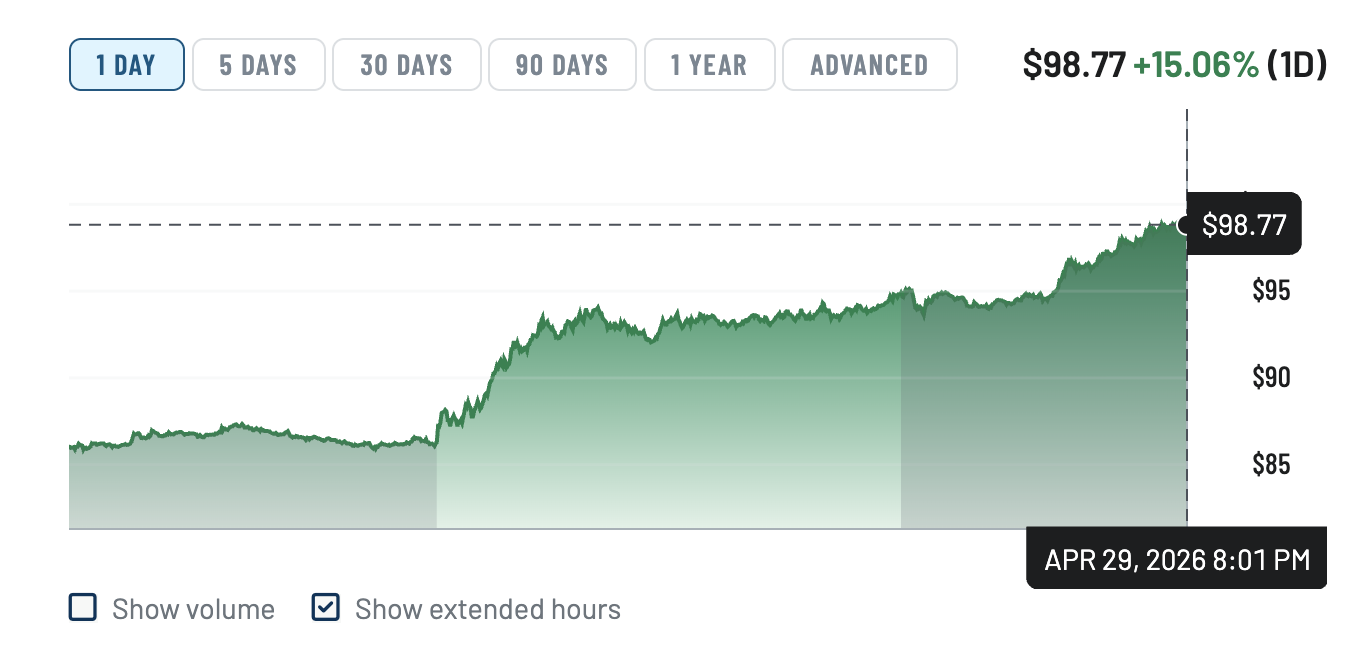
As of MarketBeat’s latest quoted data, Intel closed at $94.75 at 4:00 p.m. Eastern and traded at $98.77 in extended hours as of 8:00 p.m. Eastern. That left the stock about 5.5% below $100 based on the regular close and about 1.2% below $100 based on the extended-hours quote. (1)
The rally has already been huge. Intel has more than doubled in 2026, rising from $36.90 at the start of the year to $94.75. At $100, the company would be valued at roughly $500 billion.
That valuation requires more than momentum. Intel still has to prove that its Q1 rebound can turn into sustained revenue growth, margin recovery, and real progress in the foundry business. (2)
Intel’s rally was triggered by a Q1 2026 report that gave investors more evidence that the turnaround may be gaining traction.
The company reported first-quarter revenue of $13.6 billion, up 7% year over year. GAAP EPS was a loss of $0.73, but non-GAAP EPS was $0.29. Intel also guided for Q2 2026 revenue of $13.8 billion to $14.8 billion and non-GAAP EPS of $0.20.
The market reacted because the quarter improved Intel’s story in several areas at once:
| Driver | Why it matters |
|---|---|
| Data Center and AI revenue rose 22% | Gives Intel a clearer AI infrastructure role beyond GPUs |
| Non-GAAP gross margin improved to 41.0% | Suggests better operating leverage and supply execution |
| Foundry revenue rose 16% | Supports the manufacturing-turnaround story, though profitability remains unproven |
| Q2 guidance supported the recovery case | Helps investors look past the GAAP loss |
| U.S. government backing remains material | Reinforces Intel’s strategic role in domestic chipmaking |
Intel’s Data Center and AI business generated $5.1 billion in revenue, Client Computing produced $7.7 billion, and Intel Foundry generated $5.4 billion.
Those numbers matter because Intel’s current rally is not only about PC chips. It is about whether Intel can become more relevant to AI infrastructure, advanced packaging, and domestic semiconductor manufacturing.
At $100, Intel would not merely be recovering. It would be asking investors to treat the turnaround as credible before all the proof is in.
That is where valuation becomes uncomfortable. MarketBeat shows a Hold consensus rating, an average price target of $72.98, and a high target of $110. A $100 share price would be about 37% above the average target, although still below the most bullish target.
| Metric | Figure |
|---|---|
| Regular-session close | $94.75 |
| Extended-hours quote shown by MarketBeat | $98.77 |
| Distance from regular close to $100 | About 5.5% |
| Distance from extended-hours quote to $100 | About 1.2% |
| Average MarketBeat analyst target | $72.98 |
| High MarketBeat analyst target | $110 |
| Implied market value at $100 | About $508 billion |
That does not mean Intel cannot trade above $100. Stocks can outrun analyst targets when estimates are rising. But it does mean the burden of proof shifts. Above $100, investors are no longer paying for a cheap turnaround. They are paying for sustained improvement.
For Intel to stay above $100, the company needs to prove that the Q1 improvement was not a one-quarter rebound.
The bull case is that Intel is no longer trading only on hope. Q1 gave investors revenue growth, margin improvement, and AI-related demand that investors can model. Intel’s Data Center and AI revenue rose 22%, non-GAAP gross margin improved to 41.0%, and foundry revenue grew 16%.
But holding $100 likely requires more than one strong report:
| What must happen | Why it matters |
|---|---|
| Data Center and AI growth must continue | Confirms Intel has a real AI-adjacent growth engine |
| Gross margins must hold or improve | Turns revenue growth into earnings power |
| Foundry losses must narrow | Reduces concern that foundry is a permanent capital drain |
| Guidance must support the recovery | Prevents the rally from looking like a one-quarter squeeze |
| Analysts must raise estimates | Helps justify a valuation above the average price target |
That is the upside case, but it is also the execution challenge. Intel’s story has moved beyond PC recovery toward AI infrastructure and domestic manufacturing. That gives the stock more upside potential, but it also raises the burden of proof.
The bear case is that Intel’s share price is now pricing in several quarters of future improvement after only one clearly better quarter.
Intel still reported a GAAP net loss attributable to Intel of $3.7 billion in Q1 2026. Non-GAAP results were much better, but investors should not ignore the gap between GAAP and adjusted earnings. Intel’s reconciliation shows that restructuring and other charges were a major part of the difference.
Foundry is the other major issue. Foundry revenue growth supports the story, but revenue alone is not enough. Intel must prove it can manufacture advanced chips at scale, win external customers, improve yields, and eventually reduce losses.
Intel Foundry reported a $2.4 billion operating loss in Q1 2026, so the foundry story remains a financial drag even as revenue grows.
Until that happens, foundry remains both Intel’s biggest strategic opportunity and one of its biggest financial risks.
The stock also faces valuation risk. At $100, Intel would be well above the average analyst target. That does not automatically make the stock overvalued, but it means continued upside probably requires higher estimates, better margins, or more confidence that Intel’s AI and foundry businesses deserve a higher multiple.
Intel’s government backing is an important part of the story, but investors should not treat it as a guarantee.
In August 2025, Intel announced that the U.S. government would invest $8.9 billion in Intel common stock. Intel said the funding would come from $5.7 billion in previously awarded but unpaid CHIPS Act grants and $3.2 billion from the Secure Enclave program. (3)
The SEC filing gives more details. Intel agreed to issue up to 433.323 million shares to the Department of Commerce, with part of the issuance tied to released CHIPS Act funds and the remainder tied to Secure Enclave disbursements. The agreement also included warrants exercisable under specified conditions if Intel ceases to own at least 51% of its foundry business. (4)
At $94.75, 433.3 million shares would be worth about $41.1 billion. At $100, they would be worth about $43.3 billion.
That support reinforces Intel’s role as a strategic domestic chipmaker. It may also make some investors more willing to give Intel time. But it does not guarantee foundry profitability, customer wins, process-node execution, or margin expansion.
Investors should also separate the government stake from Trump’s personal financial disclosures. An Office of Government Ethics transaction report listed a purchase of “INTEL CORP 3.75% DUE 08/05/27” on Aug. 29, 2025, in the range of $1,000,001 to $5,000,000. That is an Intel corporate bond, not Intel common stock. (5)
That distinction matters. A bond purchase primarily reflects credit exposure to Intel’s ability to repay debt. Common stock is exposed to earnings growth, valuation multiples, dilution, competition, and long-term upside or downside.
Yes. Intel can hit $100 soon because it is already close to that level.
But investors should not confuse a price target with a business milestone. A brief move above $100 would be a momentum event. Holding $100 would require evidence that Intel’s Q1 improvement can continue.
The stock is more likely to hold above $100 if Intel keeps beating revenue expectations, protects gross margin, narrows foundry losses, and shows that AI-related CPU demand is not temporary.
It is more likely to fall back if margins weaken, foundry losses remain heavy, guidance disappoints, or analysts do not raise estimates enough to support the new valuation.
No. The cited OGE report does not show a purchase of Intel common stock. It lists a purchase of Intel corporate bonds, specifically “INTEL CORP 3.75% DUE 08/05/27.”
It may be stretched relative to current analyst targets. MarketBeat shows an average price target of $72.98 and a high target of $110. That puts $100 well above the average target but still below the most bullish target.
The rally could fade if Q1 proves to be a one-quarter spike, if foundry losses remain large, if gross margins decline, if AI CPU demand slows, or if analyst estimates do not rise enough to support the valuation.
Intel’s move toward $100 is believable, but the stock is no longer trading like a cheap turnaround. At this level, investors are paying for continued revenue growth, margin recovery, and real progress in the foundry business before any of that has been fully proven.
That makes $100 possible, but fragile. The next few quarters matter more than the latest price move.