Published on: 2026-01-06
Updated on: 2026-01-06
The Asian stock market open time signals the start of global price discovery, as Asia’s major exchanges are the first to react to overnight economic data, geopolitical events, and corporate earnings while US and European markets are closed.
Because the Asian trading session unfolds across multiple time zones, understanding the exact Asian stock market open time is important for accurate trade execution, futures positioning, and volatility management.
Japan and India, two of Asia’s most influential markets, open hours before Western exchanges, meaning their early price action frequently influences US and UK futures before those markets officially begin trading.
Global markets operate in a rolling sequence rather than a single unified session. The asian stock market open time represents the transition from the US close to the next trading day, bridging overnight risk between regions.
Asia session: Price discovery begins
Europe session: Trends are confirmed or challenged
US session: Liquidity peaks and positioning are finalized
This sequence explains why sharp moves during the Asian open frequently echo through European indices and into the US cash open.
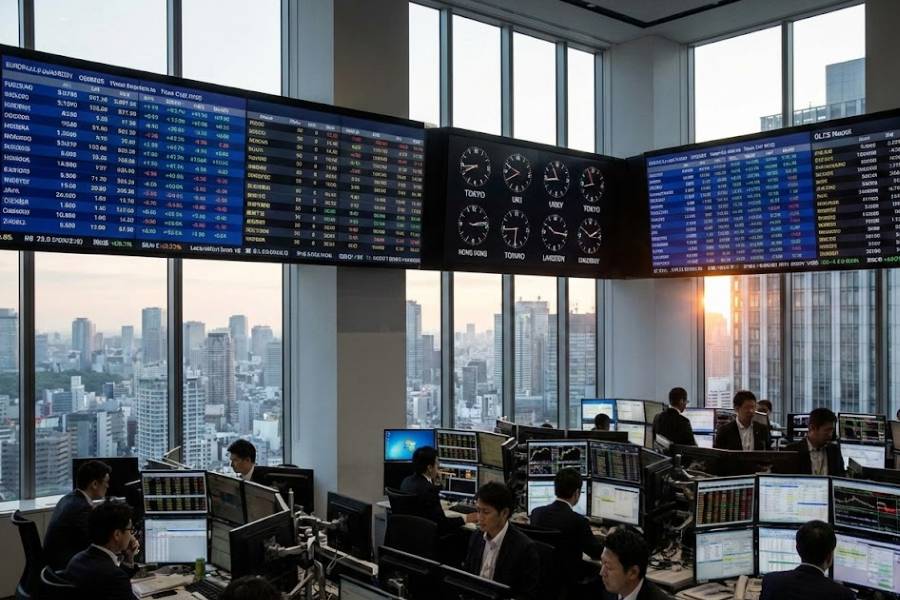
Asian Stock Market Opening Times
| Country / Region | Stock Exchange | Local Open | Local Close | Liquidity & Volatility Characteristics |
|---|---|---|---|---|
| Japan | Tokyo Stock Exchange (TSE) | 09:00 | 15:00 | Very high liquidity at open; sets regional tone; strong FX sensitivity |
| South Korea | Korea Exchange (KRX) | 09:00 | 15:00 | High volatility early; tech- and export-driven flows |
| China | Shanghai Stock Exchange (SSE) | 09:30 | 15:00 | Policy-sensitive; volatility spikes on macro headlines |
| China | Shenzhen Stock Exchange (SZSE) | 09:30 | 15:00 | Higher retail participation; sharper intraday swings |
| Hong Kong | Hong Kong Stock Exchange (HKEX) | 09:20 | 16:00 | High volatility; strong linkage to US ADRs and China policy |
| Singapore | Singapore Exchange (SGX) | 09:00 | 17:00 | Stable liquidity; regional hub for FX and derivatives |
| India | National Stock Exchange (NSE) | 09:15 | 15:30 | Secondary volatility wave; strong reaction to global cues |
| India | Bombay Stock Exchange (BSE) | 09:15 | 15:30 | High domestic participation; momentum at the open |
| Taiwan | Taiwan Stock Exchange (TWSE) | 09:30 | 13:30 | Semiconductor-driven; reacts to global tech sentiment |
| Malaysia | Bursa Malaysia (MYX) | 09:00 | 17:00 | Moderate liquidity; commodity and financial sector bias |
| Thailand | Stock Exchange of Thailand (SET) | 10:00 | 16:30 | Volatility around open; sensitive to regional flows |
| Indonesia | Indonesia Stock Exchange (IDX) | 09:00 | 15:00 | Commodity-linked volatility; emerging-market risk premium |
| Philippines | Philippine Stock Exchange (PSE) | 09:30 | 15:30 | Lower liquidity; volatility spikes on macro news |
| Vietnam | Ho Chi Minh Stock Exchange (HOSE) | 09:15 | 14:30 | Retail-heavy; sharp opening moves possible |
| Vietnam | Hanoi Stock Exchange (HNX) | 09:00 | 15:30 | Thinner liquidity; higher relative volatility |
| Australia | Australian Securities Exchange (ASX) | 10:00 | 16:00 | Strong open volatility; commodity and China exposure |
| New Zealand | New Zealand Exchange (NZX) | 10:00 | 17:00 | Lower liquidity; follows Australia and Asia trends |
| Bangladesh | Dhaka Stock Exchange (DSE) | 10:00 | 14:30 | Thin liquidity; price gaps more common |
| Sri Lanka | Colombo Stock Exchange (CSE) | 10:30 | 14:30 | Low liquidity; volatility event-driven |
| Pakistan | Pakistan Stock Exchange (PSX) | 09:30 | 15:30 | Emerging-market volatility; macro-sensitive |
| Turkey | Borsa Istanbul (BIST) | 09:00 | 17:30 | High volatility; bridge between Asia and Europe |
Japan’s open marks the core Asian stock market open time, delivering the first wave of liquidity and establishing the initial directional bias for the region.
East Asian openings in Korea, China, and Hong Kong add depth in stages, creating layered liquidity rather than a single concentrated surge.
Mid-session trading is generally calmer, with lower volatility and more range-bound price action as early information is absorbed.
India’s opening introduces a second liquidity wave, often shaping European pre-market futures and late-Asian momentum.
The Asian stock market open time is defined by sharp price discovery, elevated volatility, and concentrated liquidity in a small group of highly traded names. The best stocks to trade during this window share three traits: deep liquidity, global exposure, and sensitivity to overnight news.
Best liquidity: Japanese blue chips at the Tokyo open (Softbank Group, Toyota Motor Corp)
Best volatility: Hong Kong-listed China stocks (Tencent, Alibaba Group Holding, Meituan)
Late-session momentum: Indian large caps (HDFC Bank, Infosys, Reliance Industries)
Highest risk window: First 30-60 minutes after each major market opens
Asian market openings frequently set the tone for global risk appetite. US and European equity index futures often adjust overnight based on price discovery in Tokyo and Mumbai, particularly when major economic releases, central bank signals, or geopolitical events occur outside Western trading hours.
Liquidity conditions are also unique at the open. Volatility is typically highest during the first hour of trading, when overnight information is absorbed and repriced.
For global portfolios, aligning execution strategies with the asian stock market open time can materially reduce slippage and improve trade quality.
US equity index futures, currency futures, and commodity markets remain active during Asian hours. These instruments often react immediately to Asian equity movements, especially when sentiment shifts sharply at the open.
For this reason, many professional traders monitor the Asian open even if they do not trade Asian equities directly. The initial move frequently signals how futures markets will behave leading into the European and US sessions.
One common mistake is overlooking daylight saving time adjustments. US Eastern Time shifts seasonally, while most Asian markets operate on fixed local schedules.

This causes Asian market opening times to shift by one hour when viewed in ET, often leading to execution errors for investors using static calendars. Professional trading desks anticipate these changes and adjust schedules in advance to maintain accurate timing.
Confusion around the asian stock market open time often stems from daylight saving time. The US adjusts clocks seasonally, while most Asian markets, including Japan and India, keep fixed local schedules, causing ET conversions to shift even though Asian opening times do not change.
Asian local opening times remain constant.
US Eastern Time conversions shift by one hour during DST
Static schedules become inaccurate without seasonal adjustments.
Professional desks adjust trading calendars in advance to avoid execution errors during these transitions.
Another issue is assuming all Asian markets open simultaneously. In reality, Asia spans multiple time zones, with Japan and India separated by more than three hours of local time, resulting in staggered liquidity waves across the region.
The Asian trading day begins with Japan at 7:00 PM ET on the previous day, followed by India at 11:45 PM ET on the previous day. These two openings define the core Asian stock market open time window for US-based investors monitoring overnight risk.
Japan opens first among the major Asian markets. Because it is the earliest large, liquid market to trade after the US close, Japan often sets the initial direction for Asian equities, regional currencies, and global futures.
Yes. Asian exchanges keep fixed local opening times, but the US Eastern Time shifts during daylight saving periods. This causes Asian market open times to appear one hour earlier or later in ET, depending on the season.
US equity index futures trade nearly around the clock and respond immediately to price discovery during the Asian session. When Asian markets react to economic data or geopolitical news, those moves are quickly reflected in US futures pricing.
Volatility is usually highest in the first 30 to 60 minutes after each major Asian market opens, as overnight news and global sentiment are rapidly priced into equities and derivatives.
Yes. Price action established during the Asian stock market open time often influences how European and UK markets open, particularly when overnight moves signal changes in global risk appetite.
The Asian stock market's open time is where the global trading day truly begins. Price discovery in Japan and India occurs while Western markets are closed, shaping risk sentiment that carries into Europe and the US.
For global investors, understanding these opening hours is practical, not theoretical. The Asian open influences overnight futures, early volatility, and how Western markets position at the bell. Tracking these timings improves execution, reduces surprises, and keeps portfolios aligned with the natural flow of global markets.
Disclaimer: This material is for general information purposes only and is not intended as (and should not be considered to be) financial, investment, or other advice on which reliance should be placed. No opinion given in the material constitutes a recommendation by EBC or the author that any particular investment, security, transaction, or investment strategy is suitable for any specific person.