Published on: 2026-05-04
GameStop stock returned to the center of speculative trading after the video game retailer launched an unsolicited proposal to acquire eBay in a transaction valued at about $55.5 billion. The bid marks Ryan Cohen’s most aggressive attempt to reposition GameStop from a shrinking physical gaming chain into a broader commerce and collectibles platform.
GameStop offered $125 per eBay share in a 50% cash and 50% stock structure, representing a 46% premium to eBay’s unaffected closing price on February 4, 2026. The company has already built a 5% economic stake in eBay through derivatives and beneficial ownership and is preparing regulatory filings tied to the proposal.
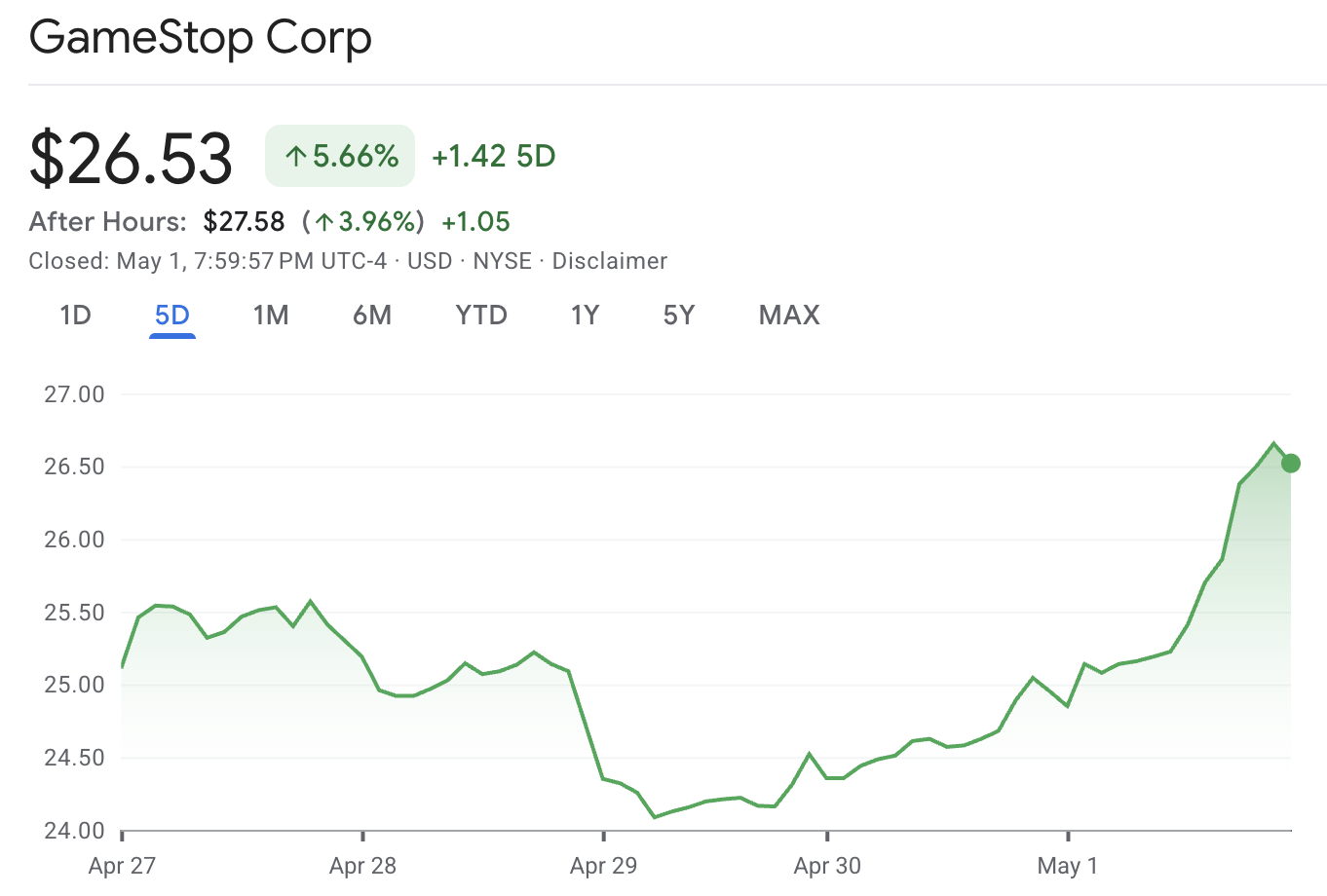
GME stock closed at $26.53 on May 1, up 6.33%, as investors priced in the possibility of a transformational deal.
The GameStop eBay acquisition proposal values eBay at about $55.5 billion, with $125 per share split evenly between cash and GameStop common stock.
GameStop ended fiscal 2025 with $9.01 billion in cash, cash equivalents, and marketable securities, nearly double the $4.77 billion held a year earlier.
Revenue still fell 5.1% to $3.63 billion in fiscal 2025, but operating income swung to $232.1 million from a $26.2 million loss.
Collectibles revenue surged 47.7% to $1.06 billion, lifting the category to 29.2% of net sales and giving the turnaround a clearer commercial anchor.
The market reaction reflects optionality rather than certainty. GameStop’s proposal is non-binding and remains subject to financing, regulatory review, shareholder approvals, eBay board engagement, and definitive transaction documents. Investors are repricing GameStop stock around the prospect of a larger strategic reset, not a completed acquisition.
The proposed structure is unusually ambitious. GameStop expects to fund the cash portion using balance sheet liquidity and third-party acquisition financing, including a highly confident financing letter from TD Securities for up to $20 billion.
The company also projects $2 billion in annualized cost reductions within 12 months of closing, including $1.2 billion from sales and marketing, $300 million from product development, and $500 million from general and administrative costs.
The strategic logic rests on overlap between eBay’s marketplace strength and GameStop’s collectibles pivot. GameStop says its roughly 1,600 U.S. retail locations could support authentication, intake, fulfillment, and live commerce for eBay. That vision gives the bid a sharper industrial rationale than a pure financial transaction, although execution risk remains substantial.
GameStop is no longer the same distressed retailer that defined the 2021 meme-stock cycle. Fiscal 2025 net sales declined to $3.63 billion from $3.82 billion, but profitability improved sharply. Gross margin expanded to 33.0% from 29.1%, while SG&A expense fell 19.5% to $910.2 million. Operating income reached $232.1 million, compared with a loss of $26.2 million in fiscal 2024.
The improvement came from cost discipline and category mix, not broad-based top-line growth. Software revenue fell 27.5%, while hardware and accessories declined 12.3%. Collectibles offset part of the pressure, rising 47.7% to $1.06 billion as trading cards and related products became a larger part of GameStop’s revenue base.
| Metric | Fiscal 2025 | Fiscal 2024 | Change |
|---|---|---|---|
| Net sales | $3.63B | $3.82B | -5.1% |
| Gross margin | 33.0% | 29.1% | +390 bps |
| SG&A expense | $910.2M | $1.13B | -19.5% |
| Operating income | $232.1M | -$26.2M | Swing to profit |
| Net income | $418.4M | $131.3M | +218.7% |
| Collectibles sales | $1.06B | $717.9M | +47.7% |
The table captures the tension behind the GameStop stock forecast 2026 debate. The company has restored profitability, improved margins, and built a liquidity base large enough to pursue acquisitions. Yet its legacy gaming business remains structurally challenged as console cycles, digital downloads, and direct-to-consumer gaming channels keep pressuring store traffic.
GameStop’s strongest asset is its balance sheet. The company held $6.30 billion in cash and cash equivalents and $2.71 billion in marketable securities at January 31, 2026. That $9.01 billion liquidity position gives Cohen flexibility to pursue acquisitions, earn interest income, and absorb operational volatility.
The balance sheet was built partly through equity issuance and zero-coupon convertible debt. That creates both financial flexibility and dilution risk. A 50% stock-funded eBay bid would likely raise further questions about ownership dilution, deal economics, and whether GameStop’s equity can serve as acquisition currency at sufficient scale.
Bitcoin exposure adds another layer of risk. GameStop purchased 4,710 Bitcoin for $500 million in fiscal 2025 and pledged 4,709 Bitcoin as collateral in a covered-call strategy. The company recorded a $131.6 million net loss on digital assets and related receivables during the year, reflecting realized and unrealized losses tied to the strategy.
GME stock closed at $26.53 on May 1, 2026, up 6.33% on volume of 15.3 million shares, as deal headlines pulled speculative capital back into the name.
The move fits GameStop’s long-running pattern: sharp rallies tend to follow catalysts tied to Cohen, capital allocation, or strategic reinvention. The difference in 2026 is that investors can now point to a larger cash base, positive net income, and a growing collectibles segment.
Those factors give the bullish case more substance, even as the proposed acquisition exceeds GameStop’s own operating scale by a wide margin.
GameStop stock is rising after the company proposed to acquire eBay for about $55.5 billion. The bid would reshape GameStop into a larger commerce platform, although it remains non-binding and faces financing, regulatory, and shareholder hurdles.
GameStop has proposed to buy eBay, but no completed transaction exists as of May 2026. The offer is unsolicited and non-binding, with $125 per eBay share split between cash and GameStop stock.
The main risk is execution. GameStop must prove it can stabilize declining gaming sales, integrate a much larger marketplace business, manage dilution, and justify the debt financing attached to the proposed acquisition.
The 2026 outlook depends on whether the eBay bid progresses and whether collectibles growth can offset legacy retail weakness. A credible deal path could support further upside, while rejection or financing concerns could quickly reverse speculative gains.
GameStop stock is no longer trading only on meme-stock nostalgia. The eBay bid, stronger liquidity position, restored profitability, and collectibles growth have created a more serious transformation narrative. The challenge is scale. A $55.5 billion unsolicited acquisition would test GameStop’s balance sheet, equity currency, and operational credibility at once.
For investors, GME stock now represents a high-volatility bet on whether Ryan Cohen can convert financial flexibility into a durable commerce platform rather than another temporary trading catalyst.