Published on: 2025-10-08
Updated on: 2026-06-18
The world has roughly $100 trillion in broad money in 2026. That means cash, bank deposits, savings accounts, and other money-like balances that people or businesses can use without selling a house, stock portfolio, or private company.
The larger $470 trillion figure refers to global wealth. That includes homes, land, stocks, bonds, pensions and business ownership. Those assets can make people rich on paper, yet they are not the same as money ready to spend today.
The short answer: around $100 trillion if you mean usable money, and closer to $470 trillion if you mean global wealth.
$100 trillion is the best quick answer if “money” means cash, deposits and savings-style balances.
Global wealth is closer to $470 trillion because homes, stocks, pensions, land and businesses are assets rather than spendable money.
Physical cash is only a small part of the total, so the money inside bank accounts matters more than notes and coins.
Debt and derivatives can make headline figures appear much larger, yet they should not be treated as money people can spend.
| Category | Rough size | What it means |
|---|---|---|
| Physical cash | $8–10T | Notes and coins |
| Broad money | Around $100T | Cash, deposits and savings balances |
| Financial wealth | Around $305T | Stocks, bonds, funds and other financial assets |
| Personal wealth | Around $470T | Property, pensions, financial assets and business ownership |
| Global debt | Around $250T | Money owed by governments, companies and households |
| Derivatives notional value | Around $846T | Contract face value, not spendable money |
Broad money is the closest answer to what most people mean when they ask how much money exists.
The larger rows answer different questions. Wealth shows ownership. Debt shows obligations. Derivatives show contract size. Mixing them all together creates a huge number, not a clearer answer.
If the world’s broad money were split evenly across roughly 8.3 billion people, it would equal about $12,000 per person. If global wealth were split the same way, the figure would rise to about $57,000 per person.
Those numbers are averages, not real ownership. They help translate trillion-dollar figures into something easier to picture, while showing why global wealth can look huge even when many people still feel short of money.
| Category | If split equally |
|---|---|
| Physical cash | About $1,000–$1,200 per person |
| Broad money | About $12,000 per person |
| Financial wealth | About $37,000 per person |
| Personal wealth | About $57,000 per person |
| Global debt | About $30,000 per person |
| Derivatives notional value | About $102,000 per person |
The most useful comparison is $12,000 in broad money versus $57,000 in wealth. One measures money that can move quickly. The other includes assets such as homes, stocks, pensions and businesses, which are valuable yet harder to turn into spending power.
The $100 trillion figure is useful because it focuses on money that can move quickly through the economy. Bank deposits, savings balances and physical currency support payments, loans, spending and market activity.
A house or stock portfolio may be valuable, yet it has to be sold or borrowed against before it becomes money someone can use.
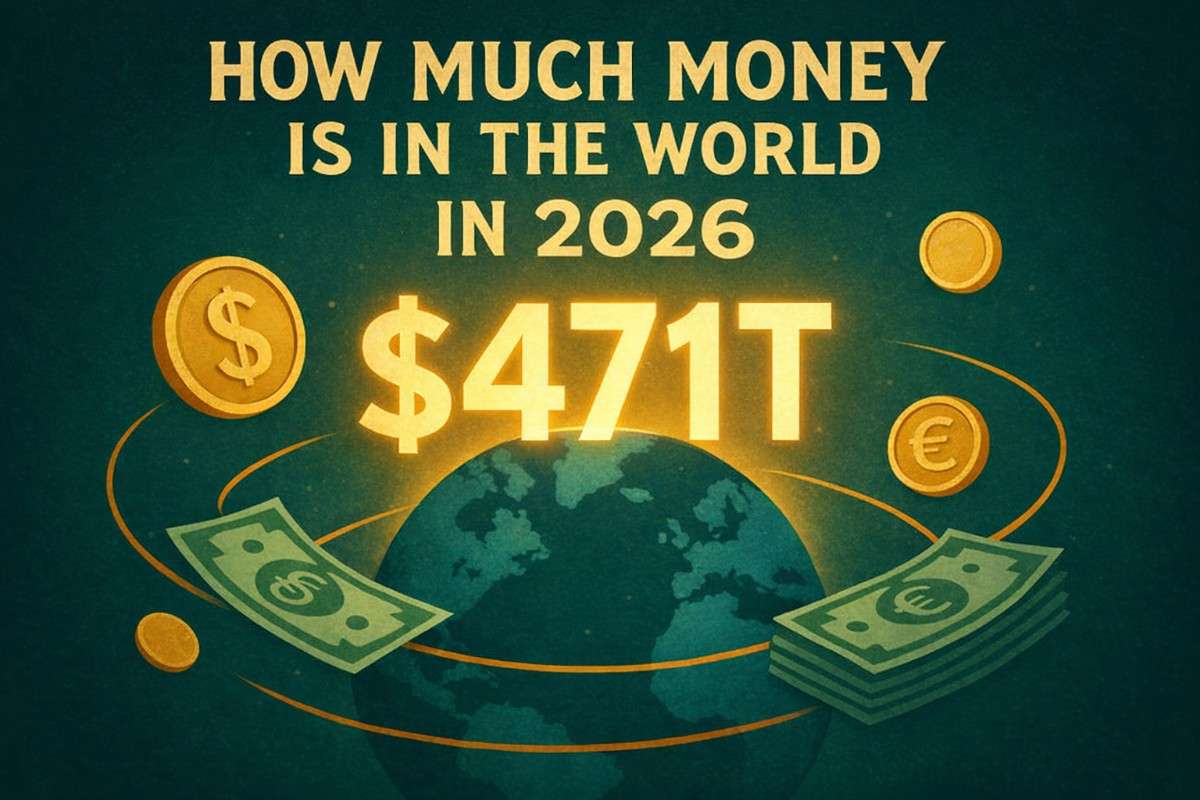
The $470 trillion figure comes from global personal wealth. It includes the value of property, financial assets, pensions, land and business ownership after debt.
This number is much larger because assets can rise in price without creating the same amount of money. A house can double in value, a stock market can climb, and a private company can become more valuable without putting extra cash in the owner’s bank account.
That is why the world can look extremely rich on paper while many households still feel short of money. Wealth measures what people own. Money measures what can move quickly through spending, payments, lending and markets.
Many people picture money as banknotes, coins and vaults. In reality, physical cash is only a small share of modern money.
Most money now exists as bank deposits. Salary payments, savings balances, business accounts, card payments and transfers all depend on money recorded inside the banking system. That is why broad money is more useful than physical cash when estimating how much money exists.
Cash still matters because it supports trust, emergency payments and access outside digital systems. For the global economy, deposits carry more weight because they move faster and support far more transactions.
Debt often gets included because borrowed money creates spending power. A government bond, mortgage, corporate loan or credit line can finance real activity.
Yet debt is not free money. It is money owed by one party and held as a claim by the other. When debt grows too quickly, the pressure shows up in higher interest payments, refinancing risk, and tighter financial conditions.
That is why global debt of nearly $250 trillion should not be added to the money supply as if it were extra cash. It tells us how leveraged the world is, not how much money people can freely spend.
Derivatives are where the numbers become most dramatic. Their notional value can reach hundreds of trillions because contracts are tied to interest rates, currencies, commodities, bonds or equity markets.
Notional value is the face value used to calculate payments. It does not mean that the full amount changes hands. A $100 million interest-rate swap does not mean both sides paid $100 million upfront.
This is where viral claims about “quadrillions of money” usually go wrong. They treat contract size as if it were cash. The result sounds shocking, yet it mixes financial exposure with spendable money.
The world does not have a single monetary number. It has layers. Around $100 trillion is the better answer for broad money because it tracks the liquid money moving through deposits, loans, spending and markets. Around $470 trillion is the better estimate of personal wealth because it includes homes, stocks, pensions, land, and businesses.
Figures above that usually involve debt, derivatives or contract values rather than money ready to spend. When broad money grows, markets have more liquid fuel. When it slows, asset prices need more support from earnings, rate cuts, policy or risk appetite.
The next time a headline claims there is half a quadrillion dollars in the world, check the category before trusting the size of the number.
The direct answer is roughly $100 trillion in broad money. This includes physical cash, bank deposits and savings-style balances, not every asset people own.
Those sources usually count wealth, not money. Wealth includes homes, land, stocks, bonds, pensions and business ownership, so the total is much larger than cash and deposits.
Physical cash is only a small part of global money. Estimates usually place notes and coins in the high single-digit trillions, far below the broader money supply held through banks.
No. Debt is connected to money because borrowing creates spending power, yet it must be repaid. It measures obligations, not free cash.
No. Derivatives are financial contracts. Their notional value can reach hundreds of trillions, yet that figure measures contract size rather than spendable money.
Broad money: StreetStats Global M2 tracker, using major money-supply blocs including the US, euro area, China and Japan.
Global wealth: UBS Global Wealth Report 2025.
Financial wealth: BCG Global Wealth Report 2025.
Global debt: IMF Global Debt Database / IMF debt analysis.
Derivatives: BIS OTC derivatives statistics.
Population: UN World Population Prospects 2024.