Published on: 2026-04-08
Updated on: 2026-04-08
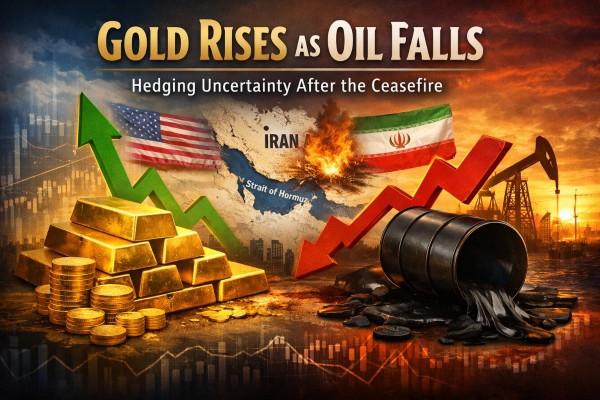
Gold rising while oil falls is not a contradiction. It is the market separating one risk from another.
Gold traded near $4,830 an ounce on April 8, up about 2.6% on the day at the time of writing, while WTI fell to $96.11 and Brent dropped to $94.76 after the U.S.-Iran ceasefire headline and the planned reopening of the Strait of Hormuz.
The gold-to-WTI ratio rose to about 50.3 from roughly 41.7 a day earlier. That roughly 20.6% jump suggests traders are moving from an inflation-shock hedge toward a broader uncertainty hedge.
U.S. macro data still does not support an aggressive easing story. March payrolls rose 178,000, unemployment held at 4.3%, and February CPI rose 2.4% year over year, with core CPI at 2.5%. Gold's bid is therefore not just a rate-cut trade.
Oil may be down hard, but the medium-term energy risk has not disappeared. The EIA indicated that Brent averaged $103 in March and still forecasts Brent peaking at $115 in 2Q26, with April shut-ins reaching 9.1 million barrels per day and 2026 demand growth slowing to 0.6 million barrels per day. That mix supports volatility, not a clean collapse.
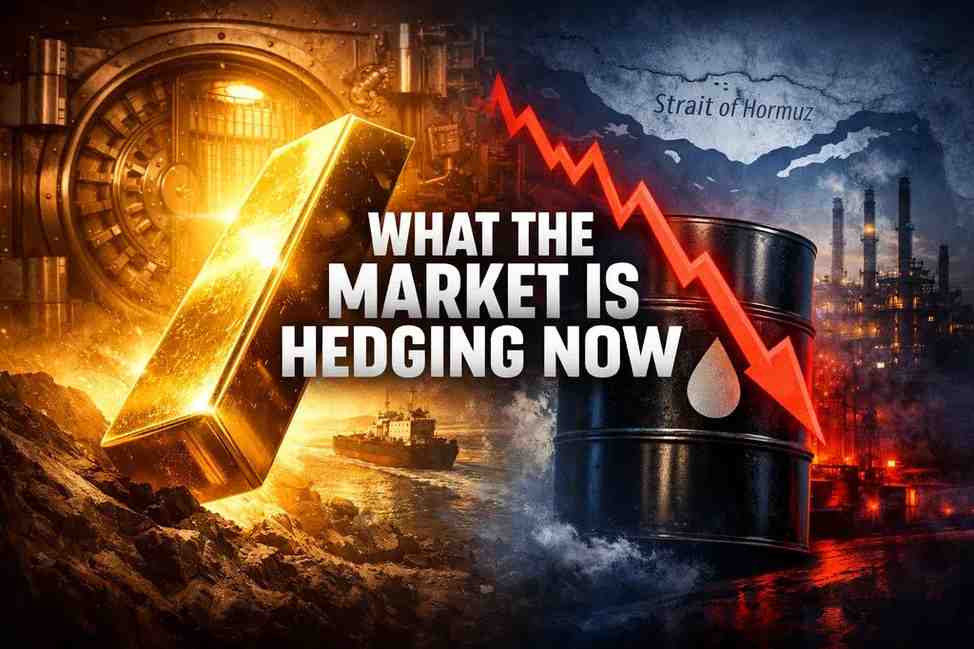
The first hedge is no longer an immediate energy shortage. The Strait of Hormuz carries nearly 20% of global oil supply, so any sign of reopening pulls a large premium out of crude. That is exactly what happened on April 8. Yet this does not mean the oil market is back to normal.
The EIA reported that Brent averaged $103 in March, with daily Brent prices peaking at nearly $128 on April 2. It anticipates Brent averaging $115 in the second quarter of 2026, assuming the conflict does not extend beyond April. The market is removing the most urgent premium, not the full tail risk.
The second hedge is against a policy path that stays messy. Gold typically struggles when real and nominal yields remain firm, yet bullion rose even as recent U.S. data showed no signs of a recession break. That tells you the market is paying for liquidity and confidence protection, not only for lower rates.
The dollar's weakness against the euro and yen after the ceasefire headline added some support, but the main driver still suggests demand for an asset that is not tied to any single central bank, shipping route, or earnings cycle.
The third hedge is structural reserve demand. Gold was not a one-quarter story in 2025. Total demand, including OTC, rose to 5,002.3 tonnes, ETF holdings increased by 801.2 tonnes, and central banks and other institutions bought 863.3 tonnes.
Those numbers matter because they create a stronger floor under dips. When oil prices fall, that helps ease the inflation scare. When central banks and ETF buyers stay active, gold does not need an inflation spike to remain supported.
| Indicator | Latest reading | Recent context | What it signals |
|---|---|---|---|
| Gold | Around $4,830/oz | Around $4,706 on Apr. 7 | Safety demand remains firm |
| WTI | $96.11/bbl | $112.95 implied prior close | Acute war premium is fading |
| Brent | $94.76/bbl | $109.27 implied prior close | Global supply fear is repricing lower |
| Gold-to-WTI ratio | 50.3 | 41.7 one day earlier | Hedge demand is rotating toward bullion |
| U.S. payrolls | +178,000 | March 2026 | Growth is slowing, not breaking |
| U.S. unemployment | 4.3% | March 2026 | No recession panic yet |
| U.S. CPI | 2.4% y/y | February 2026 | Disinflation is progressing, not finished |
| Core CPI | 2.5% y/y | February 2026 | The Fed still lacks a clean all-clear |
| 2025 gold demand | 5,002.3t | Full year 2025 | Structural support for bullion |
The most important signal in the table is the ratio move. A 50.3 gold-to-WTI reading is high by recent standards, and the jump from about 41.7 in one session is unusually large.
It indicates that the market is now hedging uncertainty itself, not just an oil-driven inflation spike. It also says the price of macro insurance is rising faster than the price of energy risk.

Oil has room to fall further if shipping normalizes quickly, because the supply shock was severe and fast. The EIA estimates that shut-ins were 7.5 million barrels per day in March and could rise to 9.1 million barrels per day in April before easing if the conflict does not persist past April.
It also expects Brent to peak at $115 in 2Q26 before falling below $90 in 4Q26 and averaging $76 in 2027. That is why the selloff can continue without implying that volatility is over.
That is the mix behind the current selloff: weaker expected demand growth meets a smaller immediate chance of a blockade.
But crude is not cheap enough to signal a full reset. Even after today's drop, prices remain well above pre-crisis levels, and the EIA still expects Brent at $88 in 4Q26 and $76 in 2027, both above its earlier forecast path. A fragile ceasefire can lower spot prices quickly, but it does not repair tanker routes, insurance costs, or geopolitical trust overnight.
Gold's strategic advantage comes from independence. It does not need strong global growth. It does not need lower policy rates tomorrow. It does not need crude to rise.
It only requires investors, central banks, and reserve managers to keep paying for balance-sheet protection in a world where macro shocks arrive faster than policy can absorb them. The 2025 demand figures show that this support is already in place.
That is why the current divergence is crucial. Falling oil prices are reducing one tax on the global economy. Rising gold is telling you the market still doubts the stability of the next phase. The hedge has shifted from "energy scarcity now" to "headline, policy, and confidence risk still ahead."
Because the market is hedging against different risks, oil is reacting to a smaller near-term supply threat after the ceasefire headline, while gold is keeping a safety premium tied to policy uncertainty, reserve demand, and the risk that de-escalation proves temporary.
No. Lower crude prices reduce one inflation channel, but the U.S. CPI is still at 2.4% year over year, with core CPI at 2.5%. That is better than last year, but it's still not strong enough to eliminate all policy risk.
Yes. The EIA still sees elevated prices through 2026 because shut-ins, inventory draws, and route disruption are not fully resolved.
No. Geopolitics matters, but structural demand matters too. Gold demand totaled 5,002.3 tonnes in 2025, ETF holdings rose by 801.2 tonnes, and central banks and other institutions bought 863.3 tonnes. That gives bullion support beyond the daily news cycle.
Gold rising while oil falls shows that the market is no longer reacting to a single shock. It is marking down a short-term energy scare while still paying for safety, reserve diversification, and policy uncertainty.
That split matters more than the daily headline. The inflation shock hedge is diminishing, but the trust hedge remains costly.
That leaves room for oil to fall on de-escalation while gold remains a bid as a hedge against policy delay, sticky core inflation, and another geopolitical reversal.