Published on: 2026-06-05
Updated on: 2026-06-05
The bond market is where governments, companies, and other groups raise money by selling bonds to investors.
A bond is like a loan you can buy and sell. When you buy a bond, you are lending money to whoever issued it. They pay you interest and return your money at the end. The bond market is huge, and for beginners, its main value is in the clues it gives about interest rates, inflation, economic growth, and risk.
When tech stocks drop as yields go up, it’s often because borrowing gets more expensive. If yields fall during a market sell-off, it usually means investors are seeking safety.
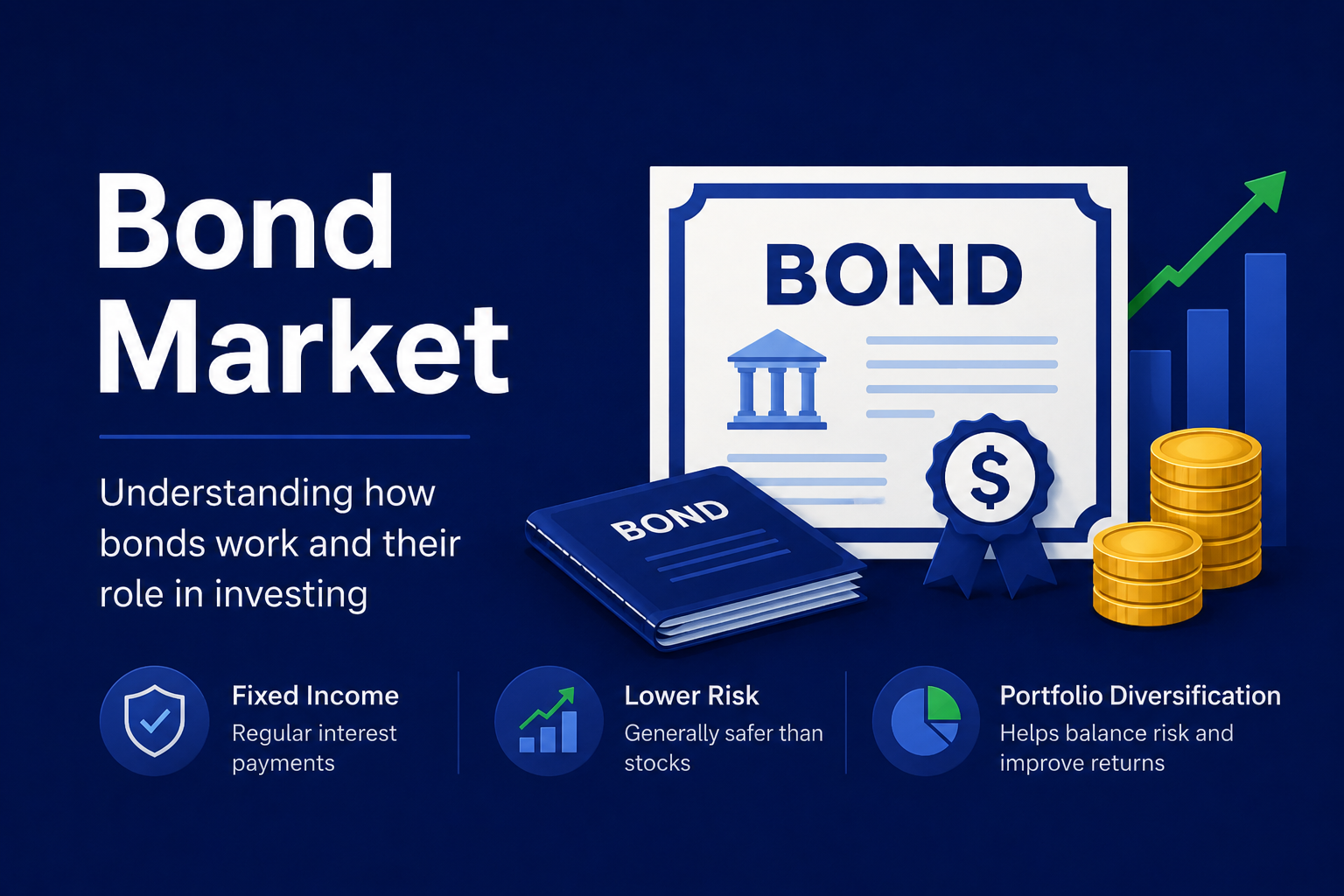
Bonds have four key parts: the issuer (who borrows the money), the principal (the amount borrowed), the coupon (the interest paid), and the maturity date (when the money is paid back).
For example, a $1,000 bond with a 5% coupon pays $50 a year. At maturity, the issuer repays the $1,000, assuming it does not default.
New bonds are sold in the primary market. After that, they trade in the secondary market. Bond prices change based on factors such as inflation, central bank decisions, jobs reports, and market stress.
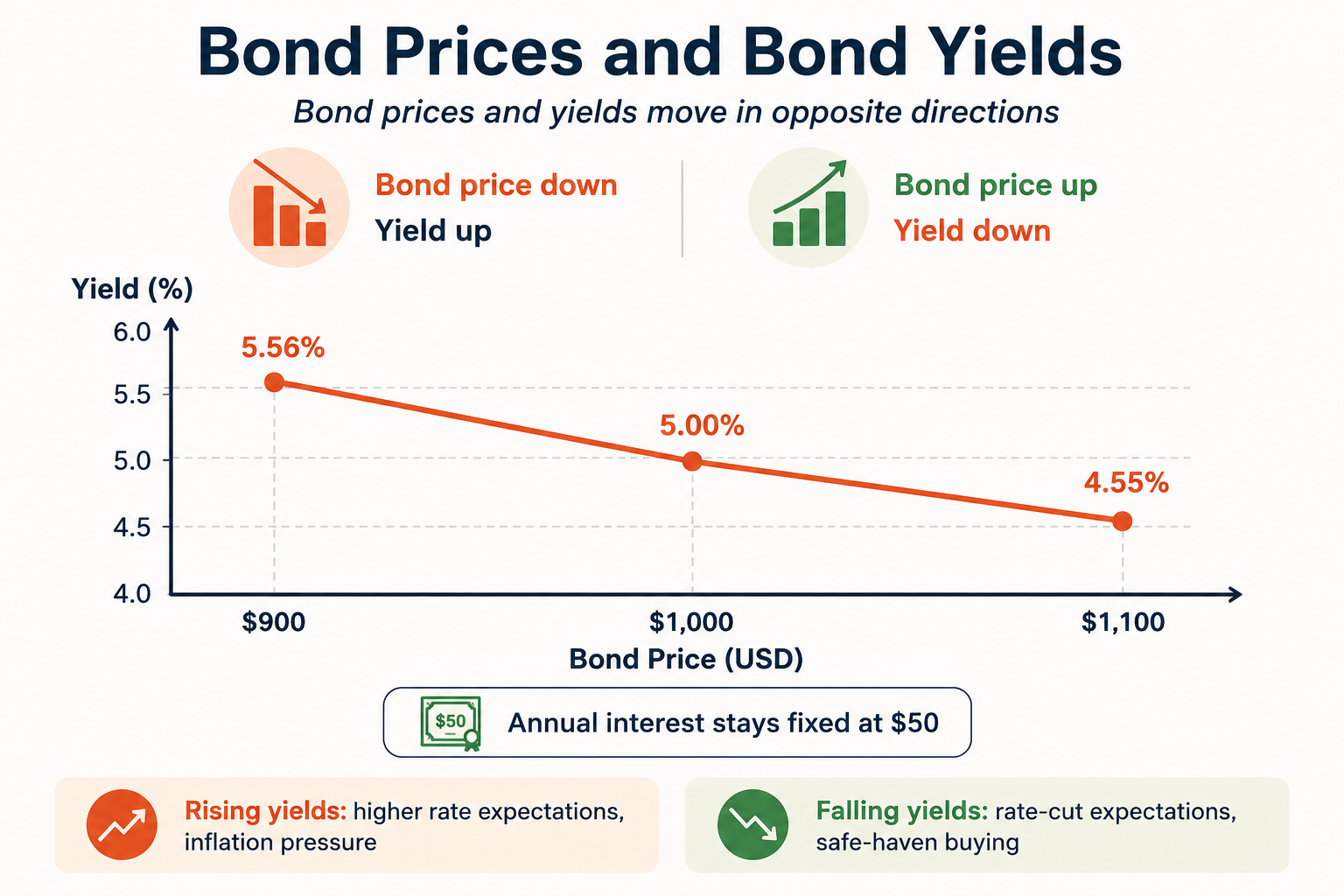
A bond yield is how much you earn from a bond, shown as a percentage. The main thing to remember is that bond prices and yields move in opposite directions.
For example, if a bond pays $50 a year and costs $1,000, the yield is 5%. If the price drops to $900, the yield goes up to about 5.56%. If the price rises to $1,100, the yield drops to about 4.55%.
When yields go up, it can mean people expect higher interest rates, more inflation, or less demand for bonds. When yields go down, it can mean people expect lower rates, slower growth, or seek safety.
Government bonds are often used as benchmarks for borrowing costs. Corporate bonds usually pay more because companies are riskier. Municipal bonds are issued by cities or local governments.
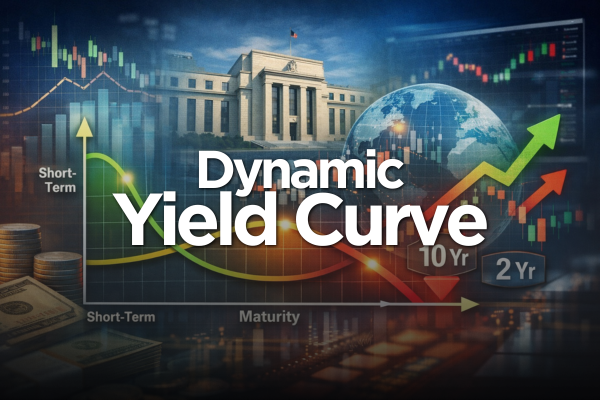
Treasury bills mature in up to a year, notes in two to ten years, and Treasury bonds in longer maturities. Traders often watch the 2-year and 10-year yields to gauge interest rate expectations and economic outlook.
Bond yields impact stocks, currencies, indices, and commodities because they help set the cost of borrowing money.
When yields go up, borrowing costs more. Companies pay more to borrow, consumers see higher loan rates, and stock prices can drop. Growth stocks often fall more because their value depends on future profits.
Currencies also move with yields. If US yields rise faster than Japan’s, the dollar can get stronger against the yen. When investors worry, they often buy safe government bonds, which pushes prices up and yields down.
Government bond yields reflect the return investors require for lending money to a country.
US Treasury yields are watched around the world. The 2-year yield often reflects what people expect from the Federal Reserve. The 10-year yield affects things like mortgages, company borrowing, stock prices, and risk-taking.
The yield curve shows the difference between short-term and long-term yields. If the curve inverts, it can be a warning sign about future economic growth. Credit spreads measure the difference between company bond yields and safer government bond yields. If the gap widens, it usually indicates greater concern about credit risk.
Suppose inflation numbers are higher than expected. Traders might think the central bank will keep interest rates high for longer. Short-term bond yields usually go up first.
Stocks might fall because higher yields make borrowing more expensive and lower the value of future profits. The country’s currency could strengthen if its yields rise faster than those of other countries.
The chain is: hot inflation → higher rate expectations → rising yields → weaker stocks → stronger currency.
Bond Yield: The return earned from a bond, shown as a percentage.
Interest Rates: The cost of borrowing money, influenced by central banks and market conditions.
Treasury Bond: A long-term government bond watched for rate and growth signals.
Yield Curve: A chart showing bond yields across different maturities.
Fixed Income: Investments, such as bonds, that usually provide scheduled payments.
A market where governments and companies borrow money by selling bonds. Traders watch it because yields influence rates, stocks, currencies, and risk sentiment.
They show the return investors demand for lending money. Rising yields can point to inflation pressure or higher rate expectations.
Higher yields can pressure stocks by raising borrowing costs and reducing the value of future earnings.
High-quality bonds are often less volatile, but not risk-free. Bond prices can fall when rates rise, inflation increases, or credit quality weakens.
The bond market is where borrowing costs, interest rates, inflation risk, and credit confidence are set for the world. It is less about memorising bond types and more about reading the signals. Rising yields can explain pressure on stocks. Falling yields can reveal safety demand. Yield curves can warn that growth expectations are changing. Credit spreads can show stress before it reaches the stock market.
If you understand the bond market, you can see the bigger picture in financial markets, not just look at more charts.