Published on: 2026-08-12
An ETF is an investment fund, while an ETN is unsecured debt issued by a financial institution.
ETF returns can differ from their benchmark because of fees, trading costs, cash holdings and replication methods.
ETNs can provide close benchmark-linked returns through a contractual formula, while introducing issuer credit risk.
ETN market prices can deviate from indicative value because of liquidity, supply and demand, issuer credit conditions or changes in issuance.
The central difference is not simply which product tracks better, but where each structure places the additional risk.
An exchange-traded fund (ETF) pools investor capital into a fund designed to provide exposure to an index, portfolio or asset class. Shares trade throughout the market session, while returns come from the assets or instruments used by the fund to reproduce its target exposure. Depending on its structure, an exchange-traded fund may hold the underlying securities directly, use representative sampling or employ synthetic replication.
An exchange-traded note (ETN) is an unsecured debt security issued by a bank or another financial institution. Rather than giving the holder an interest in a fund portfolio, the ETN creates a contractual obligation under which the issuer promises a return linked to a specified benchmark, subject to fees and the terms of the note.
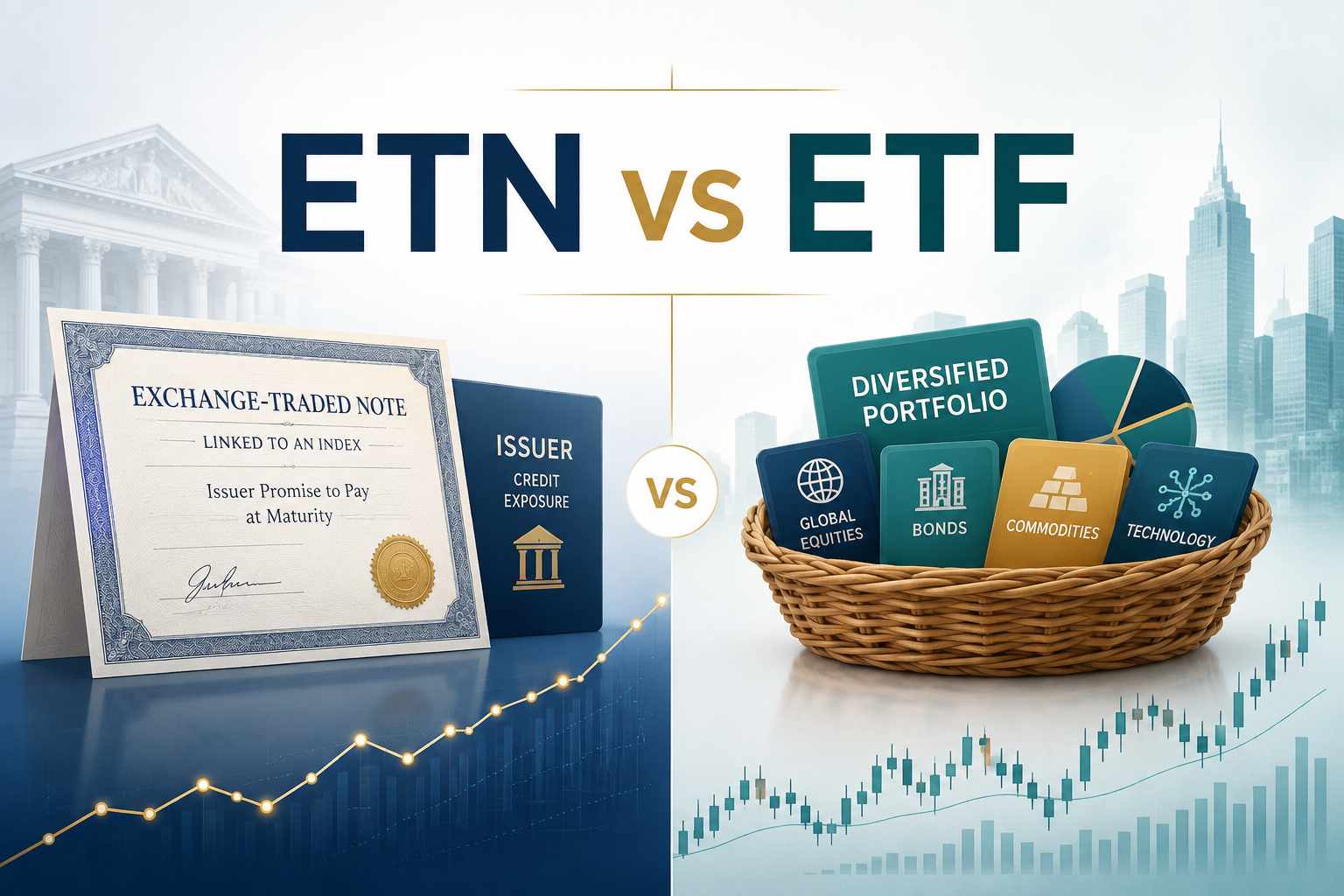
This structural difference explains most of the distinctions between the two products.
| ETF | ETN | |
|---|---|---|
| Structure | Investment fund | Unsecured debt security |
| Return source | Portfolio or replication strategy | Contractual benchmark-linked return |
| Issuer credit risk | Not the defining structural risk | Yes |
| Benchmark tracking | Can differ because of costs and replication | Usually follows its stated return formula closely |
| Maturity | Generally no fixed maturity | Often has a maturity date |
| Underlying assets | Held directly or exposure replicated synthetically | ETN itself does not hold a fund portfolio backing the benchmark |
| Exchange trading | Yes | Yes |
| Call or early redemption | Generally not an issuer call feature | May apply depending on the note |
The products can therefore appear almost identical on a trading screen while exposing the holder to different mechanisms underneath.
An ETF produces its return through a fund structure. A physically replicated equity ETF, for example, may own all the shares represented in an index. Other funds may hold a representative sample, while synthetic ETFs can use derivatives and counterparties to reproduce the intended return.
Large financial institutions known as authorised participants can create and redeem ETF shares in large blocks. This mechanism helps keep the ETF’s market price close to the value of its underlying portfolio, although premiums and discounts can still occur. ETF liquidity therefore depends on more than the number of shares changing hands on an exchange; the liquidity of the underlying assets and the creation-redemption process also influence how efficiently the fund trades.
Neither mechanism guarantees an exact benchmark return. Management fees, transaction costs, rebalancing, cash holdings and replication choices can all influence performance.
The gap between the ETF’s return and its benchmark over a given period is known as tracking difference. Tracking error is related but technically distinct: it measures how variable those return differences are over time.
Two ETFs tracking the same index can therefore produce different results even when both operate as intended. Fees, taxes, portfolio implementation and trading costs, for example, contribute to the tracking differences between XEQT and VEQT.
An ETN replaces portfolio replication with a debt obligation.
The issuing institution sets out a formula linking the value or redemption amount of the note to a reference index or benchmark. The ETN itself does not need to own the shares, futures contracts or other assets represented by that benchmark, although the issuer may separately hedge its own exposure.
Consider an ETN linked to an index that rises 10% over a specified period. If its terms call for the index return less a hypothetical 0.75% fee, the contractual return would be approximately 9.25% before any other adjustments specified in the product documentation.
The holder is relying on the issuer to honour that obligation.
ETNs also commonly publish an indicative value, which reflects the theoretical value of the note based on the reference benchmark and its contractual formula. It provides a useful reference point, although it does not guarantee that the ETN can always be bought or sold at that price.
The issuer therefore sits directly inside the investment structure. If its creditworthiness deteriorates, the ETN can lose value even when the underlying benchmark performs as expected. In an issuer default, ETN holders are unsecured creditors and may recover less than the benchmark-linked value of the note.
The most important structural trade-off between ETFs and ETNs is how benchmark exposure is produced.
An ETF has to translate an index into an investable portfolio or replication strategy. That process introduces costs and operational choices, creating the possibility that the return delivered by the fund will differ from the benchmark.
An ETN can remove much of this portfolio-replication friction because its return is calculated contractually rather than produced by a fund attempting to hold or reproduce the index.
Suppose a benchmark rises 8%. An ETF may return 7.6% after fees, transaction costs and other replication effects. An ETN linked to the same benchmark may calculate a return closer to 8% after its stated fee, but payment still depends on the financial institution standing behind the note.
ETNs therefore do not remove risk in exchange for closer benchmark alignment. They shift part of the risk from portfolio replication to the issuer’s balance sheet.
Because an ETN does not require a fund portfolio to reproduce an index, it can avoid much of the tracking difference caused by portfolio construction, rebalancing and transaction costs. Its contractual return can therefore remain closely tied to the benchmark formula.
The exchange price of the ETN is a separate issue.
ETNs trade on the secondary market, where price is influenced by liquidity, supply and demand, changes in issuer creditworthiness and the availability of new notes. An ETN can consequently trade above or below its indicative value even when its contractual return continues to follow the benchmark correctly.
Issuance can be particularly important. If an issuer suspends the creation of additional notes while demand remains strong, limited supply can push the ETN to a premium over indicative value. A later resumption of issuance, weaker demand or changing market conditions can cause that premium to contract quickly.
Two forms of alignment should therefore be considered separately:
Benchmark alignment refers to whether the contractual value of the ETN behaves as specified relative to the reference benchmark.
Market-price alignment refers to whether the ETN’s exchange price remains close to its indicative value.
An ETN can perform well on the first measure while experiencing significant deviations on the second. Close contractual tracking does not remove secondary-market pricing risk.
ETNs can be effective when an index is expensive or operationally difficult to replicate through a conventional fund.

Commodity indexes provide a useful example. A futures-based fund may need to hold collateral, replace expiring contracts, rebalance exposures and absorb transaction costs. The return ultimately received can therefore differ materially from movements in the underlying spot market.
Futures curves add another layer. During contango, replacing an expiring futures contract with a higher-priced later-dated contract can create a recurring drag on performance. These mechanics help explain why different commodity fund structures can produce materially different results even when they appear to target the same market.
An ETN can instead link its return directly to the specified index calculation without requiring the note itself to maintain the corresponding portfolio. This can make the structure useful for certain commodity indexes and other specialised strategies where direct replication introduces substantial operational friction.
The potential benefit in benchmark replication does not remove the need to assess the note itself. Issuer quality, fees, maturity provisions, liquidity, redemption terms and issuance conditions all influence the final risk profile.
ETN liquidity can vary significantly between products. A lightly traded note may develop a wide bid-ask spread, while an issuance suspension can restrict supply and create a premium that has little to do with movements in the underlying benchmark. Selling before maturity may therefore produce a substantially different result from the benchmark return shown on paper.
Maturity also distinguishes many ETNs from conventional ETFs. Some notes are issued with long maturity dates, while others include call or early-redemption provisions that allow the issuer to terminate the product under specified conditions. The expected holding period therefore needs to be considered alongside the terms of the individual note.
Fees can also materially affect long-term ETN returns. Even a modest annual charge compounds over a long holding period, while some ETNs apply additional financing costs or more complex fee formulas. The product’s pricing supplement or prospectus therefore needs to be considered alongside the benchmark methodology.
Two ETNs linked to the same index are consequently not interchangeable. Differences in issuer credit quality, maturity, call terms, liquidity, fees and issuance conditions can produce materially different outcomes.
Both products remain exposed to movements in the market they are designed to track. A falling equity index, for example, can reduce the value of either an equity ETF or an ETN linked to that index. Their additional structural risks differ.
An ETF can underperform its benchmark because of expenses and implementation, while its market price can temporarily trade at a premium or discount to net asset value. The quality of the portfolio, underlying liquidity, costs and replication method therefore form a large part of the analysis.
An ETF also does not carry the same direct issuer-credit exposure inherent in an unsecured ETN, although individual ETF holdings, derivatives or counterparties may introduce their own credit risks.
An ETN requires the same assessment of the underlying market exposure alongside a separate examination of issuer creditworthiness, maturity terms, call provisions, indicative value and secondary-market liquidity. Strong benchmark performance cannot compensate for an issuer that is unable to meet its obligations.
Neither structure is universally safer. The relevant risks depend on how the exposure is constructed and which structural weaknesses are most significant under the intended holding conditions.
No. An ETF is an investment fund, while an ETN is an unsecured debt security issued by a financial institution. Both can trade on exchanges and track similar benchmarks, but their legal structures and additional risks differ.
The ETN itself generally does not hold a fund portfolio containing the assets represented by its benchmark. Its return is determined by a contractual formula. The issuing institution may hedge its exposure separately, but those hedges do not turn the ETN into an asset-backed investment fund.
ETN holders are exposed to the creditworthiness of the issuer because the note represents an unsecured obligation. If the issuer defaults or cannot meet its liabilities, holders may lose part or potentially all of the amount owed regardless of the performance of the reference benchmark.
Many ETNs are issued with a stated maturity date. Some also contain call or early-redemption provisions that allow the issuer to terminate the note under specified conditions, making the individual product terms important when assessing the expected holding period.
Yes. Supply and demand, liquidity, changes in issuer credit conditions and decisions to suspend or resume issuance can cause an ETN’s exchange price to move above or below its indicative value. Large deviations can increase the risk of buying at a premium that later disappears.
With an ETF, the difference generally arises inside the fund. Fees, portfolio construction, trading costs, cash holdings and replication choices can leave the realised return slightly above or below the index it is designed to follow.
With an ETN, portfolio replication becomes less central. The analysis shifts toward the financial institution promising the return, the contractual formula, maturity and call terms, liquidity, and whether the market price remains aligned with indicative value.
An ETN may therefore offer cleaner benchmark-linked mechanics without offering a simpler risk profile. It exchanges part of the ETF’s replication problem for credit and structural exposure. Comparing the two requires moving beyond the benchmark itself and examining how the return is actually being delivered.