Published on: 2026-04-07
Updated on: 2026-04-07
Key Takeaways
Delta is the first major U.S. airline to provide updated insight into travel demand after the recent oil shock.
Guidance matters more than the quarter itself, as fuel costs are rising faster than fare adjustments.
Delta enters the report with stronger demand quality than many rivals, supported by premium travel, loyalty revenue, and a more resilient business mix.
Wall Street expects Delta to deliver adjusted profitability and solid revenue growth, keeping the focus on whether demand stayed firm through March.
Options markets are pricing in a meaningful post-earnings move, suggesting investors see this report as a major event for both Delta and the wider airline sector.
This DAL earnings preview is more significant than a typical airline earnings release. Delta Air Lines will report first-quarter 2026 results on April 8 at 10:00 a.m. ET, becoming the first major U.S. carrier to show how the sector is responding to the recent oil shock.
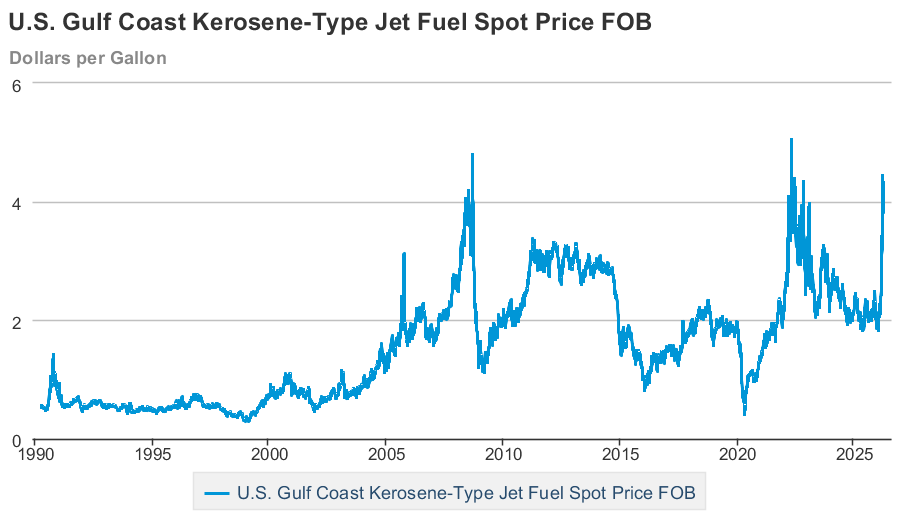
That timing is critical. U.S. crude has stayed above $110 as the Strait of Hormuz crisis keeps energy markets tight, while the latest official U.S. Gulf Coast jet fuel spot data shows prices still above $4 per gallon heading into April.
For airlines, this marks the difference between a strong quarter and one under significant pressure.
Delta’s January outlook for the March quarter called for revenue growth of 5% to 7%, adjusted operating margin of 4.5% to 6%, and adjusted EPS of $0.50 to $0.90.
On March 17, management raised its first-quarter revenue growth outlook to 7% to 9% and said earnings should still land within the initial guidance range.
| Metric | Delta company view | Current market expectation | March 2025 actual | Why it matters |
|---|---|---|---|---|
| Adjusted EPS | $0.50 to $0.90 | $0.59 | $0.46 | Shows how much fuel inflation hit profits |
| Total revenue | $15.0B to $15.3B | $15.08B | $13.0B adjusted | Tests demand and pricing power |
| Revenue growth | 7% to 9% | About 7% | 3.3% adjusted growth | Shows whether March momentum held |
| Adjusted operating margin | 4.5% to 6.0% | Not uniform across providers | 4.6% | Measures cost discipline |
| Expected stock move | Not guided | About 7% either way | Not applicable | Signals event risk into guidance |
Analysts currently expect adjusted EPS of $0.59 on $15.08 billion in revenue, with options markets suggesting a potential 7% move in either direction following the report. This indicates that the quarter is not viewed as routine.
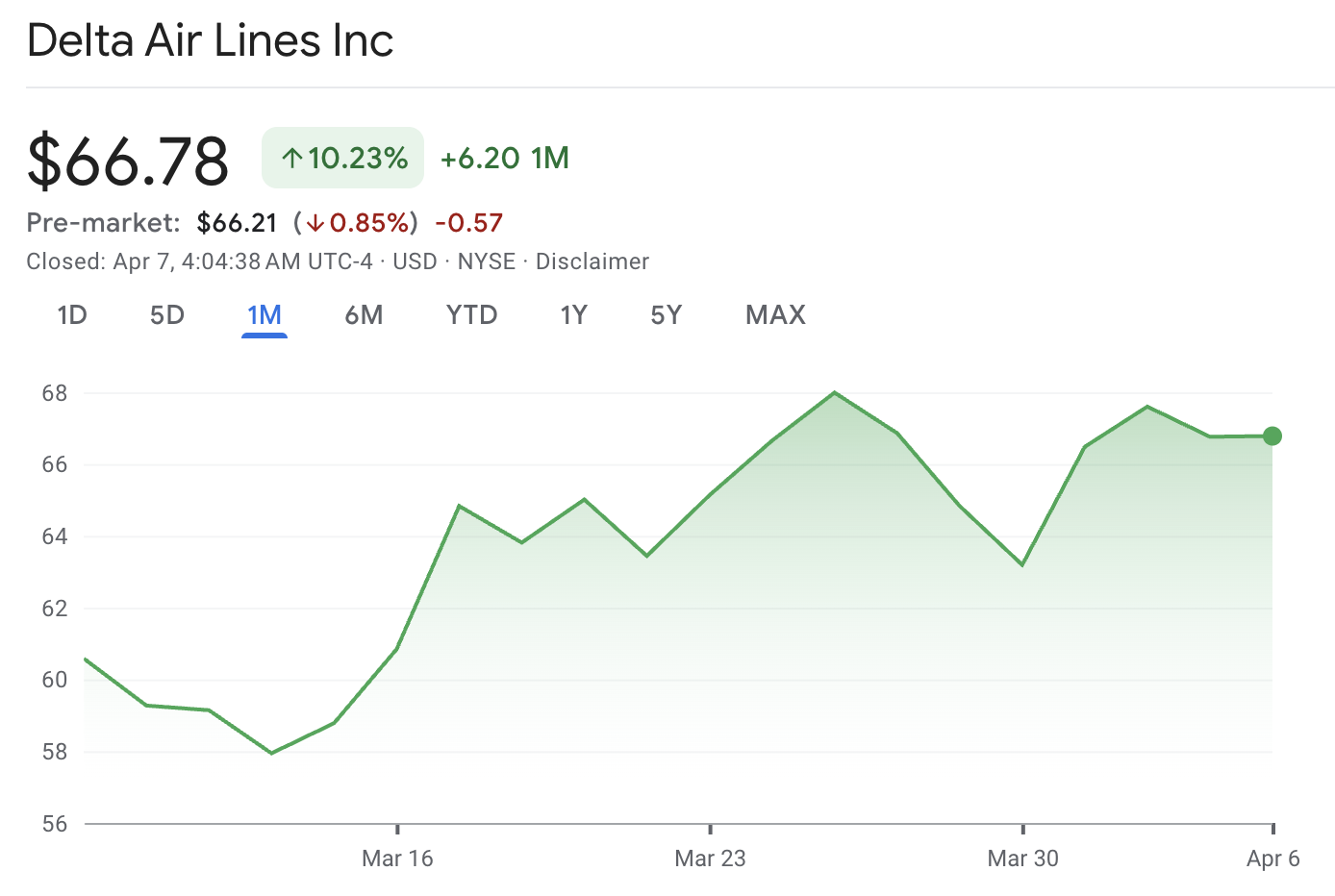
Delta is not only reporting earnings; it is doing so in a quarter when investors are focused on two key questions: the strength of demand through March and the extent to which the industry can absorb higher fuel costs before margins are affected.
Delta’s March update indicated that both consumer and corporate trends accelerated, with strong performance across main cabin, premium, loyalty, and MRO revenue.
Management also noted that the industry is acting quickly to recover higher fuel costs and that Delta is maintaining capacity flexibility should fuel prices remain high.
The airline story changed fast once energy prices broke higher. WTI was reported at $110.99 on April 6, after a recent high of $111.54, while official EIA data shows U.S. Gulf Coast jet fuel reached $4.348 per gallon on March 27 and was still $4.237 on March 30, with the next government update due April 8.
That matters because fuel was already a large cost line before the latest shock. Delta’s 2025 annual report said fuel accounted for about 17% of operating expenses last year.
Typically, airlines can offset some of this pressure through fare adjustments, product mix, and capacity management. However, during a rapidly evolving oil crisis, these measures are less effective due to timing lags.
This pressure is tangible. Barron’s reported that jet fuel prices have surged approximately 70% since the onset of the Iran conflict, and fuel uncertainty is already weighing on airline stocks. As a result, this Delta earnings preview serves as a true test of margin resilience.
Delta does have real cushions. In its March 2025 quarter, premium revenue grew 7% year over year, and American Express remuneration reached a March-quarter record $2.0 billion, up 13%.
This is significant because premium and loyalty revenue are generally more resilient than the most price-sensitive segments of the main cabin.
Delta also began 2026 from a position of strength, reporting $58.3 billion in non-GAAP revenue for 2025, $5.82 in adjusted EPS, $4.6 billion in free cash flow, and an adjusted debt-to-EBITDAR ratio of 2.4x at year-end.
Management said 2026 had started strongly and guided to full-year EPS of $6.50 to $7.50 back in January.
Additionally, Delta’s Monroe Energy subsidiary allows the company to source aircraft fuel from its Trainer refinery. While this does not make Delta immune to the crisis, it provides a supply and refining advantage over many competitors.
The options market suggests Delta’s earnings report is not being treated as a routine airline update.
A widely cited options-based estimate points to a move of about 7% in either direction after the results, while another options analytics provider showed an expected move of 10.5% for the reporting week. For traders, the main point is simple:
Options are pricing volatility, not certainty
The market expects a notable move, but it does not signal direction.
Guidance may matter more than the headline beat.
Analysts already expect about $0.59 in adjusted EPS on $15.08 billion in revenue, so the bigger swing factor may be management’s tone on fuel, summer demand, and full-year guidance.
Delta’s report could reset airline expectations.
Because Delta reports before Alaska, United, and Southwest later this month, its commentary may shape how traders price the rest of the sector.
In practice, this means the options market is treating Delta less like a standard earnings report and more like an early-sector stress test.
A simple beat may not be enough. Investors will closely monitor whether Delta maintains its full-year guidance, narrows its guidance range, or adopts a more cautious stance amid volatile fuel prices.
This is important because some analysts have suggested that airlines may need to widen or suspend guidance if fuel costs remain unstable.
Traders should focus on three points in particular:
How much of March's strength came from pricing versus demand
Investors will seek to determine whether revenue growth resulted from higher fares or sustained travel demand.
Whether premium and loyalty are still leading growth
Delta’s premium cabin and loyalty business have supported margins. Traders will look for confirmation that these segments continue to outperform the rest of the network.
Whether Delta can pass higher fuel costs to customers without negatively impacting bookings
This may be the most important question for the summer outlook. If Delta sees room to offset fuel pressure through pricing, the market may view the guidance as more durable.
Delta’s March conference presentation highlighted strong demand momentum, and management noted that the industry is acting swiftly to recover higher fuel costs. This message will likely be reiterated during the earnings call.
In summary, this report is less about Delta’s quarterly performance and more about its ability to maintain its 2026 outlook amid a challenging fuel environment.
Possibly. While Delta is still exposed to higher market fuel costs, its Monroe refinery and stronger premium mix provide more protection than many competitors.
Guidance is more important. While the quarter reflects March demand strength, the outlook informs investors whether fuel pressures are developing into a broader margin issue.
Partly. Airlines can increase fares and adjust capacity, but rapid fuel price spikes often outpace their ability to adjust fares. This makes margin commentary especially important.
Because Delta reports before other major U.S. carriers, it provides the market with the first direct insights into demand, fares, and fuel risk during the current oil shock.
Delta’s first-quarter report comes at a challenging time for airlines but an opportune moment for investors. Demand remained strong through March, but oil above $110 and jet fuel above $4 have altered margin dynamics across the sector.
Delta retains significant strengths in premium, loyalty, balance sheet quality, and refinery-linked fuel access. The key question is whether these advantages are sufficient to maintain guidance as the oil crisis unfolds.
Disclaimer: This material is for general information purposes only and is not intended as (and should not be considered to be) financial, investment or other advice on which reliance should be placed. No opinion given in the material constitutes a recommendation by EBC or the author that any particular investment, security, transaction or investment strategy is suitable for any specific person.