Published on: 2026-04-03
Updated on: 2026-04-03
Applied Optoelectronics (AAOI) jumped roughly 20% on April 2, 2026, after announcing a new $71 million order for 800G single-mode data center transceivers from a major hyperscale customer. Total orders from this single customer have reached $124 million since mid-March 2026.
AAOI has guided for over $1 billion in revenue and over $120 million in non-GAAP operating profit for full-year 2026, up from $455.7 million in revenue in 2025. In its March 9 release, management also said it expects to produce more than 500,000 combined 800G and 1.6T transceivers per month by the end of 2026.
AAOI stock closed at $103.91 on April 2, up 20.3% on the day and 588.6% over the past 52 weeks. Following that move, the stock was trading at approximately 17.8x trailing EV/sales, which corresponds to around 8.1x management's minimum revenue guidance for 2026, projected to exceed $1 billion. Therefore, the shares are no longer obviously cheap on a sales multiple basis.
The biggest risk is still customer concentration. In its 2025 10-K, AOI reported that its top 10 customers accounted for 96.6% of revenue, with Digicomm and Microsoft together making up 81.9% of that total. The company also notes that it typically relies on recurring purchase orders rather than long-term contracts.
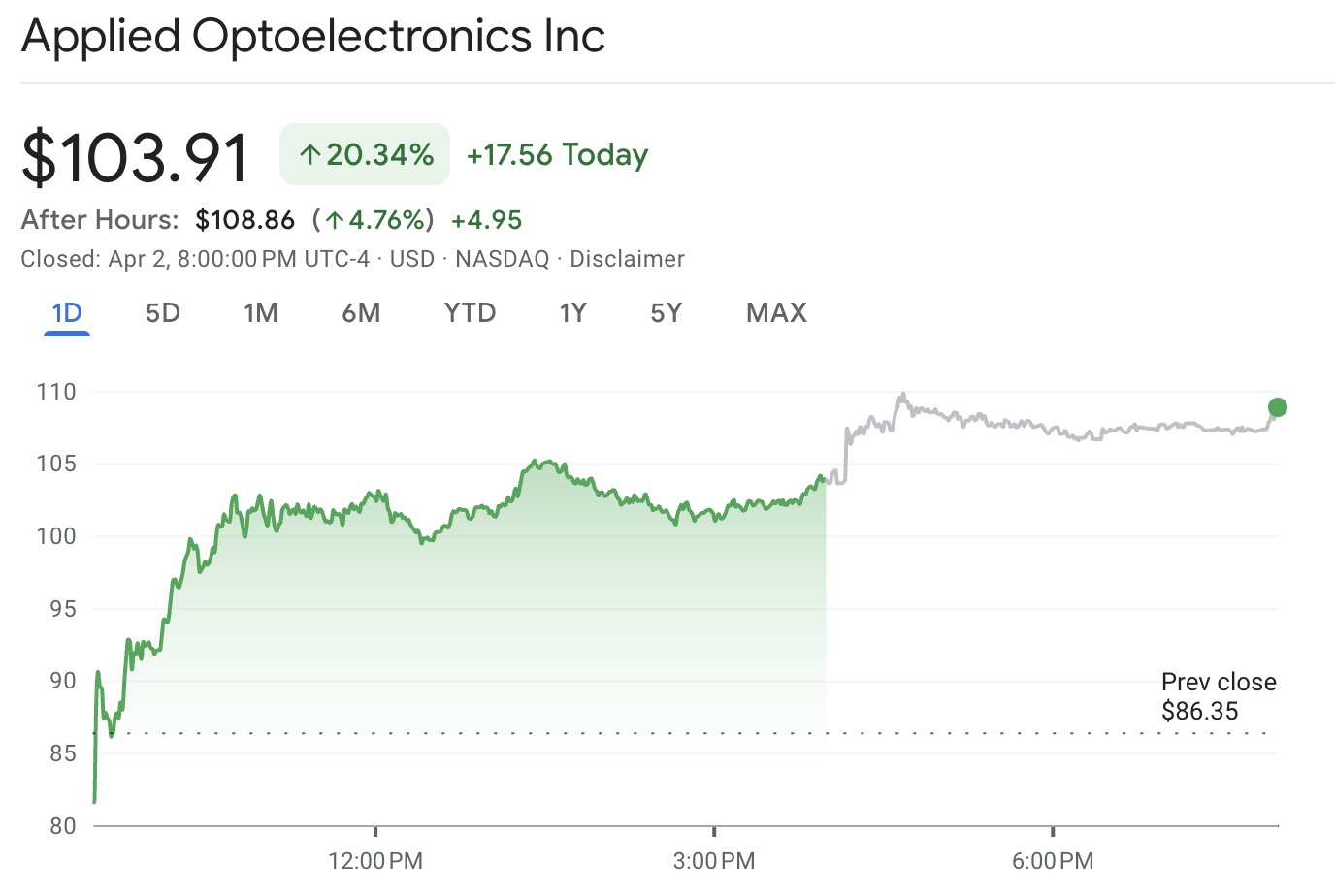
From a momentum standpoint, the easy repricing happened fast. A roughly 20% one-day surge compresses near-term upside and raises volatility risk. From an earnings-cycle perspective, the timing of this move may still be premature.
Management has projected Q1 revenue to be between $150 million and $165 million. Furthermore, they anticipate generating over $1 billion in revenue for 2026, along with more than $120 million in non-GAAP operating profit.
If the March order cadence converts into repeat shipments, the market will focus less on whether AAOI caught one contract and more on whether it has entered a multi-quarter 800G and 1.6T revenue cycle.
The main restraint is execution risk. The customer remains unnamed. AOI disclosed a transaction agreement and warrant with Amazon for 2025, related to commercial arrangements and purchase commitments; however, this does not confirm that Amazon is the buyer for the orders placed in March and April.
That distinction matters because concentration is already extreme. In its 2025 10-K, AOI said Digicomm represented 53.1% of revenue, Microsoft represented 28.8%, and the top 10 customers accounted for 96.6% of total revenue. AAOI now has a stronger product story, but the stock still carries concentration and capacity risk that larger peers can absorb more easily.
| Date | Event | Disclosed value | Why it matters |
|---|---|---|---|
| Mar. 9, 2026 | First volume 1.6T order from long-term hyperscale customer | >$200M | Signals next-generation AI cluster demand and return of a 10%+ customer |
| Mar. 23, 2026 | Initial 800G order from same customer | >$53M | Shows the ramp is not limited to 1.6T and starts Q2 shipments |
| Apr. 2, 2026 | New upsized 800G order | $71M | Takes 800G orders from that customer to $124M since mid-March and more than doubles backlog from that account |
| Q4 2025 base | Total revenue / Datacenter revenue / Non-GAAP GM | $134.3M / $74.9M / 31.4% | Shows the company entered the order cycle with improving mix and margins |
*Source data from company releases and company presentations; ratios are calculated from disclosed figures.
In our analysis of AAOI's March disclosures, the critical change is sequencing. On March 9, the company announced its first order for 1.6 terabits from a long-term major hyperscale customer, valued at over $200 million. Then, on March 23, it secured an initial order for 800 gigabits from the same customer, worth more than $53 million.
On April 2, it disclosed a new $71 million 800G order and said the latest award alone would more than double the existing backlog from that customer. That is the pattern institutions want to see: qualification, initial deployment, then follow-on scale.
This is why AAOI stock reacted so sharply. The new order is worth about 45.1% of the midpoint of AAOI's Q1 revenue guidance, and the $124 million of 800G orders since mid-March equals about 78.7% of that midpoint. For a company that is still smaller compared to larger optics peers, that level of order density can quickly change near-term utilization, product mix, and operating leverage.
The operating detail that matters most is vertical integration. AAOI states it operates a fully in-house laser fabrication facility in the United States, and its investor materials indicate a broader manufacturing presence in Houston, Taipei, and Ningbo. That matters because the company is trying to scale output and automation simultaneously, not just add final assembly.
Management's own capacity plan is the cleaner way to frame the upside. In the March 9 release, AOI said it expects combined 800G and 1.6T transceiver production to exceed 500,000 units per month by the end of 2026.
In its investor presentation, the company outlined a ramp that takes 800G OSFP capacity from 138,000 units per month in Q2 2026 to 550,000 by Q2 2027, while 1.6T OSFP capacity rises from 10,000 to 230,000 over the same period. That is the operating lever to watch more than any single headline order.

Anyone who has followed AAOI for long enough remembers 2017. That year, AAOI stock rose above $100 due to demand for 100G transceivers from Amazon. Amazon changed its procurement strategy, resulting in a market flood of cheaper alternatives from Chinese manufacturers, causing AAOI to collapse. By early 2023, it was trading near $2.
The structural difference this time is that 800G and 1.6T transceivers carry higher technical barriers to entry than 100G modules did. Vertical integration in laser manufacturing is harder to replicate. And the AI data center buildout is creating a supply deficit, not a surplus. McKinsey projects that 800G transceiver production could fall 40% to 60% short of demand through 2027.
That said, the parallels serve as a warning. AAOI has been here before: rapid order growth, a surging stock price, and a dependence on a handful of customers. The 2017 cycle ended when procurement shifted. The risk has not disappeared; it has just taken a different form.
After the April 2 move, AAOI stock was no longer trading like a deep-discount optics name. Public market data indicated a market capitalization of approximately $8.07 billion and an enterprise value of around $8.11 billion at market close. With a projected 2025 revenue of $455.7 million, this results in a trailing EV/sales ratio of about 17.8x. In relation to the management's minimum revenue goal of over $1 billion for 2026, the EV/sales ratio is approximately 8.1x.
On the same date, Coherent had an enterprise value-to-sales (EV/sales) ratio of approximately 8.4 times, while Lumentum's ratio was approximately 29.1 times. That does not kill the bull case, but it does change the debate.
The more relevant question is no longer whether AAOI looks cheap against stale sales multiples. It is whether management can convert backlog into repeat shipments, sustain gross margin, and narrow the gap between non-GAAP progress and GAAP profitability.
The risk premium still exists for good reasons. AAOI remains GAAP-loss-making; the share count is up 44.9% year over year; the company expanded its at-the-market program to $500 million in March; and the five-year beta is 3.27. If management meets its 2026 targets, the upside case can still be achieved, but the stock is already pricing in much of that execution.
Because the market treated the new $71 million 800G order as proof of production-scale demand rather than another pilot headline.
AAOI has not disclosed the customer name. Analysts may speculate, but the company has not confirmed any identity for the March 23 or April 2 800G orders. The 2025 Amazon warrant agreement also does not prove that Amazon is the buyer behind those recent orders.
No. AAOI reported a GAAP net loss of $38.2 million for full-year 2025 and a loss of $2 million in Q4 2025. However, management has guided for over $120 million in non-GAAP operating profit in 2026 if the production ramp goes as planned.
Customer concentration. In its 2025 10-K report, AOI stated that, combined, Digicomm and Microsoft accounted for 81.9% of revenue, while the top 10 customers accounted for 96.6% of total revenue. The order flow is strong, but procurement concentration remains a risk even in a better cycle.
The $71 million order confirms that AAOI's 800G qualification is converting into repeat volume from the same buyer, which is the pattern institutions want to see before assigning a full-cycle revenue multiple.
Backlog is building, the production ramp is underway, and management's 2026 revenue target of more than $1 billion looks more plausible than it did a month ago. But this is still a company that has not produced a full-year GAAP profit, carries extreme customer concentration, and has already re-rated sharply.
As of the close on April 2, the stock has increased by 588.6% over the past 52 weeks. For new investors, the key upcoming points to watch are the execution of Q2 shipments, the progress on profit margins, and the next earnings release, rather than more speculation about customer names. The investment thesis remains valid, but there is little room for error.
Disclaimer: This material is for general information purposes only and is not intended as (and should not be considered to be) financial, investment or other advice on which reliance should be placed. No opinion given in the material constitutes a recommendation by EBC or the author that any particular investment, security, transaction or investment strategy is suitable for any specific person.