Published on: 2026-09-14
Updated on: 2026-09-14
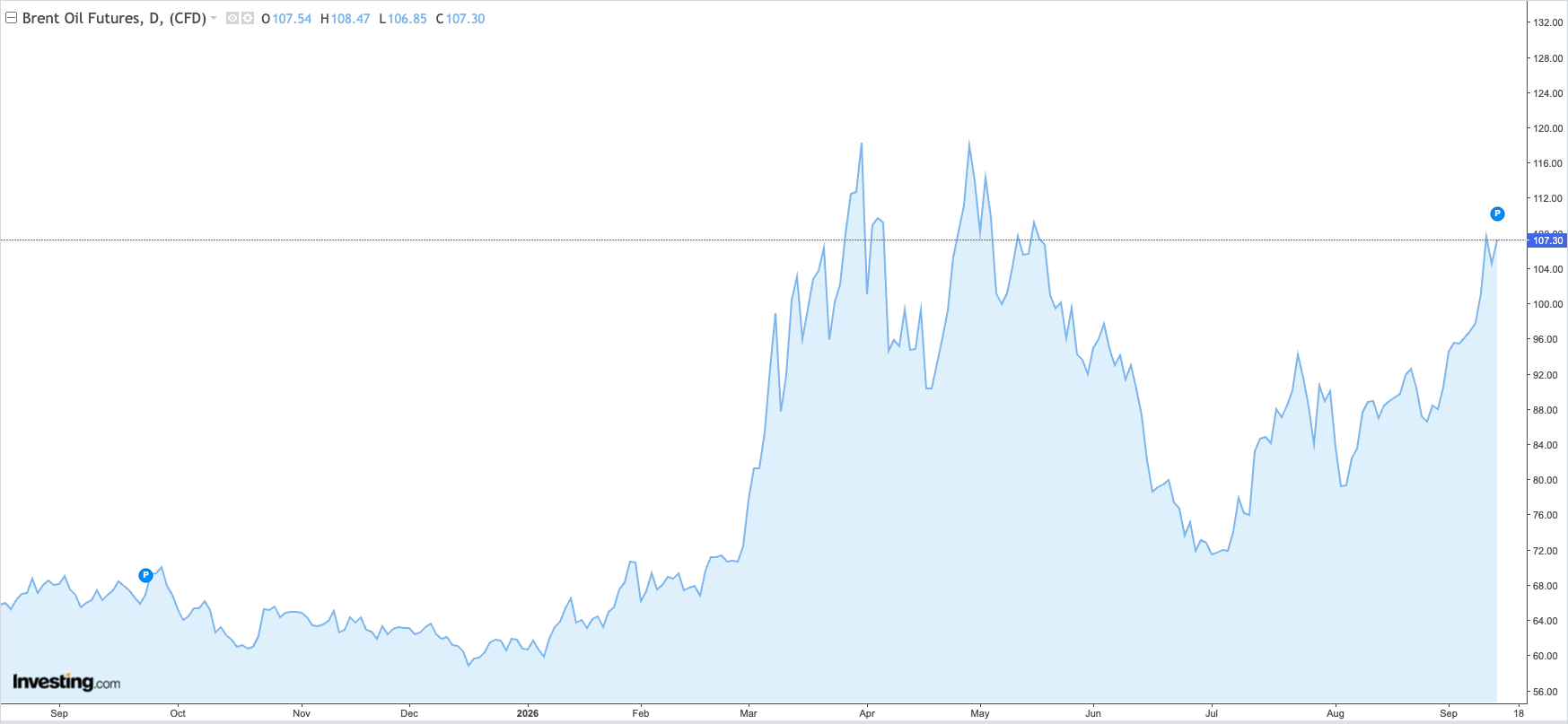
Brent crude climbed back above $107 on Monday with Saudi Arabia’s East-West Pipeline still shut after last week’s incidents. The international benchmark traded around $107.51 a barrel, up 2.77%, while WTI added 2.27% to $102.32 after opening more than 3% higher. Riyadh has released no damage assessment and no restart date.
The line had been carrying 4 million to 5 million barrels a day before it closed, according to ship-tracking companies and analysts, or 4% to 5% of world supply. How much of that has genuinely been held back, and for how long, is what Brent is now attempting to price.
The Saudi Energy Ministry confirmed the shutdown on Friday, describing it as a precautionary measure taken after multiple attacks on the line. It said the incidents caused a number of injuries, that technical teams were securing the route and assessing its condition, and that further developments would be announced as they arise.
Nothing more detailed has followed. The ministry has not said whether the closure covers the full route or only the affected sections, and no figure has been put on the crude held back.
Traders are therefore working without the one variable that sets the size of this disruption. A line halted for inspection can return within days. A line halted for repairs to pumping infrastructure returns in weeks, and the difference between those two outcomes is most of the premium currently sitting in Brent.
| Pipeline Detail | Latest Context |
|---|---|
| Route | Eastern Province to Yanbu, Red Sea |
| Length | About 1,200 km |
| Maximum capacity | 7 million bpd |
| Recent estimated throughput | 4–5 million bpd |
| Operator | Saudi Aramco |
| Official status | Shut as a precaution, no restart confirmed |
The 1,200-km conduit runs from oil production facilities in the Eastern Province to Yanbu on the Red Sea and is operated by Saudi Aramco. With the Strait of Hormuz largely shut for six months, it has been the principal route out for Middle East crude.
Aramco’s chief executive said last month that the pipeline had done more to offset war-related disruption than the release of emergency reserves.
Its 7 million bpd rating is the figure most often quoted and actually the least useful. Capacity is what the line can move. Throughput is what it was moving. Neither measures barrels withheld, and Saudi Arabia has not quantified those.
If inspections clear the line and pumping resumes within days, the premium accumulated since Friday would have little support. Crude would not need to fall sharply. The market would simply stop pricing weeks of interruption into prompt barrels, a modest adjustment against a demand backdrop this weak.
If the damage runs to pumping infrastructure and the route stays offline for weeks, the market stops reacting to the event and starts pricing its length. Brent can hold elevated levels in that environment without further news.
Crude reached roughly $119.50 in early March, when transport constraints last hardened into concern over sustained shortages. That is a measure of how far the market has travelled before, not a target for this disruption.
Export data will settle this more reliably than any pipeline headline, and the starting point is unusually low. Saudi crude supply fell 2.3 million bpd in August to 6 million bpd, the weakest in more than three decades, while loadings dropped 1.1 million bpd to 3.5 million bpd, the IEA reported on Friday.
Shipments were already contracting before the pipeline closed, which changes what a further decline would mean. A fall from a normal export base can be absorbed by drawing down stocks held near the buyer.
A fall from 3.5 million bpd arrives after six months, when those stocks have already been drawn down, and the barrels are harder to replace because the alternatives that once covered Saudi shortfalls are themselves constrained. That is why the next loading figures carry more weight than anything said about capacity.
Brent settled at $104.61 on Friday, down 2.81%, and still finished higher for a second consecutive week. Monday’s recovery reflects the unresolved pipeline alongside a supply premium that has been accumulating all month, with a regional meeting on Hormuz shipping, set for Monday in Oman, postponed.
Demand pulls hard in the other direction. The IEA expects global consumption to contract by 2.5 million bpd in 2026, the steepest annual fall since the pandemic. OPEC, more optimistic, has still trimmed its growth forecast for a fifth consecutive month to 380,000 bpd. A market priced above $107 against forecasts like these is trading supply, not consumption.
A restart confirmation. The energy ministry has undertaken to announce developments as they arise. Word that pumping has resumed would strip the duration risk out of Brent quickly. Continued silence leaves it priced in.
Saudi export volumes. The IEA has already cut its 2026 forecast for Saudi crude supply by 885,000 bpd to 7.6 million bpd. Another downgrade would mean the disruption has spread beyond the pipeline.
Yanbu loadings and Red Sea transit. Tanker activity around Yanbu reads directly on crude availability, since the pipeline feeds the western export system. A restored line delivers less if the Red Sea corridor stays difficult, so the two need watching together.
Hormuz shipping arrangements. A workable transit arrangement would reduce Saudi reliance on bypass routes and take part of the premium out of Brent. It is the clearest bearish catalyst on the horizon.
Inventories will confirm or deny all of it. Observed global stocks fell a further 95 million barrels in August, taking cumulative draws since February to 507 million barrels, an average of 2.8 million bpd, and leaving cover at its thinnest since 2023.
Draws continuing alongside disrupted Saudi flows would point to genuine tightening. A build would suggest the market has run ahead of the barrels.
Brent above $107 prices uncertainty rather than a quantified loss. The East-West Pipeline remains central to Saudi export flexibility while Hormuz stays constrained, but a route carrying 4 million to 5 million barrels a day is not the same as that volume leaving the market.
Export volumes, loading data and a restart date will settle which of the two this becomes. Until they arrive, the premium in Brent is an estimate of a number nobody knows.