Published on: 2026-09-14
Updated on: 2026-09-14
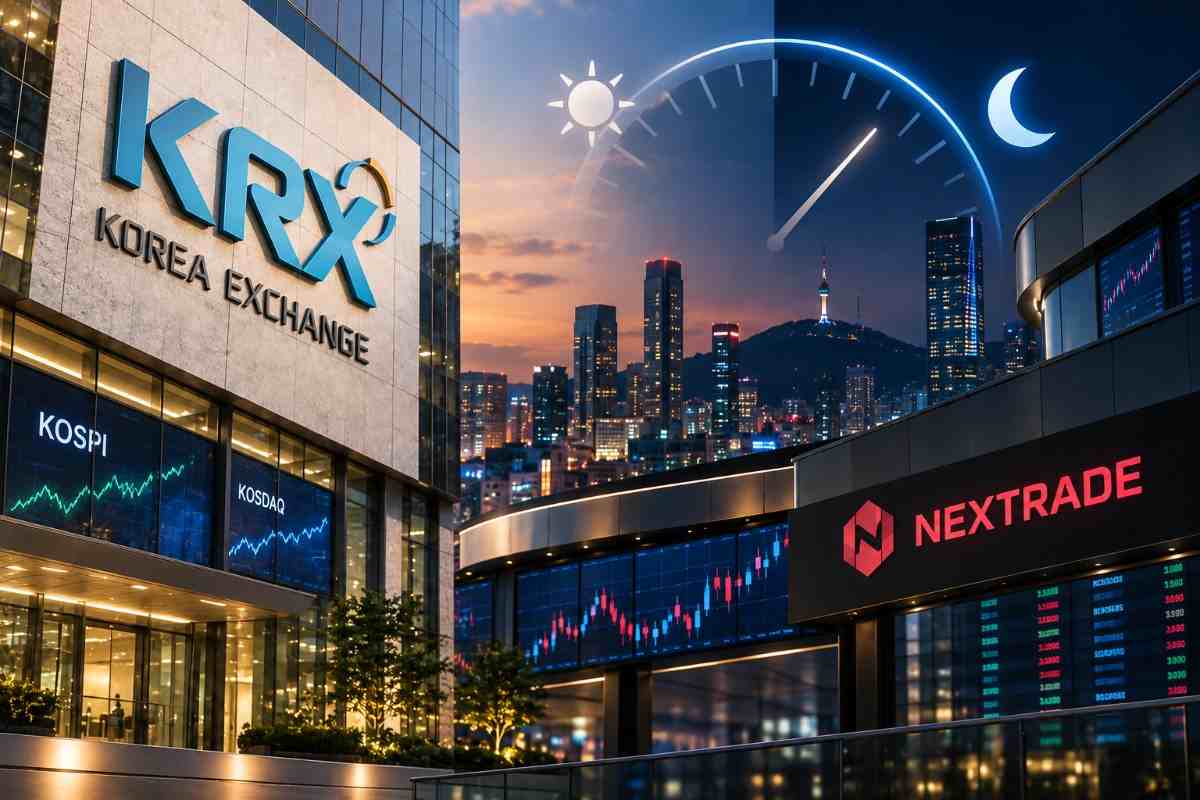
KRX after-hours trading begins on September 14, 2026, with continuous KOSPI and KOSDAQ trading from 4 PM to 8 PM KST, replacing the old evening market that matched orders every 10 minutes.
Around 2,700 eligible securities are covered through 38 participating brokerages, while ETFs and ETNs remain outside the new continuous session. The daily ±30% price band does not restart at 4 PM, and an 8 PM trade does not automatically become the next day’s KRX reference price.
| Session | Before September 14 | From September 14 |
|---|---|---|
| Regular KRX market | 9:00 AM–3:30 PM | 9:00 AM–3:30 PM |
| Closing-price trading | 3:40 PM–4:00 PM | 3:40 PM–4:00 PM |
| Evening trading | 4:00 PM–6:00 PM | 4:00 PM–8:00 PM |
| Matching method | Every 10 minutes | Continuous |
Korea already had after-hours stock trading before September 14. The change is not simply that KRX stays open later, but that its former 10-minute single-price market has been replaced by continuous price formation through 8 PM. The separate 3:40 PM to 4 PM closing-price facility remains in place.
The old KRX system accumulated orders and produced an execution price every 10 minutes. The new after-market matches compatible bids and offers continuously under price and time priority, allowing new information to affect executable prices without waiting for the next scheduled auction.
A corporate disclosure released at 5:07 PM can begin affecting the order book immediately. Earnings announcements, regulatory developments and overseas market moves released after the regular close can feed into KRX price discovery before the next trading day begins.
Continuous trading does not mean every eligible stock will trade continuously. An execution still requires compatible orders on both sides of the book. Less active KOSDAQ names can remain thin even while the exchange itself is open for four additional hours.
KRX and Nextrade compete directly for eligible stock orders between 4 PM and 8 PM. Nextrade’s after-market runs from 3:40 PM to 8 PM, while KRX uses the first 20 minutes after the regular close for its separate closing-price facility before continuous trading begins at 4 PM.
The two venues maintain separate order books. The same KRX-listed stock can therefore show different bids, offers and available quantities on KRX and Nextrade at the same moment. Nextrade is an alternative execution venue for KRX-listed securities, not a separate listing market.
Where direct venue selection is available, an order can be sent to the chosen market. Otherwise, Smart Order Routing applies the brokerage’s best-execution policy, considering factors such as price, available quantity, transaction costs, quoted depth, spreads and execution probability.
Nextrade already has meaningful evening activity. Its September 11 after-market recorded 604 traded securities and about ₩2.02 trillion in turnover. KRX enters the overlapping window with much broader coverage, creating direct competition over where post-close liquidity concentrates.
Most eligible KOSPI and KOSDAQ shares can enter the new KRX after-market. The trading universe also covers foreign shares, depositary receipts, REITs and several other listed equity vehicles, while KONEX is excluded.
KRX also removes securities requiring tighter market supervision, including stocks suspended at the regular close, names that did not trade during the regular session, investment-warning or investment-risk securities, administrative issues, abnormal-volatility names and ultra-low-liquidity stocks.
ETFs and ETNs are excluded from continuous trading between 4 PM and 8 PM. Industry reporting linked the decision partly to volatility concerns around leveraged and inverse products and to the difficulty of maintaining reliable indicative values once underlying cash markets close. They can still trade through KRX’s existing 3:40 PM to 4 PM closing-price facility.
A stock does not receive another ±30% range simply because the regular session has ended. KRX keeps after-hours trading inside the same daily band already calculated from the day’s base price, which is generally derived from the previous regular-session close.
If that previous close was ₩100,000, the normal daily range is approximately ₩70,000 to ₩130,000. A stock that closes the regular session at ₩125,000 therefore still has a ₩130,000 after-hours ceiling, not a new limit of ₩162,500.
Only about 4% of additional upside remains from ₩125,000 before the existing daily ceiling is reached. The new session therefore opens access to the unused portion of the day’s price range rather than creating a second ±30% window.
The former single-price market was narrower, restricting evening prices to ±10% around that day’s regular close while still remaining inside the overall daily ceiling and floor.
No. An 8 PM KRX price can influence the next morning’s opening auction without automatically becoming the next day’s official base price.
KRX generally derives the next day’s base price from the previous regular-session close. Its rules define the relevant closing price as the final price formed during the regular session, subject to adjustments for events such as stock splits and other corporate actions.
Suppose a stock closes the regular market at ₩100,000 and trades at ₩108,000 during the evening after a major announcement. Orders entered for the next opening auction can reflect that new information, so the market may open near, above or below ₩108,000 depending on subsequent supply, demand and overnight developments.
The ₩108,000 evening print does not mechanically replace the ₩100,000 regular close in KRX’s reference-price framework. After-hours prices provide fresh price discovery, not a guaranteed next-day opening level.
Four more hours of continuous KRX trading do not guarantee four hours of regular-session liquidity. At launch, there is no historical KRX continuous after-hours record for spreads, order-book depth or turnover, so actual market quality will emerge from the first weeks of trading.
Separate KRX and Nextrade order books can divide displayed liquidity. A stock may attract buyers and sellers across both venues while either individual book remains shallow. Smart routing can seek better available execution terms, but it cannot create depth that is absent from both markets.
Thin books can mean wider bid-ask spreads, smaller executable quantities and sharper price responses to modest orders. These risks can be more pronounced in less active securities than in the largest KOSPI names.
The meaningful test is whether competitive spreads and usable depth persist as trading moves deeper into the evening.
No. KRX permits limit, best-limit and immediately executable limit orders in the new session. Standard market orders are excluded, reducing the risk of an unrestricted order executing through several price levels when evening depth is thin.
No. Orders registered during the regular session are not accepted into the KRX after-market. You must submit a new order for the evening session after 4 PM.
No. Ordinary KRX equity trades remain under the standard T+2 settlement framework. Extending the execution window changes when a transaction can occur, not the normal settlement timetable.
Early market quality will show up in spreads, order-book depth, turnover, and how evening executions split between KRX and Nextrade. Korea’s equity-market extension follows its July move to introduce near-24-hour USD/KRW trading, another market-access reform whose success will ultimately depend on liquidity outside traditional Seoul hours.
ETF and ETN eligibility remains another open question, with KRX indicating it will reconsider future inclusion after assessing after-market stability, liquidity, and industry feedback.
Longer trading hours increase access to price discovery, but only sustained depth and competitive spreads will show whether Korea’s longer trading day also becomes deeper.