Published on: 2026-04-27
UHS, or Universal Health Services, will release its first-quarter 2026 results, due after the market closes on 27 April, with the investor call scheduled for 9:00 a.m. ET on 28 April. The report will test whether stronger hospital demand can offset wage pressure, supply costs and softer patient-volume trends.
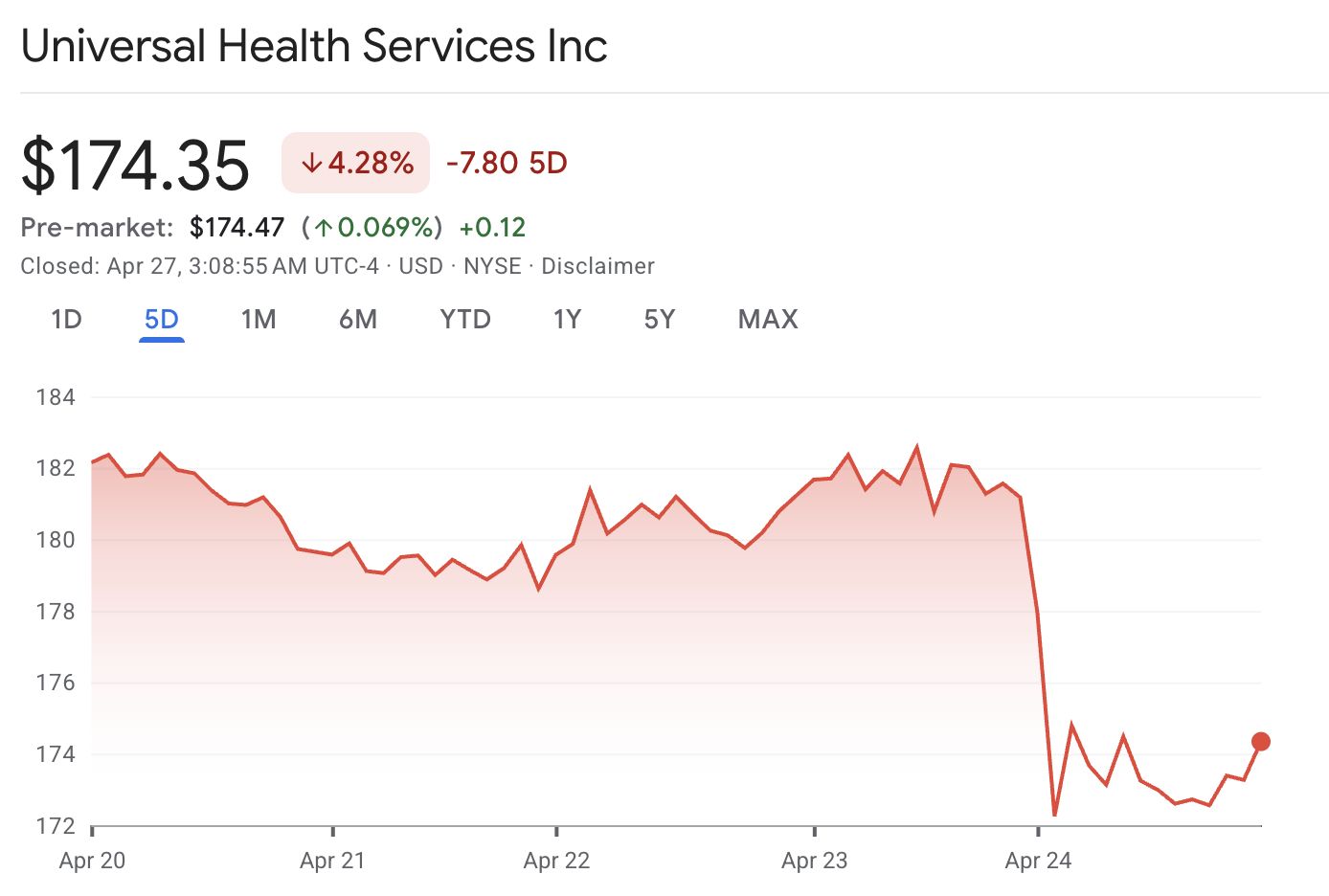
UHS enters earnings with investors already cautious. The stock closed at $174.35 on 24 April, down 3.77%, with a market value near $11.1 billion and a trailing P/E of about 8.3x. That valuation looks inexpensive, but it reflects a clear market question: can UHS protect margins while volumes recover?
Analysts expect Q1 EPS of about $5.36, with revenue near $4.37 billion to $4.39 billion.
Q4 revenue rose 9.1% to $4.49 billion, but adjusted EPS of $5.88 missed estimates by 0.6%.
Acute care is expected to remain the main support, with segment revenue projected near $2.5 billion and same-facility admissions forecast to rise 3.7%.
Rising costs remain the main risk, with wages projected up 4.3% and supply costs expected to rise 5.4%.
The stock reaction will likely depend more on margins, admissions and guidance than on headline revenue alone.
| Metric | Current Market Focus |
|---|---|
| Earnings date | 27 Apr 2026, after close |
| Investor call | 28 Apr 2026, 9:00 a.m. ET |
| Q1 EPS estimate | About $5.36 |
| Q1 revenue estimate | $4.37B to $4.39B |
| Recent UHS stock price | $174.35 |
| Market cap | About $11.1B |
| Trailing P/E | About 8.3x |
Universal Health Services ended 2025 with solid top-line growth, but the market was not fully convinced. Q4 revenue improved, yet earnings missed expectations as softer admissions and elevated operating costs limited margin upside.
That makes Q1 a credibility test. Investors need to see whether Q4’s margin pressure was temporary or whether hospital operators are still struggling to convert stronger pricing into earnings growth.
The strongest part of the UHS setup is acute care. Higher admissions would support hospital utilization, procedure volumes and payer-mix stability. That matters because UHS needs operating leverage, not just higher revenue.
The risk is that cost inflation absorbs too much of the benefit. Wage pressure, supply costs and staffing requirements can all narrow margins even when patient demand improves.

Same-facility admissions will be the first operating signal. A strong admissions figure would support the view that hospital demand is normalizing. A weak number would pressure the stock because UHS already trades at a discounted multiple.
The margin debate starts with expenses. Hospitals remain exposed to higher wages, contract staffing needs and medical supply inflation. A good report would show expense growth slowing relative to revenue. A weaker report would show volumes improving without meaningful margin recovery.
Behavioral health gives UHS a second operating pillar beyond acute care. In Q4, same-facility behavioral health revenue rose 7.2%, supported by revenue per adjusted patient day and modest admissions growth.
Continued strength would help stabilize the earnings mix. Any slowdown would make UHS more dependent on acute care performance at a time when labor and supply costs remain elevated.
Management’s full-year commentary may matter more than the quarter itself. UHS has pointed to 2026 net revenue of $18.417 billion to $18.789 billion, adjusted EBITDA of $2.641 billion to $2.789 billion, and EPS of $22.64 to $24.52.
A reaffirmed outlook would support confidence. Any caution on admissions, labor, payer mix or California staffing rules would likely weigh on sentiment.
A bullish reaction would likely need:
EPS near or above $5.36
Revenue close to or above $4.4 billion
Strong acute-care admissions
Stable behavioral health growth
Clear evidence that wage and supply inflation are manageable
Reaffirmed full-year guidance
A weaker reaction could follow:
EPS miss despite revenue growth
Higher labor or supply-cost pressure
Soft same-facility admissions
Weaker behavioral health volumes
Cautious guidance on margins or staffing regulation
UHS enters earnings from a vulnerable short-term setup. The stock closed at $174.35 after falling nearly 4% on 24 April, with an intraday low of $170.83. A weak report could put the $170 to $171 area back in focus, while a cleaner margin and volume update could shift attention toward the $180 zone.
The technical picture remains secondary to earnings quality. For UHS, the stock needs margin proof more than simple revenue growth.
UHS earnings are important because investors want to know whether hospital demand can overcome rising labor and supply costs. The stock’s low valuation reflects concern over margin durability.
Same-facility admissions and margin performance matter most. Revenue growth is useful, but investors need proof that higher patient volumes are converting into stronger earnings.
UHS trades at about 8.3x trailing earnings, which looks inexpensive. The discount will narrow only if management shows stronger margins, stable volumes and confidence in 2026 guidance.
Universal Health Services enters Q1 earnings with a clear market test. Acute care demand appears supportive, behavioral health remains an important stabilizer, and valuation is already discounted.
The risk is that costs absorb too much of the revenue benefit. For UHS stock to recover, investors need more than a headline beat. They need evidence that patient volumes, pricing and expense control are moving together. A clean report could turn the low multiple into a recovery opportunity. A margin disappointment would keep the stock trapped in value-risk territory.