Published on: 2026-04-02
Updated on: 2026-04-02
The collapse of Barings Bank in 1995 remains one of the most infamous cautionary tales in financial history. A single trader accumulated losses of £827 million, enough to wipe out a 233-year-old institution. This event was not simply a market failure, but a clear breakdown in risk management. For modern traders, it serves as a powerful lesson in discipline, oversight, and downside risk management.
Risk management failures, not markets alone, cause catastrophic losses.
Traders should risk only a small percentage of capital per trade.
Leverage must be controlled to prevent exponential losses.
Emotional decision-making can significantly worsen outcomes.
Monitoring and transparency are essential for long-term survival.
Founded in 1762, Barings Bank was one of the oldest and most respected merchant banks in the United Kingdom. By the early 1990s, it had expanded into derivatives trading in Asia.
Nick Leeson, a trader based in Singapore, was given responsibility for both executing trades and overseeing settlement operations. This lack of segregation allowed him to hide losses while continuing to take increasingly risky positions.
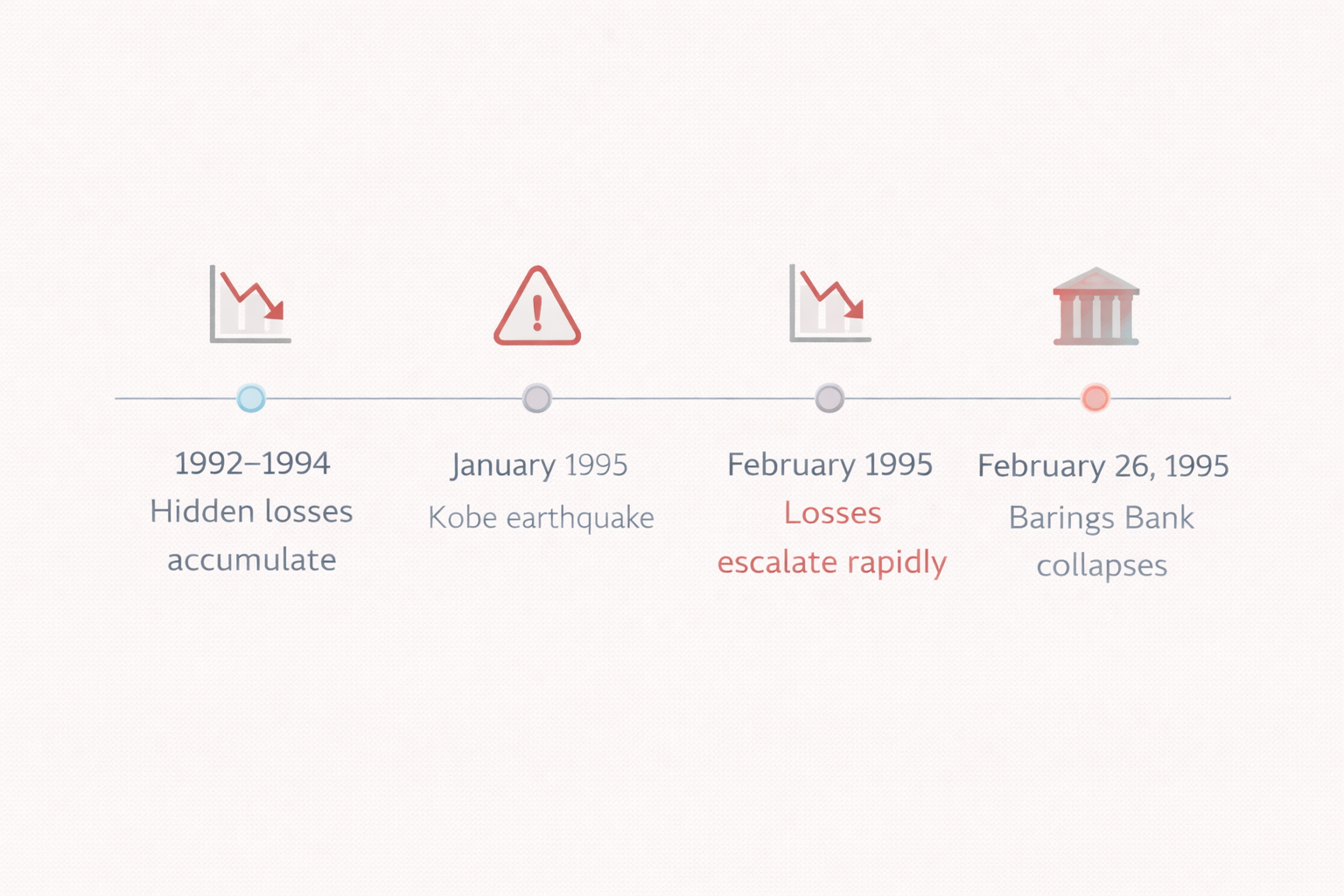
Leeson primarily traded futures contracts linked to the Nikkei 225 index. Initially, losses were small, but instead of closing positions, he concealed them in a secret account known as “Account 88888.” Over time, these losses compounded.
In January 1995, the Kobe earthquake triggered a sharp decline in the Japanese stock market. Leeson’s leveraged positions moved heavily against him, causing losses to spiral beyond control. By February, total losses reached £827 million, more than double the bank’s capital, forcing Barings into bankruptcy. The bank was later sold for £1, marking the end of its long history.
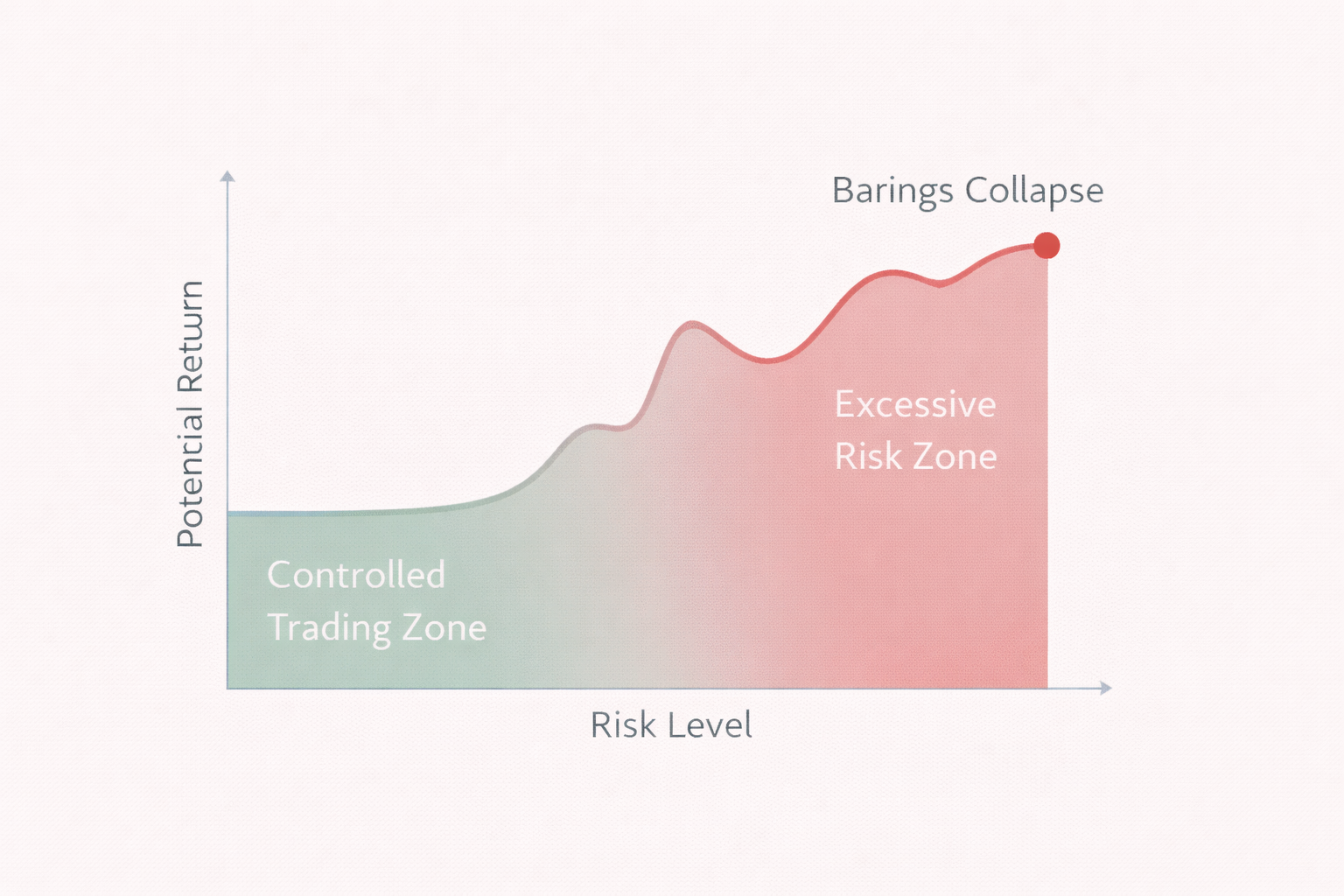
The Barings collapse highlights that risk management must be applied consistently through clear, practical rules. Traders today can adopt the following guidelines:
Risk no more than 1–2% of total trading capital per trade
Example:
Trading account = $10,000
Maximum risk per trade = $100–$200
Always define an exit point before entering a trade.
Example:
Buy an asset at $100
Set stop-loss at $95 → limits loss to 5%
Avoid concentrating capital in correlated assets.
Limit exposure to 5–10% per market theme.
Leverage amplifies both gains and losses.
Avoid using maximum margin without strict controls.
Do not increase position size after a loss.
Follow consistent position sizing regardless of outcomes.
Although the Barings collapse occurred in 1995, its lessons remain highly relevant in today’s trading environment.
In 2026, traders face heightened volatility driven by:
Central bank policy uncertainty and interest rate shifts
Geopolitical tensions affecting global markets and commodities
AI-driven and algorithmic trading, which can accelerate price movements
For example, leveraged positions in major index instruments can experience rapid drawdowns during unexpected macroeconomic events. A sudden market reaction to a central bank decision or geopolitical development can quickly magnify losses if proper risk controls are not in place.
The core lesson remains unchanged: Losses become catastrophic not because markets move, but because risk is not controlled when they do.
The Barings collapse developed over time, with clear warning signals that were ignored. Traders should be aware of the following red flags:
Increasing position sizes after losses
Entering trades without a defined exit strategy
Overconfidence in a single market direction
Lack of proper trade tracking or review
Emotional decision-making driven by fear or greed
Recognising these behaviours early can help prevent small losses from escalating into major drawdowns.
The collapse was caused by unauthorised trading activities by Nick Leeson, who accumulated large losses using leveraged derivatives while concealing them from management through a hidden account.
Leverage allowed Leeson to control large positions with relatively small capital. When the market moved against him, losses were magnified significantly, quickly exceeding the bank’s total capital.
Yes. Proper segregation of duties, strict risk limits, and regular independent audits would likely have identified the losses early and prevented them from escalating.
The most important lesson is to control risk at all times. Even a correct market view can lead to losses if position sizing and exposure are not properly managed.
While regulations and systems have improved, similar failures can still occur if risk management practices are ignored or bypassed, especially in fast-moving or highly leveraged markets.
The Barings Bank collapse is more than a historical event; it is a timeless lesson in risk management. It demonstrates that even the most established institutions can fail when discipline, oversight, and control mechanisms break down.
For traders, success is not defined solely by profits but by the ability to manage losses effectively. Long-term survival in the markets depends not on predicting every move correctly, but on ensuring that no single mistake becomes catastrophic.
Disclaimer: This material is for general information purposes only and is not intended as (and should not be considered to be) financial, investment or other advice on which reliance should be placed. No opinion given in the material constitutes a recommendation by EBC or the author that any particular investment, security, transaction or investment strategy is suitable for any specific person.