Published on: 2026-04-08
AXON has been heavily rerated. AXON closed at $372.87 on April 7, 2026, down about 57.9% from the $885.92 52-week high.
Revenue momentum is still strong. Full-year 2025 revenue rose 33% to $2.8 billion, and Q4 revenue rose 39% to $797 million.
The recurring engine still looks intact. Annual recurring revenue reached $1.347 billion, net revenue retention was 125%, and future contracted bookings climbed 43% to $14.4 billion.
The market is reacting to earnings quality and valuation. Q4 operating loss was $50 million, 2025 stock-based compensation reached $610.2 million, and 2025 GAAP net margin was only 4.5%.
Margin pressure is real. Q4 company gross margin fell to 57.9%, while Connected Devices' adjusted gross margin dropped to 49.3%, partly because of tariffs and product mix.
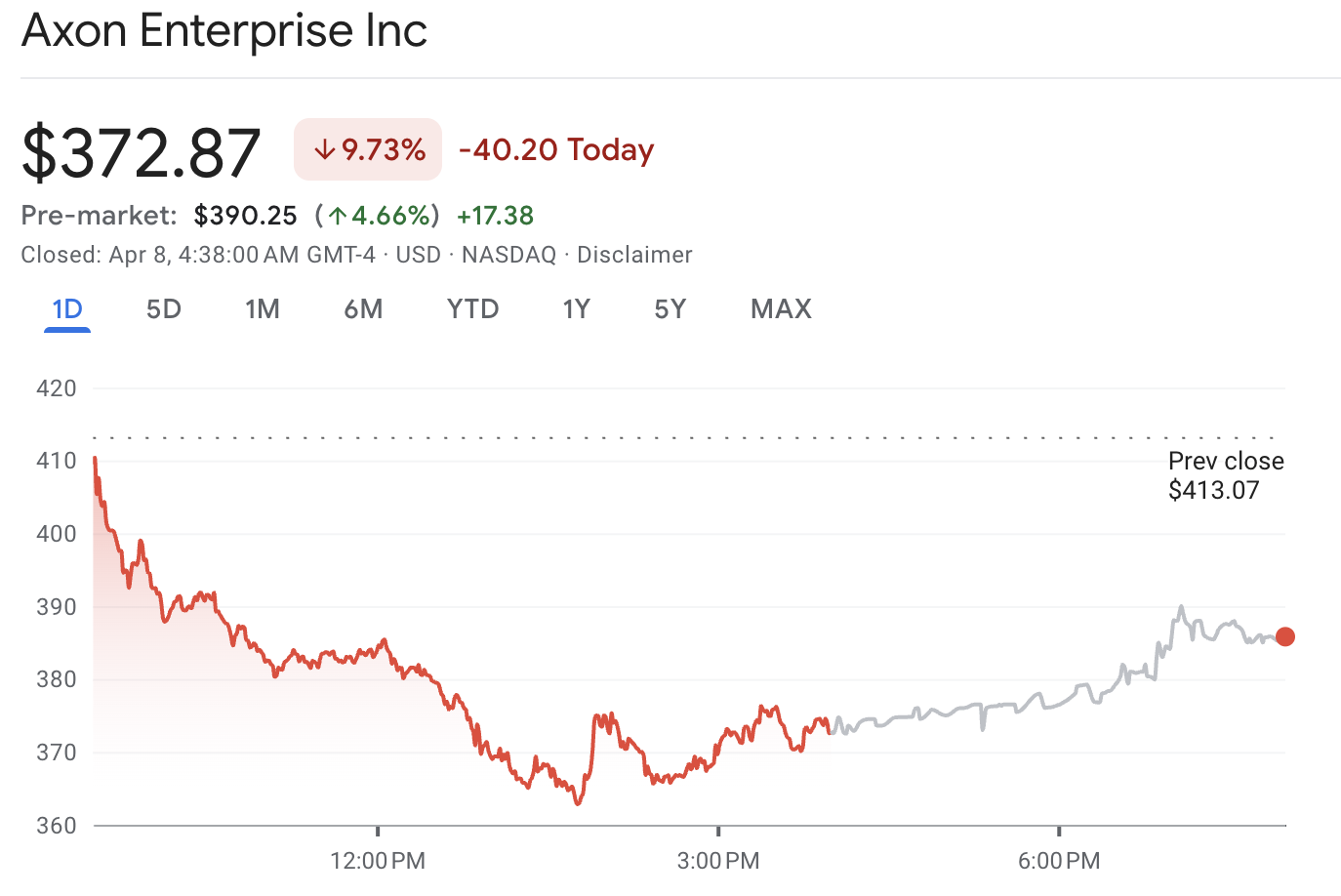
The clearest explanation is that AXON's fundamentals do not look broken, but its premium multiple has compressed. Broken fundamentals would usually show up in weakening recurring revenue, falling customer retention, shrinking order visibility, or clear balance-sheet stress.
AXON's latest filings do not show that pattern. They show a company still growing at scale, but one asking the market to absorb slower growth than its peak phase, lower gross margins, heavy stock-based compensation, and a much wider gap between GAAP profit and adjusted profit.
So far, the selloff looks more like multiple compressions than a business break. Using the April 7, 2026, closing price, year-end net debt, and 2026 revenue guidance, AXON appears to trade at roughly 8x to 9x forward enterprise value to revenue, versus around 20x near its 52-week high.
That is not a small rating. It is the market moving the stock from "priced for perfection" toward "priced for execution."
The main argument against the broken-fundamentals perspective is based on the order and retention data. AXON exited 2025 with $14.4 billion in future contracted bookings, up 43% year over year. Management expects 20% to 25% of that balance to be fulfilled over the next 12 months.
That suggests an expected range of approximately $2.88 billion to $3.60 billion, encompassing a significant portion of the 2026 revenue forecast. Annual recurring revenue rose 35% to $1.347 billion, while net revenue retention improved to 125%. Those are not the numbers of a business losing relevance.
The mix also matters. In Q4, revenue from Software and Services reached $342.5 million, showing a year-over-year increase of 39.8%. This segment achieved a gross margin of 72.9%, with the software-only gross margin exceeding 80%. Meanwhile, Connected Devices generated $454.2 million, reflecting a 37.6% growth.
That split shows that AXON is not relying on a single product cycle. It is still expanding both the hardware layer and the recurring software layer, which is the structural reason investors gave the stock such a high multiple in the first place.
Customer concentration also does not point to fragility. AXON disclosed that no customer represented more than 10% of total net sales in 2025. That lowers the risk that one delayed budget cycle or one lost contract can break the growth story.
The problem is not top-line demand. The problem lies beneath it.
The company reported a $50 million operating loss and only $3 million in net income for Q4, compared to $178 million in non-GAAP net income. For full-year 2025, GAAP net income was $124.7 million on $2.8 billion of revenue, which is a 4.5% net margin.
That is a thin GAAP earnings base for a stock that once traded at a near-20 times forward revenue multiple.
This is the biggest quality issue. AXON recorded $610.2 million of stock-based compensation expense in 2025, equal to about 21.8% of annual revenue. The 2026 guide estimates that stock-based compensation will range from $590 million to $620 million.
Management's 2028 target includes limiting annual dilution from stock-based compensation to less than 2.5%, indicating the issue is already on the company's list of areas for improvement.
Operating cash flow for the full year fell to $211.3 million in 2025 from $408.3 million in 2024, a decline of about 48.2%. AXON said the Q4 cash flow slowdown reflected receivables timing and inventory investment, which fits with deferred revenue of about $1.07 billion and contract assets of about $760.9 million on the year-end balance sheet.
That combination means revenue recognition and billing timing can diverge, so short-term cash generation can look weaker than revenue growth. Even so, when a premium stock sells off, investors usually stop giving full credit to timing explanations until cash conversion improves.
Company gross margin fell to 57.9% in Q4. Software and Services adjusted gross margin slipped to 76.7% from 78.0%, and Connected Devices adjusted gross margin fell to 49.3% from 52.2%. Management pointed to tariffs and mix, especially within platform products.
That matters because multiple compression often starts when investors believe the next dollar of growth is less profitable than the last.
No. Broken fundamentals would mean three things.
Recurring metrics would weaken. That would show up in annual recurring revenue slowing hard, net revenue retention falling, or customer churn becoming visible.
Order visibility would fade, with future contracted bookings flattening or shrinking.
The balance sheet would start carrying the story instead of the business. This would result in increased net debt, strained liquidity, or reliance on external capital.
AXON's latest numbers do not show that pattern today. What they do show is a business shifting from hyper-premium expectations to normal premium expectations.
For context, AXON ended 2025 with $1.7 billion in cash, cash equivalents, and short-term investments against $1.8 billion of notes, leaving net debt of about $112 million at year-end. The company also guided for 27% to 30% revenue growth in 2026 and said it aims to reach $6 billion in annual revenue with an adjusted EBITDA margin of about 28% by 2028.
Those targets are ambitious, but they are not the numbers of a business that looks operationally broken today.
| Metric | Latest reading | Why it matters |
|---|---|---|
| Share price | $372.87 | Confirms a deep rerating from the peak |
| Drawdown from 52-week high | 57.9% | Shows a major valuation reset |
| 2025 revenue | $2.8 billion | Demand still expanded at scale |
| Q4 2025 revenue | $797 million | Growth stayed strong into year-end |
| Annual recurring revenue | $1.347 billion | Recurring base continues to build |
| Net revenue retention | 125% | Existing customers are still spending more |
| Future contracted bookings | $14.4 billion | Order visibility remains high |
| 2025 GAAP net margin | 4.5% | Shows how thin reported profitability still is |
| 2025 stock-based compensation | $610.2 million | Main quality-of-earnings concern |
| Net debt at year-end | about $112 million | Balance sheet is not pristine, but it is not distressed |
| 2026 revenue growth guide | 27% to 30% | Growth stays strong, but below peak enthusiasm |
| Forward EV/revenue | about 8x to 9x | Well below the peak multiple, but still not cheap |
The table makes the split plain. Demand metrics still support the core story. Valuation, GAAP earnings quality, and cash conversion explain why the stock no longer commands a peak multiple.
The next test is not whether AXON can keep growing. It is whether that growth starts to translate more clearly into cash generation and lower dilution.
Investors should watch annual recurring revenue, operating cash flow, stock-based compensation as a share of revenue, and whether Connected Devices' gross margin stabilizes after the recent tariff and product-mix pressure.
Because the market is no longer paying a peak premium for growth that is still strong but no longer rare enough to justify a near-20 times forward revenue valuation.
Not on the latest reported numbers. Revenue, annual recurring revenue, retention, and future contracted bookings all moved higher. The weakness is more about earnings quality and valuation discipline than about a collapse in demand.
The biggest risk is that revenue keeps growing while GAAP profitability and cash conversion remain too weak to support a premium multiple.
AXON's decline looks more like multiple compressions and investor concern about earnings quality than a clear break in the underlying business.
The company still shows strong demand, rising recurring revenue, and substantial order visibility. But the market is now asking a tougher question: can AXON convert that growth into stronger reported profitability, better cash conversion, and less dilution?
For AXON to reclaim a premium market rating, it must show that growth can translate into better margins, stronger cash flow, and lower stock-based compensation over time.
Disclaimer: This material is for general information purposes only and is not intended as (and should not be considered to be) financial, investment, or other advice on which reliance should be placed. No opinion given in the material constitutes a recommendation by EBC or the author that any particular investment, security, transaction, or investment strategy is suitable for any specific person.