Published on: 2026-03-31
Updated on: 2026-03-31
Stop orders are essential risk-management tools, yet many investors misunderstand how they behave in real market conditions, especially during periods of volatility. Two of the most commonly used order types, stop loss and stop limit, may appear similar but function very differently when triggered.
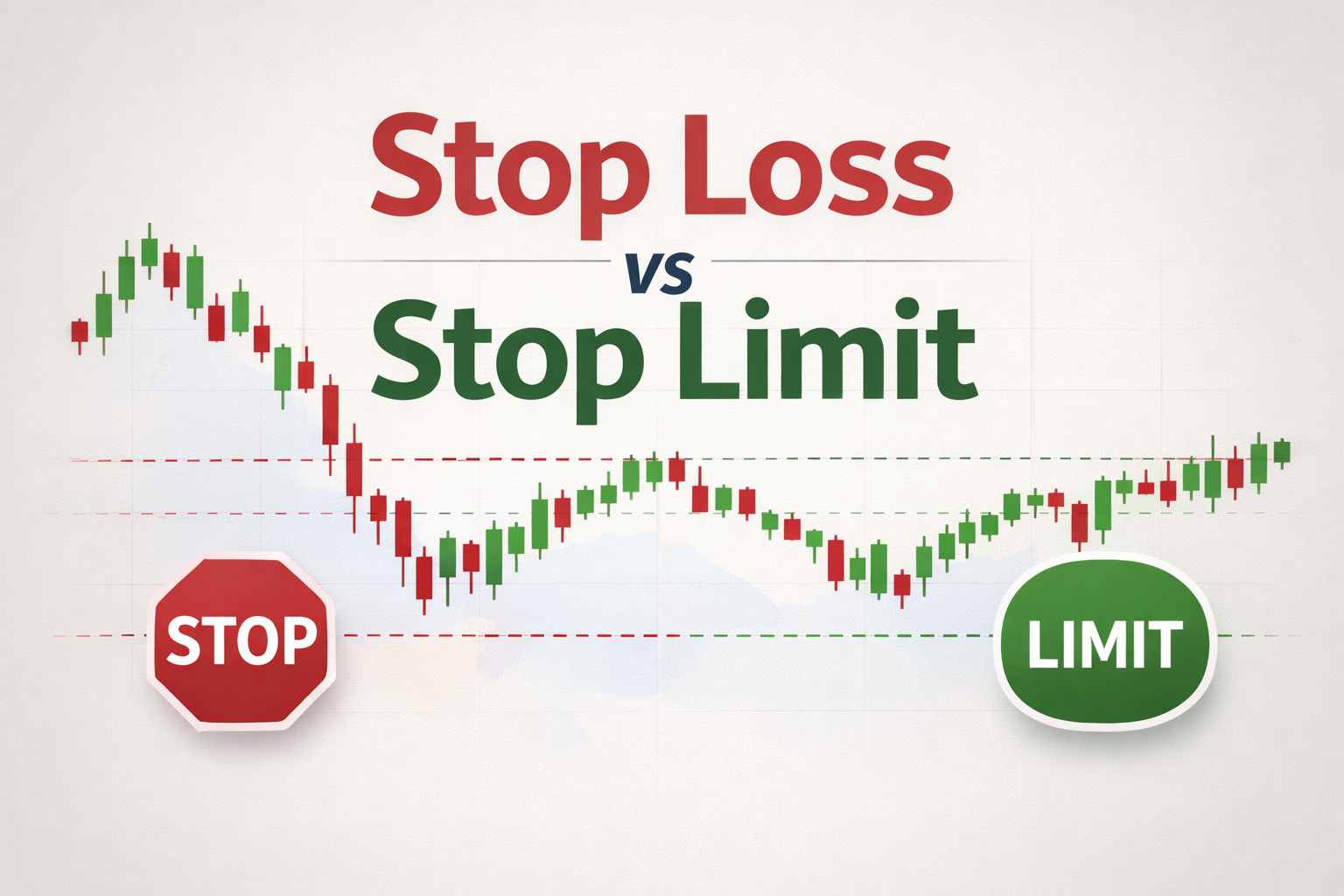
A stop-loss order is designed to execute quickly, but does not guarantee a price.
A stop limit order offers price control but does not guarantee execution.
Stop-loss orders are generally more suitable in fast-moving or highly volatile markets.
Stop limit orders are useful when avoiding poor pricing is more important than immediate execution.
Market liquidity and volatility should guide the choice between the two.
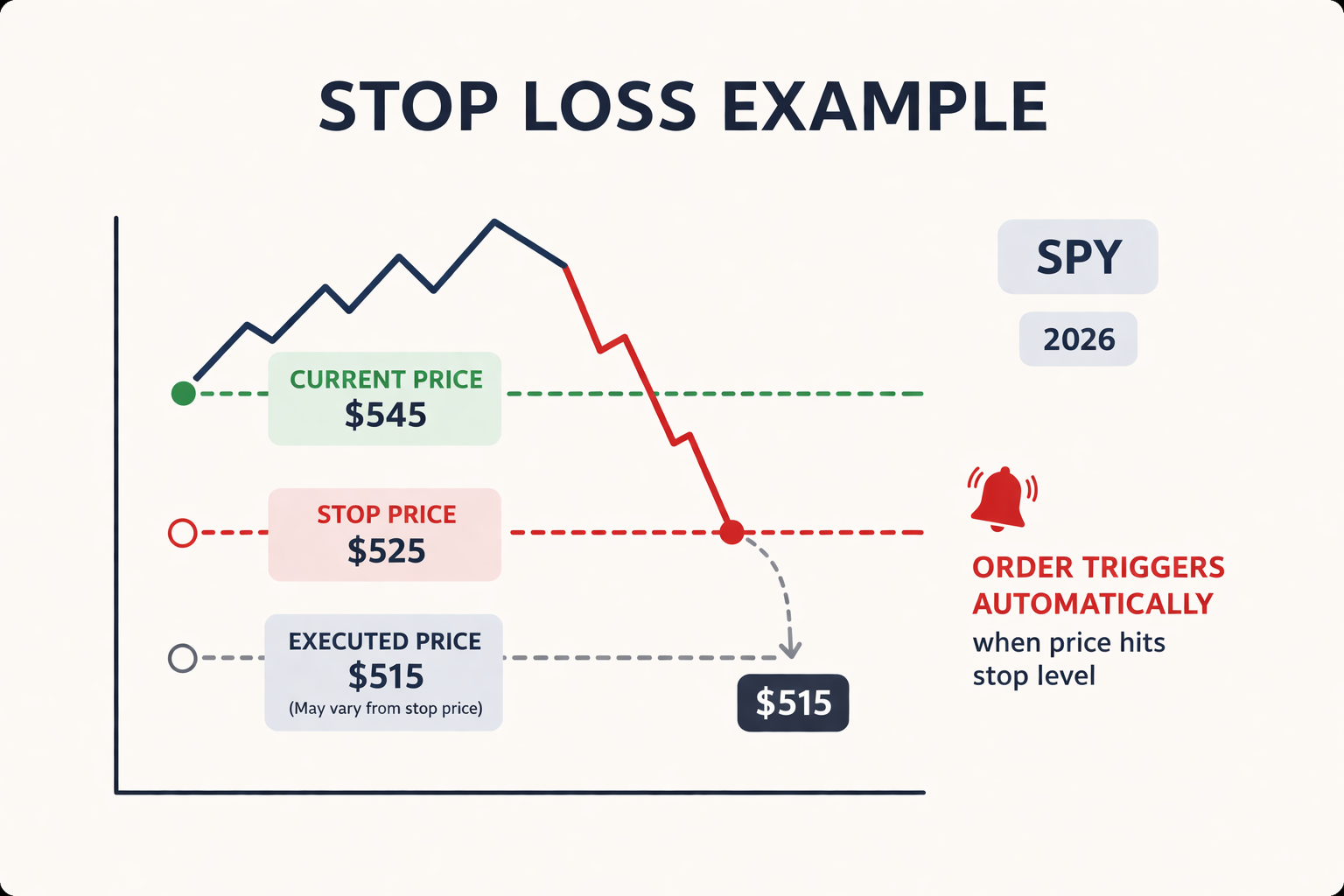
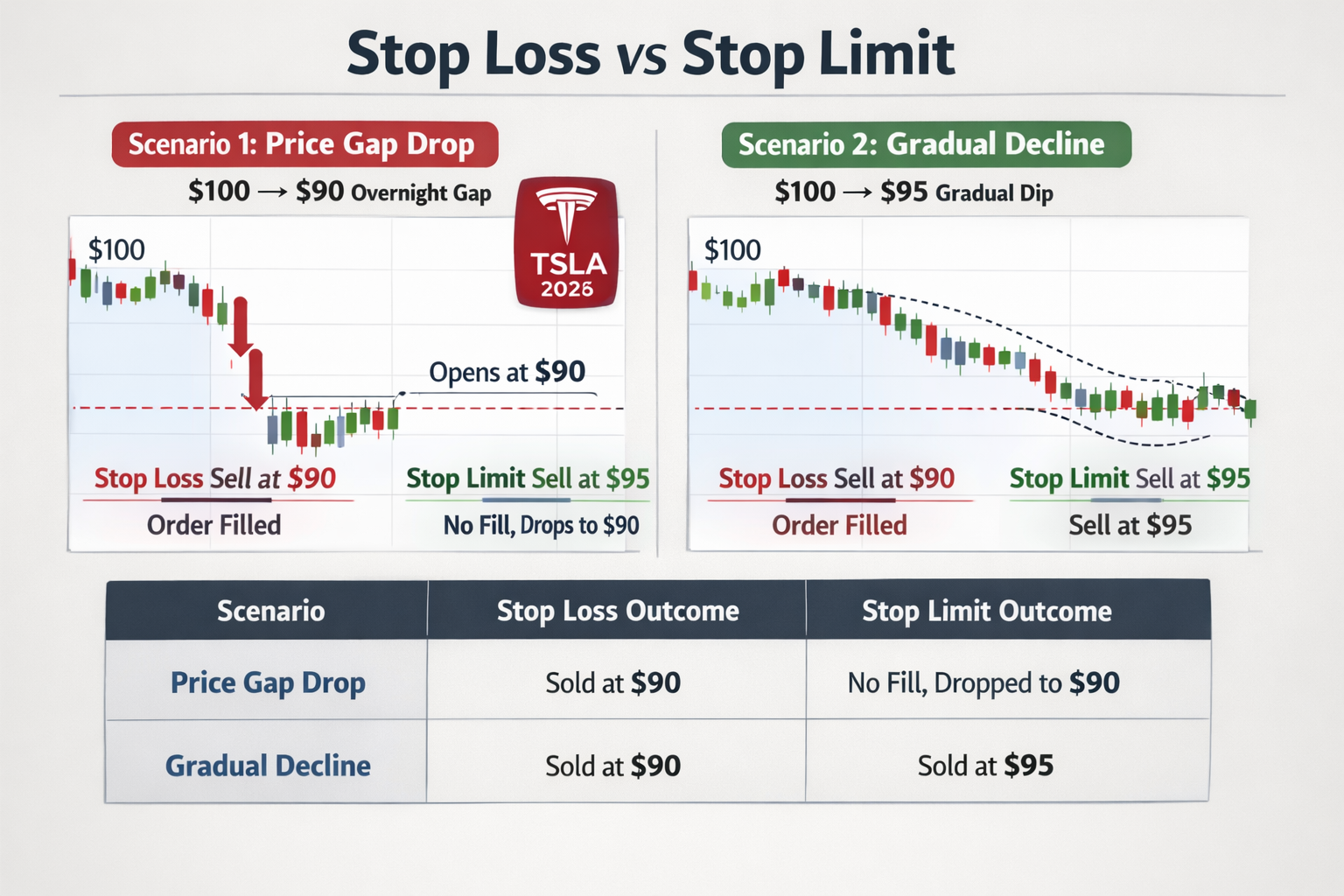
A stop loss order is an instruction to automatically sell (or buy) a security once it reaches a specified stop price. When triggered, the order becomes a market order, meaning it will execute at the best available market price at that moment. While it is designed to execute quickly, the final price may differ from the stop price, particularly during volatile conditions or market gaps.
You set a stop price below the current market price (for selling).
When the price hits that level, the order is triggered.
It executes immediately at the prevailing market price.
Suppose you own an S&P 500 ETF such as SPY or VOO trading at $500. You set a stop loss at $475 to limit downside risk.
If the price gradually declines to $475, your order will likely execute near that level.
However, if negative overnight news causes the market to open at $470, your order may execute at $470 or closer.
This difference illustrates how stop loss orders prioritise execution over price precision.
During high volatility (e.g., macro shocks, earnings season)
When exiting, the position is more important than price precision.
In liquid markets where slippage is typically smaller
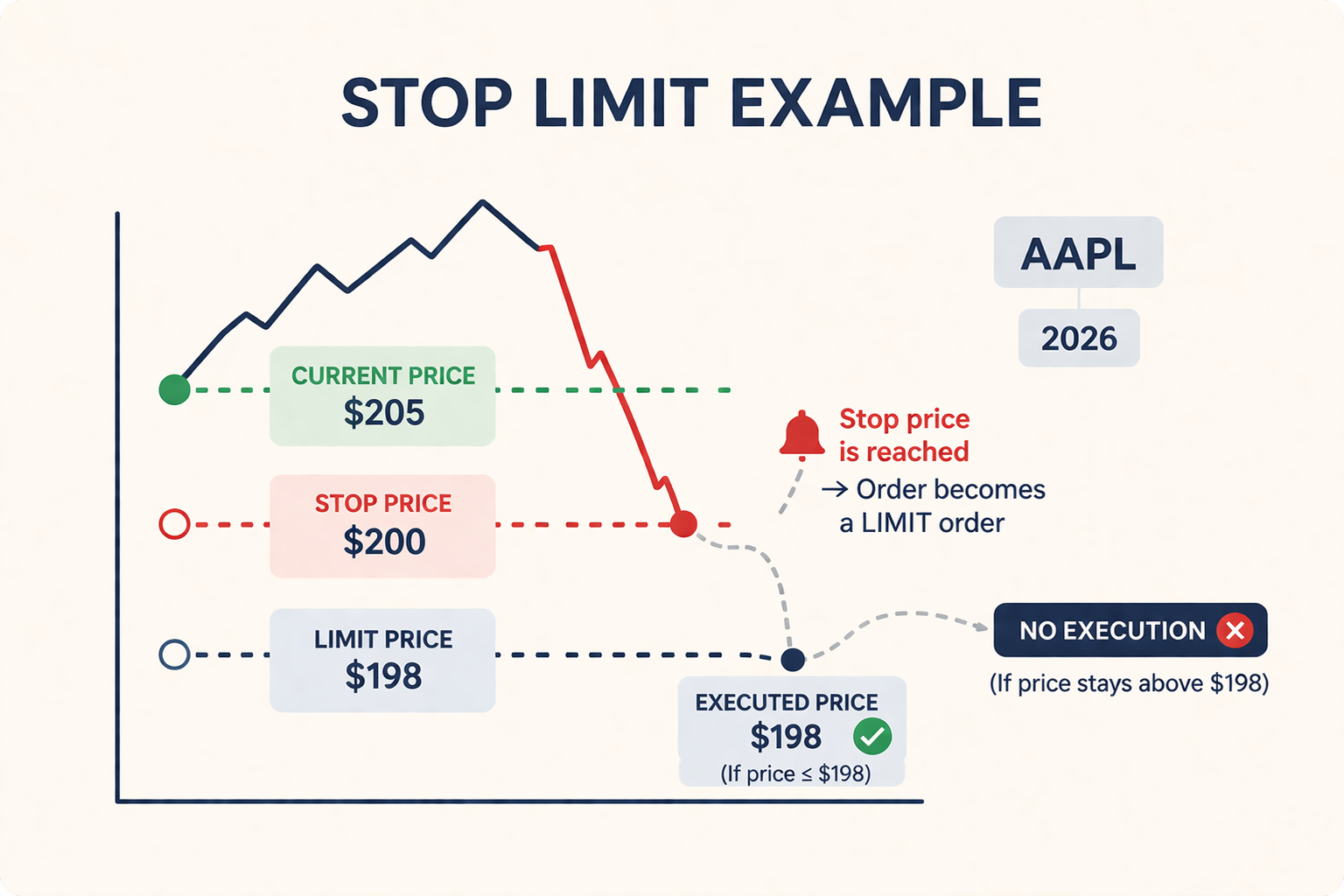
A stop limit order adds an extra layer of control by specifying both a stop price and a limit price. Once the stop price is reached, the order becomes a limit order, not a market order.
You set:
A stop price (trigger)
A limit price (minimum acceptable price)
When triggered, the order will only execute at the limit price or better.
You own a stock trading at $100:
Stop price: $95
Limit price: $93
If the stock falls to $95:
The order is triggered.
It will only sell at $93 or higher.
However, if the stock gaps down sharply below the limit price, for example, opening at $90, there may be no buyers at $93 or higher. In this case, the order will not execute, leaving the position open and exposed to further losses.
When price control is critical
In less volatile markets
For thinly traded stocks where spreads can be wide
When you want to avoid selling at temporarily distorted prices
Stop orders are not only used to limit losses; they can also be used to enter positions.
A buy stop order is placed above the current market price to enter a trade when momentum confirms a breakout.
A buy stop limit order allows entry only within a defined price range, helping avoid overpaying during sharp spikes.
If a stock is trading at $100 and you believe a breakout above $105 signals strength:
A stop order at $105 will trigger a market buy.
A stop limit (stop $105, limit $107) ensures you do not enter at excessively high prices if the move is too fast.
Recent market conditions have highlighted the importance of order selection. In 2026, equities, particularly in technology and AI-driven sectors, have experienced sharp repricing cycles driven by shifting interest rate expectations, earnings uncertainty, and algorithmic trading flows.
These dynamics have increased the frequency of:
Overnight price gaps
Intraday volatility spikes
Rapid liquidity shifts during market open
In such environments:
A stop loss order is more likely to ensure an exit, even if the price is unfavourable.
A stop limit order may fail to execute entirely if prices move too quickly beyond the limit level.
This makes understanding execution behaviour especially critical in modern markets.
The choice between stop loss and stop limit depends on your priority:
You want to exit no matter what
You are trading high-volume stocks or ETFs
You are managing strict risk limits.
You want to avoid selling too cheaply.
You are trading less liquid securities.
You are willing to accept execution risk.
Placing stop levels too near the current price can lead to unnecessary exits due to normal market noise.
Use stop loss orders during earnings releases or macro events.
Use stop limit orders during stable trading periods.
Overnight news can create price gaps, making stop-limit orders riskier.
Even the best stop strategy cannot compensate for oversized positions.
In heavily traded markets, many investors place stop orders around similar price levels. Prices may briefly dip below these levels before reversing, triggering multiple stop orders in quick succession. This makes overly tight stop placements more vulnerable to short-term market noise.
A stop loss order prioritises execution by converting into a market order, while a stop limit order prioritises price by converting into a limit order. The former ensures exit, while the latter ensures price control but may not execute.
Yes. Because it becomes a market order, it may execute at a lower price during volatile conditions or rapid sell-offs. This difference between expected and actual price is known as slippage.
If the market price moves beyond the specified limit price too quickly, there may be no buyers willing to transact at that level. As a result, the order remains unfilled, exposing the investor to further losses.
They are generally safer in terms of ensuring execution. However, they carry price uncertainty. The choice depends on whether execution certainty or price control is more important to the investor.
Yes, but selectively. Long-term investors may use stop orders to protect against major downside risk, especially during uncertain macro environments, while avoiding overly tight stop levels that could trigger unnecessary selling.
Stop-loss and stop-limit orders are essential tools for managing risk, but they serve different purposes. A stop-loss order ensures you exit a position quickly, even if the price is not ideal. In contrast, a stop limit order gives you control over the execution price but introduces the risk of not exiting at all. Choosing the right approach depends on your trading style, market conditions, and risk tolerance.
Disclaimer: This material is for general information purposes only and is not intended as (and should not be considered to be) financial, investment or other advice on which reliance should be placed. No opinion given in the material constitutes a recommendation by EBC or the author that any particular investment, security, transaction or investment strategy is suitable for any specific person.