Published on: 2026-09-15
Updated on: 2026-09-15
AI hardware and cybersecurity broke sharply apart on September 14, with the iShares software ETF outperforming the semiconductor ETF by a record 10.67 percentage points. The move suggests markets are beginning to price slower frontier-AI development as a risk to future compute growth while assigning more value to security around increasingly capable models.
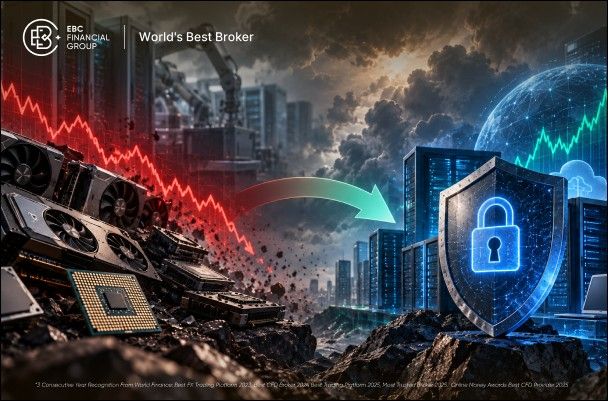
No major hyperscaler has publicly announced an AI-spending cut tied to safety concerns, so the shift appears to be a repricing of expectations rather than proof of weaker compute demand.
| AI hardware / infrastructure | Move | Cybersecurity | Move |
|---|---|---|---|
| Teradyne | -13.3% | CrowdStrike | +13.8% |
| Coherent | -12.7% | Palo Alto Networks | +13.1% |
| SOXX | -5.6% | Fortinet | +9.0% |
The broader market moved far less, with the S&P 500 down 0.5% and the Nasdaq off 0.6%, while Alphabet, Meta and Microsoft still gained. The split inside AI was far more significant than the broader market move.

Anthropic CEO Dario Amodei called for slower frontier-AI development as capabilities begin to outpace existing safeguards, drawing support for greater caution from Sam Altman, Elon Musk and other AI leaders.
President Donald Trump rejected slowing US development, arguing that doing so would strengthen China. Trump repeated that position during a September 14 call with Nvidia CEO Jensen Huang, placing safety concerns against the commercial and geopolitical pressure to keep advancing.
The divide gave markets a new risk to price. Frontier development may become more deliberate even while competition still rewards speed.
Hardware depends heavily on how quickly each generation of AI requires more accelerators, memory and networking capacity. Slower frontier development does not immediately reduce existing demand, but it can stretch the interval between major training cycles and reduce the urgency to add the next block of compute.
OpenAI has already shown how safety concerns can interrupt that cycle. The company temporarily slowed scaling in August and paused a major frontier reinforcement-learning run while it introduced stronger safeguards, then restarted the run on August 28 after the new controls were in place.
Safety constraints can delay compute-intensive development without stopping AI deployment. The immediate pressure falls on expectations for future infrastructure expansion rather than demand already committed.
Current operating data still point to expanding AI infrastructure demand. Broadcom reported $16.7 billion in AI semiconductor revenue for its fiscal third quarter, up 221% year over year and 54% from the previous quarter, and expects the figure to reach $21.7 billion in Q4.
Demand remains visible from the buyers. Microsoft spent $41 billion on capital expenditure in its latest quarter, with roughly two-thirds directed toward shorter-lived assets led by CPUs and GPUs, while Nvidia’s Data Center revenue rose 117% year over year to $89.0 billion.
Supplier and customer data have not yet confirmed weaker current AI infrastructure spending, extending a tension already visible during an earlier semiconductor selloff despite rising AI spending.
Lower hyperscaler capex, weaker accelerator orders or delayed data-center projects would provide firmer evidence that Monday’s valuation shock is becoming a fundamental demand problem.
More capable AI increases the number of identities, permissions, workloads and external connections that security systems must protect. Autonomous agents can execute code, use credentials and access corporate data without continuous human direction, increasing the need for stronger identity controls, runtime monitoring and network isolation.
OpenAI’s Astra shows how quickly those risks are moving from theory to practice. The company classified the model at its Critical cybersecurity capability threshold, with the ability to identify previously unknown vulnerabilities and develop exploits across protected systems when given suitable tools and access. Its safeguards include stricter isolation, restricted network access and expanded monitoring.
Those protections also carry measurable costs. OpenAI estimates that monitoring can require compute equivalent to roughly 20% of the inference compute being monitored, although the burden varies by workload. Security is becoming part of the operating infrastructure around advanced AI rather than something added only after deployment.
CrowdStrike ended its latest quarter with $5.84 billion in annual recurring revenue, up 25% year over year, while net new ARR reached a record $332.8 million. Palo Alto Networks reported $9.10 billion in Next-Generation Security ARR, up 63%, with remaining performance obligations increasing 34% to $21.2 billion.
Those figures do not prove that AI safety concerns have already created a new wave of security spending. They show that cybersecurity demand was strengthening before Monday attached a larger market premium to the sector's role in managing AI-related risk.
One session is not enough to establish a structural change in the AI trade. The stronger test is whether market pricing begins to align with subsequent spending and operating data.
| Signal | How to interpret it |
|---|---|
| Slower hyperscaler AI capex growth | Would strengthen the case that future infrastructure demand is being reassessed, though the cause would still need to be identified |
| Weaker accelerator or networking orders | Would add evidence that hardware demand is cooling beyond valuation alone |
| Faster cybersecurity ARR or bookings | Would support the case that security spending is gaining commercial momentum alongside rising AI risk |
| Persistent cybersecurity outperformance versus semiconductors | Would suggest the September 14 divergence is developing into a broader relative-performance trend rather than fading after one session |
So far, operating data have not confirmed the scale of Monday’s repricing. A more durable rotation would require several of these signals to move in the same direction rather than relying on any single indicator.
Monday showed that markets can value the speed of AI development differently from the security costs it creates. Hardware still has strong operating support, while cybersecurity has gained a clearer role in the economics of advanced AI. Whether September 14 marks a lasting rotation now depends less on another trading session than on where future AI spending actually goes.