Published on: 2026-02-24
Updated on: 2026-02-24
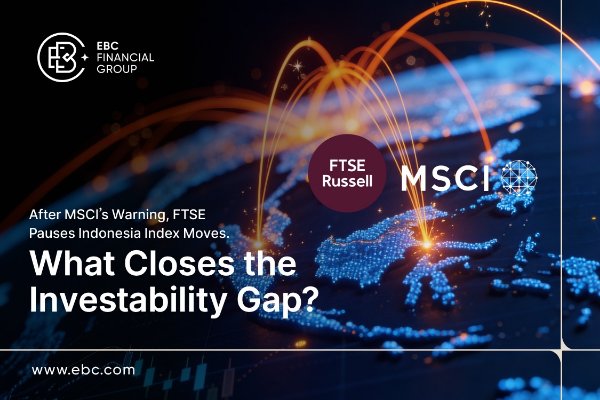
EBC Financial Group (EBC) said FTSE Russell's pause is the latest reminder
that benchmark providers are now testing the same issue: whether Indonesia's
ownership and free-float data can be verified consistently. The move follows
Morgan Stanley Capital International's (MSCI) warning that if insufficient
progress is made towards necessary transparency enhancements by May 2026, it
will reassess Indonesia's market accessibility status, which could lead to a
weighting reduction and potential reclassification outcomes, subject to
consultation.
Against that backdrop, FTSE Russell cited uncertainty in determining accurate free-float percentages during an ongoing reform plan and, effective immediately, paused several index actions tied to reviews and updated share data, postponing the March 2026 index review. The reason this matters is mechanical. Index rules drive real money, especially during review windows and corporate actions. Even when the long-term story is unchanged, uncertainty around float and ownership can widen bid-ask spreads, reduce risk appetite, and amplify ETF and quant rebalancing effects into bigger price moves than fundamentals alone would suggest.
"We see trust building over time. When free-float and ownership data are clear and consistent, investors do not need to guess, and risk pricing can start to ease," said Samuel Hertz, Head of APAC, EBC Financial Group.
EBC analysts see the investability gap as a measurement premium. When investors cannot confidently map "headline market cap" to "tradable market cap," they price the market more cautiously. That typically shows up as a higher discount rate in equity valuations and tighter conditions for secondary placements, rights issues, and IPOs, because investors demand more compensation for liquidity and governance uncertainty.
During the late-January selloff, Indonesia's market capitalisation was reported around Rp 15,046 trillion (about $894 billion), down from the prior week, and foreign investors were net sellers, with year-to-date net selling reported at Rp 9.88 trillion by end-January. This indicates that when markets are already sensitive, data credibility becomes the shock absorber. If the data are clean, flows adjust with less drama. If the data are disputed, flow events become volatility events.
FTSE Russell said it will postpone the March 2026 index review for Indonesia and will provide an update in advance of the FTSE Global Equity Index Series June 2026 quarterly review announcement date of Friday 22 May 2026. It also noted the pause is separate from its country classification timetable, with the next classification announcement scheduled for 07 April 2026.
FTSE Russell also said it will not implement several index changes for domestically listed Indonesian securities for now. These include review-driven additions and deletions, review-driven size changes, updates to shares-in-issue based on refreshed data, investability weight changes linked to secondary offerings or updated shareholder information, and rights issues that will be assumed sold.
EBC views that pausing these actions does not remove benchmark-related pressure. In many cases, it delays it, concentrating attention on the first window where passive funds, index trackers, and systematic strategies believe the updated data can be trusted.
Regulators have outlined reforms aimed at making float and ownership disclosure more usable for global investors. Indonesian Financial Services Authority (OJK) has stated that share ownership disclosure will cover holdings above and below 5%, categorised by investor type, and referenced a minimum free float of 15% with stronger transparency.
Additionally, Indonesia Stock Exchange (IDX), The Indonesia Central Securities Depository (KSEI), and OJK have also described operational steps that matter to investors because they make the data more testable. These include expanding disclosure to shareholders owning more than 1%, expanding investor classifications (as sub-categories), and issuing templates covering 35,022 Single Investor Identifications (SID) requiring reclassification, with data submission targeted for March 2026.
IDX and KSEI have separately stated that monthly disclosures (including ownership stakes above 1%), enhanced investor classification, and a gradual move from 7.5% to 15% minimum free float are targeted before the end of April 2026. In EBC's assessment, this direction may be viewed positively by some market participants, but investors will also price the near-term supply and dilution implications. According to IDX data, as of September 2025, over 300 companies may need to issue up to $12.11 billion worth of shares to comply with new free-float requirements, with final regulations expected by March 2026. The key point is sequencing: near-term supply can be a headwind, but credible disclosure and deeper float can be a tailwind if it lowers the "guesswork premium" that global allocators embed in pricing.
A key factor that market participants are monitoring is MSCI's May 2026 transparency checkpoint. In EBC's view, the bigger risk is not the wording of any single review, but a scenario where ownership and free-float data still cannot be verified consistently across corporate actions. That is when benchmark providers start treating "accessibility" as impaired, which can translate into benchmark weighting changes and, at the extreme, a reclassification review for Indonesia.
Even though Indonesia is only about 1% of the MSCI Emerging Markets Index, flow impact can still be meaningful when liquidity and positioning are tight. Passive funds, index trackers, and systematic strategies tend to trade mechanically, so attention will stay on whether the new disclosures are stable month to month, and whether reported free float matches what is actually tradable when markets are stressed.
"Indonesia does not need a new story to look investable. It needs market data that investors can check and trust, especially on who owns what and what is actually tradable," said Hertz.
Disclaimer: EBC has no affiliation with FTSE Russell, MSCI, OJK, IDX, or KSEI. All views are expressed independently formed by EBC's market team. This material is for information only and does not constitute a recommendation or advice from EBC Financial Group and all its entities ("EBC"). Trading Forex and Contracts for Difference (CFDs) on margin carries a high level of risk and may not be suitable for all investors. Losses can exceed your deposits. Before trading, you should carefully consider your trading objectives, level of experience, and risk appetite, and consult an independent financial advisor if necessary. Statistics or past investment performance are not a guarantee of future performance. EBC is not liable for any damages arising from reliance on this information.