Published on: 2026-06-11
AED/INR is entering a short-term cooling phase after the dirham’s strong advance against the Indian rupee earlier this year. The pair remains elevated near the 26 handle, but softening momentum indicators suggest the move has shifted from a one-way rally into a more selective, range-bound phase.
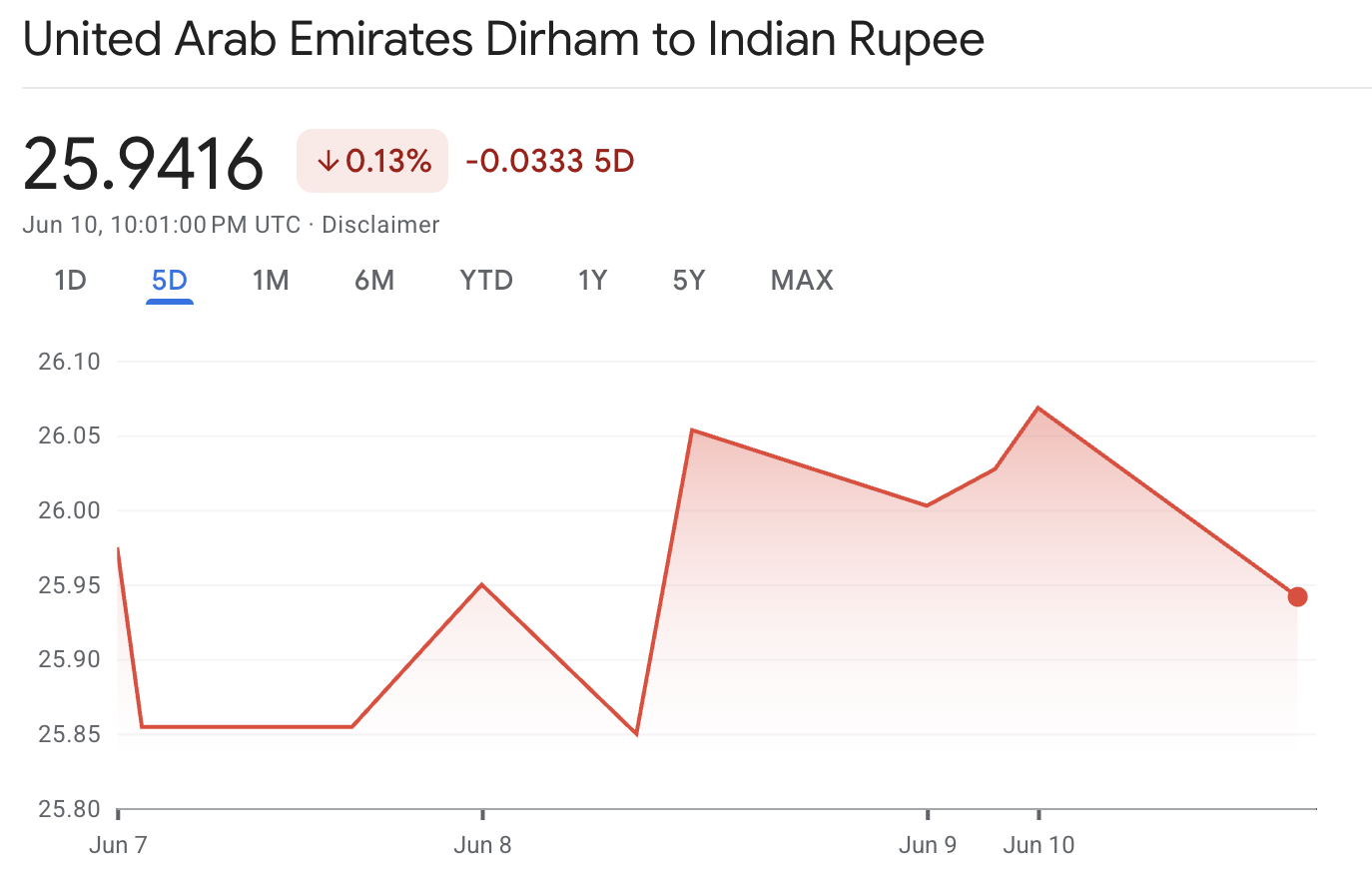
The setup matters because the UAE dirham is effectively pegged to the US dollar. AED/INR therefore tracks rupee movement against the dollar far more than any independent dirham volatility.
For UAE-based remitters and FX traders, the key question is simple: is this pullback a healthy pause, or the start of a deeper rupee rebound?
The pair sits close to historically firm levels for the dirham, but it has lost upside momentum after failing to push beyond the 26.30-26.35 resistance area. That zone is now the main technical ceiling.
The latest live quotes showed AED/INR ranging around 25.94 to 26.07 across market data sources, with Wise showing the pair near 26.07 and Investing.com showing a daily range of 25.94 to 26.07. Recent range data also showed the pair pulling back from the 26.30-26.35 high zone, while the broader 90-day structure remains well above the 25.10 area.
This gives a cleaner technical map than USD/AED, which stays tightly anchored by the dollar peg. AED/INR behaves more like a rupee stress gauge for Gulf remitters: when the rupee weakens, the dirham buys more rupees; when the rupee steadies, AED/INR cools.
The daily picture has shifted from bullish extension to corrective consolidation. RSI at 46.45 is neutral; the market is neither overbought nor oversold, which leaves room for either a rebound from support or a deeper slide if sellers force the pair below its near-term moving averages.
MACD at -0.03 flags short-term bearish momentum. StochRSI, Williams %R, CCI, ROC and bull-bear power all lean negative as well, while ATR at 0.0825 points to elevated volatility relative to the pair’s normally slow-moving profile.
| Signal | Latest reading | Technical interpretation |
|---|---|---|
| Spot area | 26.05 to 26.06 | Holding near upper range |
| RSI 14 | 46.45 | Neutral momentum |
| MACD 12,26 | -0.03 | Short-term sell signal |
| ATR 14 | 0.0825 | Higher volatility |
| EMA 20 | 26.02 | Near-term pivot |
| EMA 50 | 26.01 | Short-term trend cap |
| EMA 200 | 25.67 | Major trend support |
| Support | 25.85 / 25.67 | Pullback defence zone |
| Resistance | 26.07 / 26.35 | Breakout ceiling |
| Trend | Long-term bullish, short-term corrective | Rally cooling, not broken |
| Momentum | Bearish short term | Buyers need reclaim above 26.07 |
The signal mix does not confirm a full bearish reversal. It points to a short-term correction inside a still-elevated longer-term structure.
The moving-average setup is the clearest sign of technical tension. Shorter-term averages around 26.00 to 26.07 are capping the upside, while the 100- and 200-period averages near 25.94 and 25.67 keep the floor in place.
The 20- and 50-period averages near 26.02 and 26.01 matter most right now, because the pair is trading inside that cluster. A sustained move above 26.07 would signal that buyers are regaining control and could reopen a test of the 26.30–26.35 zone.
A break below 25.85 would weaken the near-term setup. A deeper fall below 25.67 would carry more weight, dropping AED/INR beneath its 200-period trend support and warning that the wider dirham uptrend is losing structure.
For traders, the immediate setup rewards range discipline over aggressive trend chasing. Buying into resistance offers poor risk-reward unless the pair clears 26.07 with conviction.
For UAE remitters, AED/INR remains attractive against most of the past 90 days, but the best conversion window has likely narrowed from the recent high. A pullback toward 25.85–25.67 could hand patient senders a better tactical entry, while a breakout above 26.35 would signal renewed rupee weakness and a stronger remittance advantage.
The macro backdrop still drives the technicals. The Reserve Bank of India has recently announced measures to support the rupee and attract foreign inflows, while USD/INR holds near the mid-95 zone after touching a May stress point above 96.8 on the FBIL reference-rate series. That keeps AED/INR sensitive to rupee policy support, oil prices, foreign portfolio flows and broad dollar strength.
The base case is consolidation between 25.85 and 26.35, a range that captures the current conflict: fading short-term momentum set against a still-supportive long-term trend.
A bullish continuation needs a clean daily close above 26.07, followed by a retest of 26.30-26.35. Clear that ceiling, and AED/INR could resume its 2026 uptrend into fresh high territory.
A bearish correction needs a break below 25.85, which would expose 25.67, the 200-period average, and the line that separates a normal pullback from a more serious reversal. Below that, the next significant area sits closer to 25.30-25.10, where the pair previously built support.
For traders and remitters following AED/INR, EBC Financial Group’s market insights can help frame the next move, especially if the pair either clears 26.35 or resets toward the 25.85-25.67 support zone.
AED is pegged to the US dollar, so AED/INR moves mainly on changes in the Indian rupee against the dollar. When USD/INR rises, AED/INR usually rises with it.
The short-term signal is bearish to corrective, but the longer-term trend stays constructive above the 25.67 support area. The pair is cooling, not clearly reversing.
The first resistance is around 26.07. A stronger breakout level sits near 26.30–26.35, where the recent rally stalled.
The first support is around 25.85. The more important trend support is near 25.67, close to the 200-period moving average.
AED/INR remains historically favourable, but momentum has cooled. Remitters may want to watch whether the pair rebounds above 26.07 or slips toward 25.85–25.67 before converting.
AED/INR remains elevated, but the rally has moved into a more selective phase. The dirham is still strong against the rupee over a broader horizon, yet short-term indicators now show fading momentum, bearish MACD pressure and resistance across the 26.07–26.35 zone.
The technical structure is not broken unless the pair loses 25.67. Until then, treat the market as a corrective pause within a wider uptrend. For traders, that means respecting the range. For remitters, the dirham still offers strong rupee purchasing power, but the best conversion levels now hinge on whether AED/INR can reclaim upside momentum above 26.07.