Published on: 2026-06-12
As of 12 June 2026, EUR/AUD is faring mildly better on the day but is not decisively bullish yet. The pair was trading around 1.6446, up about 0.13% intraday, with the day’s range between 1.6415 and 1.6453. It opened near 1.6425, so the euro is a touch firmer against the Aussie, but it remains below the 11 June high of 1.6520, the near-term ceiling that has defined this move.
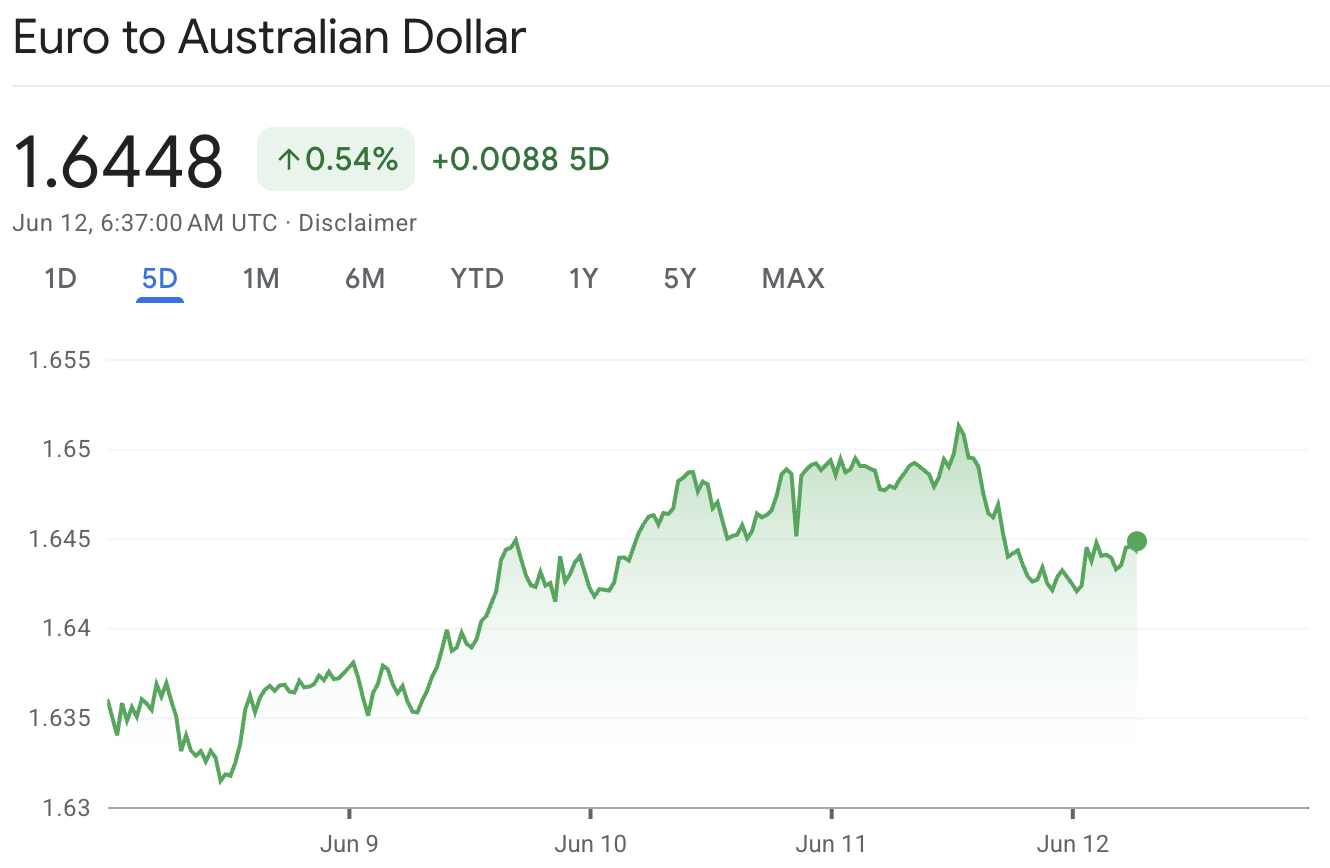 Step back and the recovery looks real but modest. Since 1 June, the pair has climbed from about 1.6250 to the mid-1.64s, a gain of roughly 1.2%. Buyers have clearly returned this month, yet EUR/AUD still sits far below its 52-week high of 1.8167 and only just above the 52-week low of 1.6109. The bounce is happening inside a much wider low range, not in defiance of it.
Both currencies are being pulled by inflation and rate expectations. The ECB has lifted its key rates, effective 17 June 2026, taking the deposit facility to 2.25%, the main refinancing rate to 2.40%, and the marginal lending facility to 2.65%.
Australia still carries the higher policy-rate backdrop, with the RBA cash-rate target at 4.35% and inflation running at 4.6% in its latest snapshot. On rates alone, the Aussie holds the advantage.
What has mattered more lately, though, is risk appetite. EUR/AUD has tracked broad market sentiment more closely than rate differentials or energy prices, with firmer sentiment favouring the Aussie and risk-off moods lifting the euro. That makes the pair as much a sentiment gauge as a rate-spread story, and it is why a shift in market mood can move it further than any single policy headline.
The recovery has a solid foundation. EUR/AUD turned higher after repeated attempts to break beneath 1.6164 failed, marking that area as the base of the move. The rally then broke a run of lower highs by clearing 1.6380, a former resistance level that now acts as the first line of support, before pushing on to about 1.6503. The price action has been notably orderly, which makes the map unusually clean.
Momentum supports the bounce without confirming a breakout. The 14-day RSI is rising and holding above its 50 midline, and MACD has crossed back above its signal line into positive territory, both pointing to a near-term bias toward buyers.
The catch is location: that improving momentum is running straight into the 100-day moving average just above 1.65, a level the pair has respected all year. Until EUR/AUD can close a day above it, the signal is a recovery leaning on resistance rather than breaking through it.
| Signal | Reading | Technical interpretation |
|---|---|---|
| Spot area | ~1.6446 | Mid-range, below the ceiling |
| Day’s range | 1.6415–1.6453 | Tight, orderly price action |
| RSI 14 | Above 50, rising | Near-term bias to buyers |
| MACD | Turned positive | Momentum crossed higher |
| First support | 1.6380 | Former resistance, now support |
| Major support | 1.6164 | Base of the recovery |
| Near-term ceiling | 1.6503 / 1.6520 | Recent high and April support flip |
| 100-day MA | Just above 1.65 | Level respected for the past year |
| Upside targets | 1.6700 / 1.6800 | On a confirmed break of the ceiling |
| Trend | Recovery within a wider low range | Constructive short term, capped above |
| Breakout trigger | Daily close above 1.6520 | Confirms buyers have cleared the key supply zone |
| Bullish confirmation | Hold above 1.6500 after breakout | Shows the move is being accepted, not just swept |
| Bearish invalidation | Break below 1.6380 | Cancels the short-term recovery structure |
| Downside targets | 1.6300 / 1.6164 | Next liquidity zones if the rally fails |
| Event risk | ECB move / risk sentiment | Volatility likely rises if rate expectations or equity sentiment shift |
It comes down to one decision point. A daily close above the 100-day moving average and the 1.6520 high would confirm the recovery and open room toward 1.6700, then 1.6800. A failure to clear it, especially if risk appetite firms and pulls flows back to the Aussie, would send the pair down to 1.6380 and potentially back toward the 1.6164 base.
For anyone converting euros into Australian dollars, the same line applies: 1.6520 is the level that decides whether to act now or wait for a cleaner break.
For traders who want exposure while that question resolves, EUR/AUD is available as a CFD on EBC’s forex platform, one of 37 pairs tradeable on MT4 and MT5 through the full 24-hour, Monday-to-Friday session, with orders routed through institutional liquidity.
Given that the outcome likely hinges on how the market digests the ECB move and where sentiment settles, sizing matters more than the entry. Set the position against your stop rather than the headline level, and keep the event risk around the rate decision in mind before adding leverage.
Mixed. Short-term momentum has improved, but price is stalling at resistance that has held all year, so the bias only turns genuinely bullish on a confirmed close above 1.6520.
1.6520, where the recent high sits just above the 100-day moving average. It is the line separating a real euro recovery from another failed bounce.
Less than the rate gap suggests. Broad risk sentiment has been the stronger driver lately, and it has often outweighed the policy difference between the two central banks.
EUR/AUD has done the hard work of basing and turning higher, but the recovery has yet to prove itself against the resistance that has shaped the pair all year. The 1.6520 ceiling is the arbiter: clear it and the euro has room to run, fail and the pair likely drifts back into its range. Until that resolves, this is a recovery on probation rather than a new trend.