Published on: 2026-07-28
Updated on: 2026-07-28
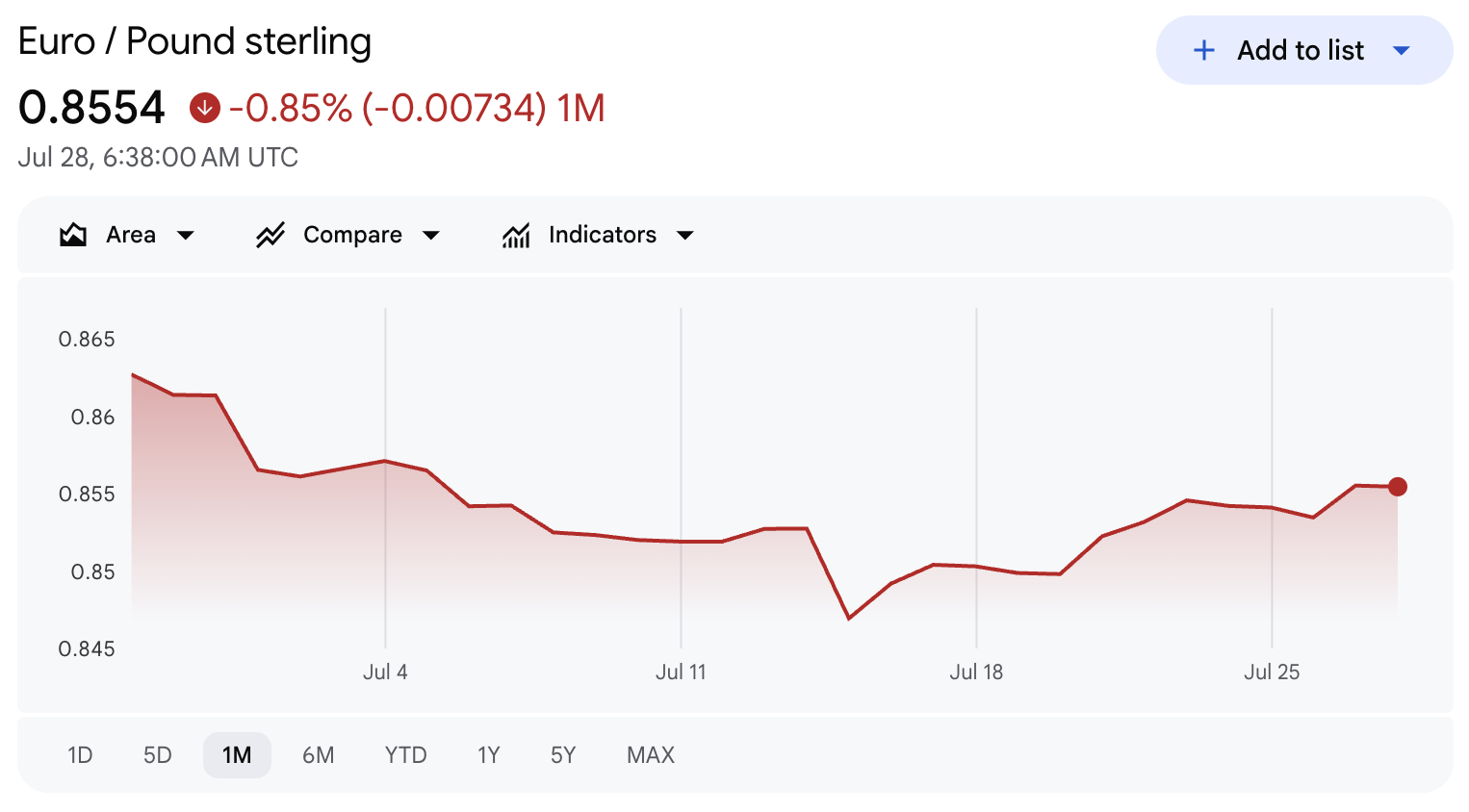
Sterling still pays a positive carry over the euro, yet for the first time this year that carry has stopped capping EUR/GBP. The pair has climbed from 0.84873 on 16 July to 0.85515 on 28 July, about 0.8% off its 2026 low, even as Bank Rate sits 150 basis points above the European Central Bank’s deposit rate.

This is not a euro revival. It is a bearish repricing of sterling’s own rate path: UK inflation has cooled, the odds of another Bank of England hike have faded, and fiscal risk has crept back, leaving the market to weigh how much of the pound’s carry premium is already priced in. The spot differential still favours the pound. The forward path behind it no longer does.
EUR/GBP has risen from 0.84873 on 16 July to 0.85515 on 28 July, about 0.8% off its 2026 low, while the Bank of England-ECB policy-rate gap held at 150 basis points in the pound’s favour.
The rebound reflects a dovish repricing of UK rate expectations, not a stronger euro-area economy.
UK June CPI cooled to 2.6% and services inflation eased to 3.6%, trimming the odds of another Bank of England hike.
The 30 July Bank of England decision is the next catalyst for the pound-to-euro rate, and the MPC vote split matters more than the expected hold on Bank Rate.
| Market signal | Latest reading | What traders see |
|---|---|---|
| EUR/GBP, 16 July | 0.84873 | 2026 low |
| EUR/GBP, 28 July | 0.85515 | 0.8% rebound |
| BoE Bank Rate | 3.75% | Sterling carry support |
| ECB deposit rate | 2.25% | 150bp below BoE |
| UK June CPI | 2.6% | Less pressure to raise |
| Euro-area June inflation | 2.8% | ECB cannot turn dovish easily |
The policy-rate gap still favours the pound. What has shifted is any conviction that it will widen from here. Follow EUR/GBP and the wider FX market with EBC Financial Group as this rate story develops.
EUR/GBP opened July at 0.85973 and fell to 0.84873 by 16 July, offering long-sterling traders both a yield pickup and the prospect that sticky UK inflation would push the Bank of England to raise Bank Rate to 4%. That trade rested on a single premise: UK rates were higher than the euro area’s and would stay higher for longer.
June inflation undercut it. Headline CPI slowed from 2.8% to 2.6% and services inflation eased from 3.7% to 3.6%. Neither print was soft enough to declare the hiking cycle over, but together they drained the urgency from a near-term move.
That was enough to turn the position. Markets had been pricing a move to 4%, and once June’s data pushed that hike further out the curve, the premium baked into sterling began to unwind and EUR/GBP lifted off its 16 July low.
Fiscal risk gave traders a second reason to trim sterling longs. Questions over Britain’s thin fiscal headroom and the funding of household support have not triggered a gilt sell-off or a broader confidence shock, but they leave the pound’s carry looking less compelling once that risk is priced in.
The euro side of the cross offers no clean bullish case of its own. Euro-area GDP contracted 0.2% quarter on quarter in Q1 2026, reversing the prior quarter’s 0.2% expansion. Annual growth slowed to 0.3%, and industrial output has stayed soft.
The ECB is weighing that soft growth against 2.8% inflation, still above its 2% target. It has little reason to declare victory on prices and little room to tighten without feeding recession risk.
So EUR/GBP is grinding higher on relative policy, not euro strength. The single currency does not need to rally; it only needs the ECB’s path to hold up better than the Bank of England’s. That same logic caps the upside: another weak euro-area GDP print, or a downside surprise in July inflation, would revive easing bets and stall the move.
The spot rate gap is already old news: Bank Rate sits at 3.75%, the ECB deposit rate at 2.25%, and that 150bp spread is what pulled EUR/GBP to its July low. Currencies price the expected path of rates, not just today’s level, so a shift in where the market thinks Bank Rate is heading can move the pair even with the spot gap fixed at 150bp.
If the Bank of England holds at 3.75% and bets on 4% keep fading, the market-implied UK path drifts lower and sterling can soften even with Bank Rate pinned.
The euro leg works in reverse. The ECB held on 23 July and kept a data-dependent, meeting-by-meeting stance, neither pre-committing to another hike nor calling the tightening cycle done. That anchored the euro’s rate leg while sterling’s drifted lower.
The carry is still there; the prospect of a widening carry is not. That is why the 150bp cushion no longer gives sterling the same support.
The June meeting split 7 to 2 to hold Bank Rate at 3.75%, with two members backing a hike to 4%, and that MPC split is the clean benchmark for the next Bank of England meeting on 30 July.
A repeat 7 to 2 would confirm the hawkish dissent but might not be enough to restart sterling’s rally. An 8 to 1 or unanimous hold would signal a fading appetite for further tightening. A 6 to 3, or an actual hike, would hand momentum back to the pound.
The decision lands a day after the preliminary euro-area Q2 GDP print, with euro-area flash inflation also due on 30 July. That compresses the repricing of both legs into a single window, so the Bank of England vote will not be read in isolation.
The headline may leave Bank Rate unchanged. The vote beneath it is where the trade sits.
Three outcomes frame the pair into the 30 July decision:
Dovish BoE with resilient euro data: a break above 0.8600.
Hawkish BoE with weak euro data: a retest of 0.8500.
No clear policy shift: the range holds between 0.8500 and 0.8600.
The 0.84873 low is the key downside pivot; a break beneath it would signal that sterling’s rate premium has reasserted itself. On the topside, 0.8600 is both a round number and the origin of July’s sell-off, so a sustained close above it would mark the move as more than a corrective bounce.
Whichever way 30 July breaks, mapping entries and stops around 0.8500 and 0.8600 in advance keeps the risk defined. EBC Financial Group’s risk-reward calculator can frame those levels before the decision.
EUR/GBP has recovered because the market stopped paying up for a sterling rate advantage it had already priced. Softer inflation cut the odds of another BoE hike, and fiscal risk dulled the appeal of holding the pound purely for carry.
The rebound does not need a strong euro-area economy, but it does need confirmation, and the 30 July MPC split is the next test. Unless the hawkish camp widens, sterling may struggle to turn its 150bp carry advantage back into fresh strength against the euro.