Published on: 2026-07-31
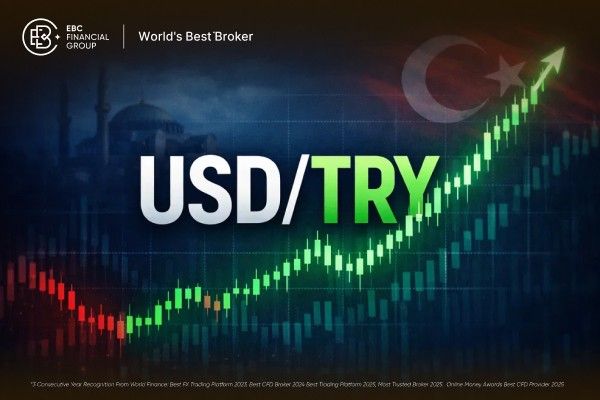
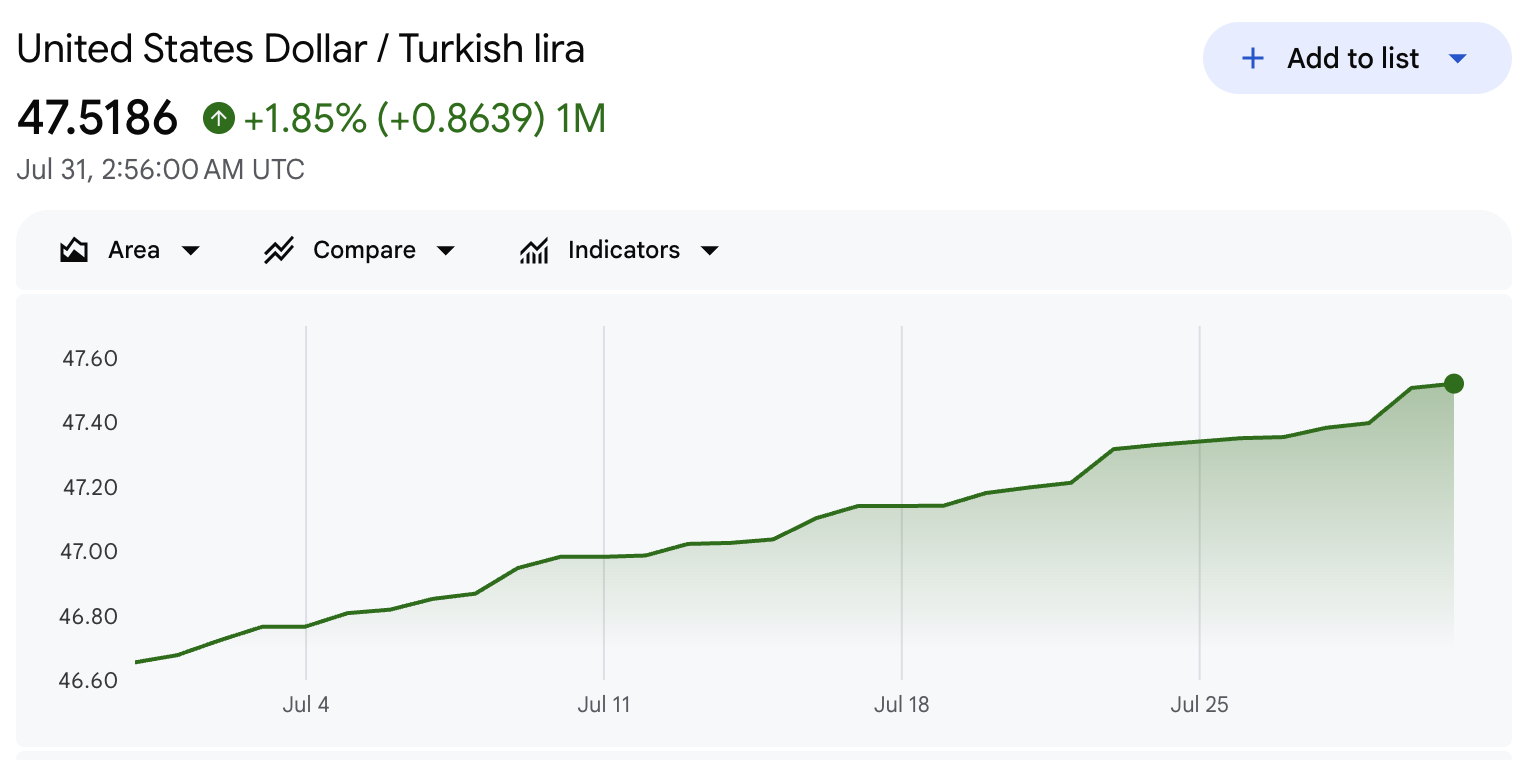
USD/TRY traded around 47.4-47.5 in early dealings on 31 July, leaving the pair near record territory and within reach of the psychological 48 level.
The move has continued even though the Central Bank of the Republic of Türkiye (CBRT) holds its policy rate at 37%, effective market funding remains close to the 40% overnight lending rate and annual inflation has slowed to 32.11%.
The lira’s persistent and relatively orderly decline is now intersecting with weaker bank profitability and thinner capital buffers. Turkish banks are not facing a systemic crisis, but expensive funding, credit limits and gradual asset-quality deterioration leave less room to absorb another inflation, energy or confidence shock.
USD/TRY is near 47.5 despite a 37% policy rate and effective funding close to 40%.
High deposit costs and credit-growth caps are limiting margin recovery and balance-sheet expansion.
July’s reserve change lifted headline FX ratios to 32% and 28% but removed a separate 2.5% lira requirement.
Capital and bad-loan indicators remain manageable, although further depreciation could increase borrower stress.
| Indicator | Latest reading | Why it counts |
|---|---|---|
| USD/TRY | Around 47.4–47.5 | Near record territory |
| CBRT policy rate | 37% | Unchanged since January |
| Effective funding cost | Near 40% | Funding at corridor top |
| Annual inflation, June | 32.11% | Disinflation continues |
| Deposit-bank ROE, May | 24.5% | Profitability weakened |
| Sector capital ratio, June | 16.59% | Above minimums |
| Sector NPL ratio, June | 2.77% | Below 3%; trend worth watching |
The dates differ because official banking data and profitability estimates are released on different schedules. The latest BDDK figures cover June, while the most recent comparable return-on-equity breakdown from BBVA Research covers May.
High nominal rates have slowed lira depreciation without producing a sustained reversal. Exchange rates respond to expected inflation, policy credibility, reserve confidence and future demand for foreign currency, rather than the latest annual CPI reading alone.
The CBRT’s July survey put end-2026 inflation expectations at 29.21% and the 12-month expectation at 23.95%. Participants expected USD/TRY to reach 51.5537 by year-end. These are market-participant estimates, not CBRT forecasts, but they show that continued depreciation remains embedded in expectations.
Energy remains another pressure point. Brent’s late-July surge briefly above $100 showed how an energy shock could quickly raise Turkey’s import bill and complicate the inflation outlook, even though prices subsequently retreated. Political uncertainty and reserve confidence can also affect local demand for dollars.
Maintaining confidence in the lira therefore depends partly on banks continuing to attract and retain local-currency deposits.
Banks need to offer attractive deposit returns to persuade households and companies to remain in lira. Those costs can reprice rapidly, while income from older loans and securities adjusts more slowly. Credit-growth caps also restrict expansion into higher-yielding assets.
BBVA Research reported that deposit-bank return on equity fell to 24.5% in May. Average monthly net income during April and May was 36% below the first-quarter average, with weaker trading gains and other net interest income contributing to the decline.
The same monetary policy helping to slow lira depreciation is also making it more expensive for banks to fund their balance sheets. Strong nominal profits can coexist with weaker economic returns while inflation remains above 30%.
On 1 July, the CBRT raised reserve requirements on foreign-currency deposits and participation funds from 30% to 32% for demand accounts and maturities up to one month. The ratio for longer maturities increased from 26% to 28%.
The change was partly offset by the removal of an additional 2.5% lira-denominated reserve requirement on the same FX deposits. Calling the reform an unqualified increase in banks’ total reserve burden would therefore be misleading. It shifted the composition toward foreign-currency reserves while keeping a large share of FX deposits unavailable for lending.
If lira weakness leads households and companies to hold more dollars or euros, banks face a larger deposit base against which the 32% or 28% ratios apply. Sector dollarisation has remained around or below 40%, so the measure is better viewed as an effort to prevent renewed dollarisation than evidence of immediate banking stress.
The first channel runs through borrowers. Companies that earn lira but owe dollars or euros face higher debt-servicing costs. Imported fuel, machinery and intermediate goods also become more expensive, weakening cash flow and raising restructuring risk.
The second channel runs through capital calculations. Foreign-currency assets and risk-weighted exposures become larger when translated into lira. Unless eligible capital grows at a similar pace, reported ratios can fall.
That effect became more visible after fixed-exchange-rate regulatory relief ended on 1 January 2026. Fitch estimated before the change that removing the relief could lower reported capital ratios by an average of 170-200 basis points, although it viewed the change as credit-neutral for most rated banks.
Banks do not automatically lose money whenever USD/TRY rises, particularly when direct currency positions are matched or hedged. Borrower stress and the expansion of lira-denominated risk-weighted assets are the broader concerns.
The latest BDDK data provide a stable baseline: the sector NPL ratio was 2.77% in June and capital adequacy stood at 16.59%.
Current data do not indicate a systemic Turkish banking crisis. Capital adequacy remains above regulatory requirements, the aggregate NPL ratio is below 3%, and the sector recorded TL527.4 billion in net profit during the first half of 2026.
The buffers have nevertheless weakened. BBVA Research put May capital adequacy at roughly 17% for private banks and 15.5% for public banks, while common-equity Tier 1 ratios continued to decline. Fitch has also reported gradual asset-quality deterioration, particularly in unsecured retail and small-business exposures.
The system remains profitable and adequately capitalised, but its capacity to absorb a larger shock is lower than headline profit growth alone suggests.
A July inflation reading above the market survey’s 1.68% monthly expectation, another oil-price spike, weaker reserves, renewed political uncertainty or faster deterioration in bank asset quality could accelerate depreciation. The 1.68% figure is the modified mean of survey participants’ estimates, rather than an official CBRT inflation forecast.
Softer inflation, lower energy prices, continued growth in lira deposits and stronger reserve confidence would favour a slower path. The 13 August Inflation Report will provide the next detailed update on the CBRT’s assessment.
For near-term monitoring, 47.00-47.30 is the first area below the market, while 48.00 remains the immediate psychological barrier. A sustained break could bring 48.50-49.00 into view. These are scenario levels, not guaranteed targets. Calling 48.50-49.00 a severe stress case would be excessive when the July survey already placed the average year-end expectation above 51.5.
No. Capital adequacy, profitability and aggregate bad-loan indicators remain manageable, although core capital buffers and returns have weakened.
Deposit costs can reprice faster than loan income, while credit-growth caps restrict expansion into higher-yielding assets.
It can contribute if weaker confidence lifts foreign-currency demand. Inflation, energy prices, reserves and political developments remain the more immediate drivers.
Turkish banks remain stable, but preserving that stability is becoming more expensive as the lira weakens. High funding costs, credit restrictions and thinner capital buffers reduce flexibility. If inflation or confidence deteriorates again, foreign-currency demand, borrower stress and USD/TRY could begin reinforcing one another.