Published on: 2026-04-20
BlueBird 7 was supposed to strengthen confidence in AST SpaceMobile’s rollout, but the mission instead revived concern over execution risk.
The direct financial hit appears limited because AST expects the satellite cost to be recovered through insurance.
The bigger issue is timing, because investors value AST largely on constellation buildout and commercial activation rather than current earnings power.
The next update on shipments, launch cadence, and the year-end satellite target now matters more than the lost spacecraft itself.
ASTS stock is back under scrutiny after AST SpaceMobile said BlueBird 7 was inserted into a lower-than-planned orbit during Blue Origin’s New Glenn 3 mission. The satellite separated and powered on, but the orbit was too low for sustained operations, forcing AST to deorbit the spacecraft.

That matters because BlueBird 7 was meant to do more than add one satellite to orbit. Blue Origin said the mission would expand AST’s direct-to-smartphone broadband capacity and help enable its initial service rollout in 2026.
ASTS was not being judged on the cost of a single spacecraft. It was being judged on whether AST SpaceMobile could turn production progress into a repeatable launch cadence and then into commercial scale. BlueBird 7 was supposed to strengthen that case. Instead, it reopened the market’s concern that execution may prove slower and less predictable than investors had hoped.
The financial damage appears manageable. AST said the cost of BlueBird 7 is expected to be recovered under its insurance policy. The market concern sits elsewhere. Investors now have to decide whether the New Glenn launch anomaly changes the timetable for constellation buildout, service readiness, and the premium valuation ASTS still carries.
BlueBird 7 launched on April 19 from Cape Canaveral aboard New Glenn’s third mission. Blue Origin had highlighted the flight as an important step for the rocket and said the mission would feature the return of the first-stage booster that had already flown once before.
The problem emerged after liftoff. AST said the upper stage of the launch vehicle placed BlueBird 7 into a lower-than-planned orbit. The satellite separated and powered on, but the altitude was too low for sustained operations using its onboard thruster system. AST said the spacecraft will be deorbited.
That distinction matters. AST did not describe the event as a satellite design failure. It pointed to the launch vehicle’s upper stage as the source of the off-nominal insertion. For the market, however, the practical result is the same: BlueBird 7 will not contribute to the network, and the mission no longer serves as the operating proof point management had hoped to deliver.
The satellite carried unusual weight in the equity story. In January, AST described BlueBird 7 as the second spacecraft in its next-generation campaign, identical to BlueBird 6 and built around a nearly 2,400 square foot communications array with peak data rates of up to 120 Mbps. AST also said future New Glenn missions could carry as many as eight next-generation BlueBird satellites per flight.
That is why the market is unlikely to view this as a routine launch mishap. BlueBird 7 sat in the middle of a sequence investors were using to judge whether AST could move from technical validation to repeatable deployment. The launch itself was important. The mission’s real significance was what it was supposed to prove about cadence.
AST SpaceMobile has moved beyond the pure-concept phase. The company reported full-year 2025 revenue of $70.9 million and said it had secured more than $1.2 billion in aggregate contracted revenue commitments from partners. Management also said 2026 should bring scaling from initial commercial activation toward broader commercial service.
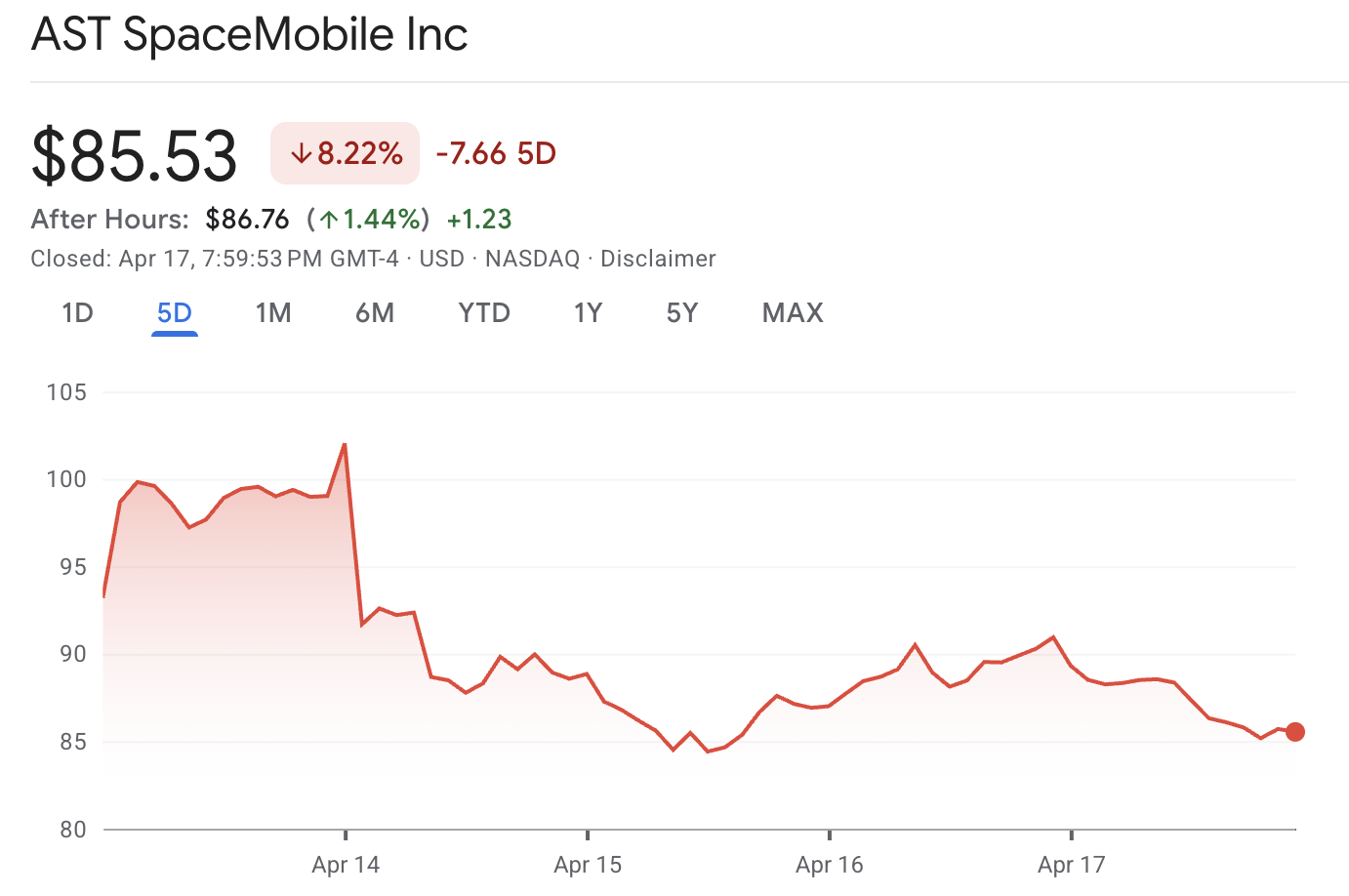
Yet the stock still trades on future economics far more than present earnings. At the latest regular close before the April 19 anomaly, ASTS stood at $85.53, implying a market capitalization of about $17.6 billion, while the company remained loss-making on an EPS basis. That gap between current revenue and market value is exactly why execution news can move the shares so sharply.
In other words, BlueBird 7 did more than remove one satellite from the plan. It forced the market to revisit whether AST still deserves the same premium attached to its rollout story. When investors are paying for future scale, a missed milestone can pressure sentiment faster than reported revenue can offset it.
AST SpaceMobile has made measurable commercial progress, but the stock still trades mainly on whether that progress can turn into a reliable launch and service cadence. The figures below summarize the company’s latest disclosed operating and market markers.
| Metric | Latest disclosed position |
|---|---|
| Last regular close before the anomaly | $85.53 |
| Market capitalization | About $17.6 billion |
| Full-year 2025 revenue | $70.9 million |
| Contracted revenue commitments | Over $1.2 billion |
| Pro forma liquidity at year-end 2025 | Over $3.9 billion |
Those figures help explain why AST SpaceMobile stock remains so sensitive to mission risk. AST is no longer a pure concept story, but the valuation still assumes that production progress, launch access, and partner demand can be converted into a functioning direct-to-device satellite network at scale. The opportunity remains large. So does the execution burden.
The cleanest financial reading is that BlueBird 7 is likely insured, but the opportunity cost is not. AST said the satellite’s cost is expected to be recovered under its insurance policy, which should soften the accounting damage and reduce the chance of an immediate balance-sheet shock.
That does not remove the larger market problem. Insurance cannot restore a missed launch window, recover lost validation, or compress the calendar needed to support commercial activation. For AST, time is not a side issue. Time is part of the valuation case.
This is why the stock reaction is best understood as a repricing of execution risk rather than a simple adjustment for lost hardware. Investors had started to view AST as a company entering a more credible deployment phase. BlueBird 7 interrupts that narrative, even if the root cause sat with the rocket rather than the satellite.
The first test is manufacturing continuity. AST said it is already in production through BlueBird 32 and that BlueBird 8 through BlueBird 10 are expected to be ready to ship in about 30 days. If that timetable holds, management can argue that the anomaly did not break factory cadence.
The second test is launch timing. In March, AST said it expected additional launches every one to two months on average. After the BlueBird 7 setback, the company reiterated that it still expects an orbital launch every one to two months on average during 2026.
The third test is the year-end constellation target. AST said in March that it saw a path to 45 to 60 satellites in orbit by the end of 2026. In its April 19 launch update, it continued to target approximately 45 satellites in orbit by year-end. That reaffirmation helps, but it also raises the bar for the next missions.
The fourth test is commercial readiness. Blue Origin had said BlueBird 7 was intended to help enable AST’s initial service rollout in 2026. Future updates on service timing now carry more weight because the market will be looking for evidence that one failed mission has not pushed the broader timetable off course.
Yes. AST said the cost of BlueBird 7 is expected to be recovered under its insurance policy. That limits the direct financial hit, but it does not restore lost time.
AST did not describe it that way. The company said the launch vehicle’s upper stage inserted the satellite into a lower-than-planned orbit.
Possibly. AST kept its expected 2026 launch cadence intact and still targets about 45 satellites in orbit by year-end. The next launches will determine whether that remains credible.
Because investors use each mission as evidence that manufacturing, launch access, and commercialization are advancing together on schedule. When one link breaks, valuation risk rises quickly.
BlueBird 7 has not broken the long-term AST thesis, but it has raised the execution bar. AST still has liquidity, contracted demand, satellites in production, and a stated path to keep launching. What changed is the degree of confidence investors can assign to that timetable after a mission meant to de-risk it instead revived uncertainty.
For ASTS stock, the next decisive signal will not come from insurance recovery alone. It will come from shipment timing, launch cadence, and whether management can keep its 2026 deployment targets intact after the BlueBird 7 launch anomaly.