Published on: 2026-02-16
Updated on: 2026-02-16
AST SpaceMobile has transitioned from proof of concept to the build phase, and ASTS now trades as a company where delivery, rather than demand, is the primary variable. With the stock at approximately $82.51 as of February 14, 2026, the market is already factoring in significant commercial success. As a result, execution quality will be the key determinant for performance from 2026 through 2030.
The next five years are particularly pivotal because ASTS is building a new layer of telecom infrastructure rather than selling a consumer product. Its satellites are designed to connect directly to standard phones using partners’ licensed cellular spectrum. If the constellation scales as planned and service quality remains high, revenue could accelerate rapidly. Conversely, delays or dilution could negatively impact valuation more quickly than anticipated.
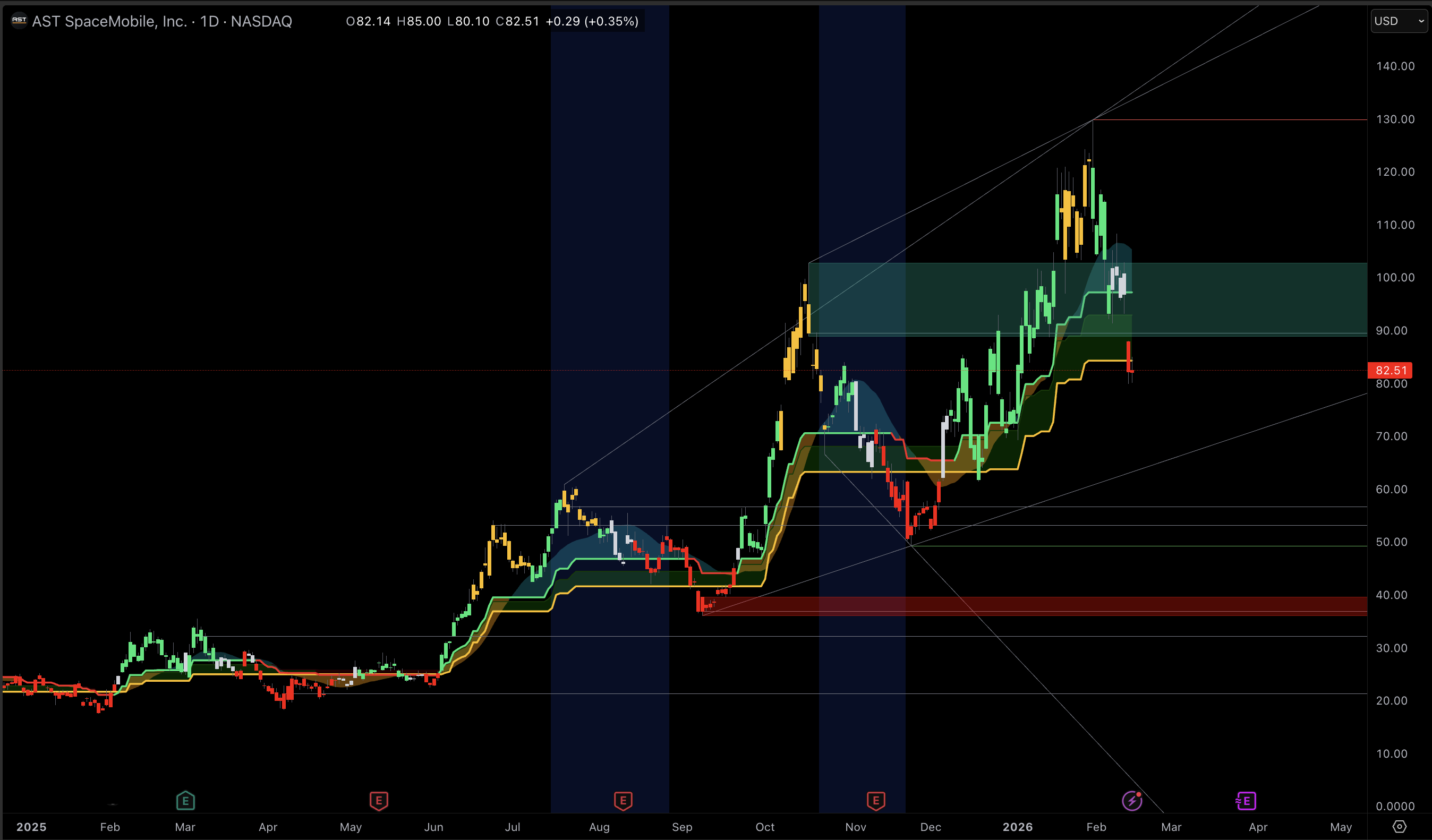
2026 is a year focused on establishing commercial credibility rather than generating mature revenue. The market will prioritize consistent service activations, stable connections, and reliable operations over subscriber numbers. Management has set a target of frequent launches and aims to place 45-60 satellites in orbit by year-end 2026, which is a key milestone for investors.
Capital risk has shifted from whether ASTS can secure funding to the cost of that funding. The company entered 2026 with a strong cash position and added new financing to accelerate deployment. While this extends the financial runway, it introduces complexities, including convertible debt, potential equity issuance, and the market’s tolerance for future dilution.
Regulatory support is present, but timelines remain critical. The FCC’s Supplemental Coverage From Space framework reduces uncertainty for satellite-to-cell partnerships, but approvals are still process-driven and may vary by market.
The stock’s valuation will be driven by the perceived probability of continuous service in key markets, rather than incremental technical achievements.
Downside risk is primarily concentrated in three areas: launch cadence, interference and spectrum coordination, and capital intensity.
Year |
Operational Milestone Investors Watch |
What Moves The Stock Most |
|---|---|---|
2026 |
45-60 satellites in orbit, early service activations |
Coverage consistency, unit economics visibility, and dilution control |
2027 |
Shift from intermittent to near-continuous coverage in priority markets |
Recurring service revenue, churn and usage patterns, capacity constraints |
2028 |
Broader geographic scaling, denser network utilization |
Operating leverage, regulatory normalization, and government monetization |
2029 |
Matured service tiers, higher-value enterprise and public sector uses |
Margin durability, competitive responses, and capital efficiency |
2030 |
Durable cash generation narrative or a renewed build cycle |
Free cash flow profile, reinvestment needs, valuation multiple stability |
ASTS is scaling a constellation purpose-built for direct-to-device cellular broadband. The technical markers investors track are antenna and capacity: BlueBird 6 is designed with an array of roughly 2,400 square feet and targets peak speeds up to 120 Mbps, and the company has positioned it as a step change in bandwidth compared with earlier satellites.
On the financial side, ASTS ended the quarter reported in its latest filed 10-Q (period ended September 30, 2025) with $1.204B in cash and cash equivalents and $15.8M in restricted cash, alongside $706.6M of total debt (current plus long-term, net figures reported). It also reported Class A shares outstanding in the high hundreds of millions across share classes, which matters because convertibles and future equity issuance translate directly into per-share outcomes.
The investment case relies on ASTS’s ability to achieve regular satellite production and launches. Company materials from late 2025 and early 2026 indicate planned launches every one to two months, with a year-end 2026 target of 45-60 satellites. Achieving this milestone will mark the transition from demonstrations to service availability.
ASTS has positioned 2026 as a year of service activation in multiple regions. Its Q3 2025 business update referenced nationwide intermittent service in the continental United States and planned activations in Canada, Japan, Saudi Arabia, and the United Kingdom in early 2026. This approach demonstrates the model with key partners before expanding coverage.
ASTS strengthened liquidity again in February 2026 by pricing $1.0B of 2.250% convertible senior notes due 2036, with an initial conversion price of about $116.30 per share and estimated net proceeds of roughly $983.7M before any option upsizing. The company described intended uses that center on accelerating spectrum deployment, investing in government opportunities, reducing higher-interest debt, and accelerating commercialization.
In parallel transactions, ASTS disclosed a structure to repurchase approximately $296.5M of existing 2032 convertibles and issue about 6.34M shares at $96.92, aiming to reduce the interest burden while limiting incremental dilution relative to the underlying convertibles being retired.
For long-term shareholders, the key consideration is how ASTS manages its timeline. If capital provides schedule certainty and reduces the weighted cost of capital during the build phase, per-share returns can improve even with moderate dilution. However, if capital is delayed, shareholders may face increased downside risk.
ASTS aims to provide carriers with a coverage extension that they can brand, bundle, and monetize without requiring new handsets. This approach reduces adoption barriers but requires seamless integration into carrier operations and billing, as well as mutually beneficial revenue sharing.
A key signal is the move from collaboration to definitive commercial arrangements. For example, ASTS has stated that its agreement with Verizon targets the availability of direct-to-device services for customers starting in 2026, which is exactly the type of timeline that can anchor investor expectations if technical performance follows.
Direct-to-device works only if spectrum access is durable. ASTS has described a hybrid approach that includes shared partner spectrum and controlled mobile-satellite spectrum, with disclosures citing access to 45 MHz of mid-band MSS spectrum in North America and broader tunable access across partner bands globally.
On the policy side, the FCC’s Supplemental Coverage From Space rules provide a clearer route for satellite operators and terrestrial licensees to collaborate using terrestrial spectrum to fill coverage gaps. That reduces the “is it even allowed?” discount, even if it does not remove the “how fast?” discount.
ASTS has positioned government work as both revenue and validation, because defense and public safety users care less about consumer price points and more about availability, resilience, and coverage. Company disclosures have included U.S. government contract activity such as work tied to the Space Development Agency and Defense Innovation Unit pathways. These are not yet the endgame, but they can support early monetization while the consumer side scales.
Satellite networks may appear uneconomic until sufficient constellation density is achieved in high-value regions. At that point, incremental traffic can grow faster than incremental costs, especially when carriers manage distribution and billing. For 2028-2030, the primary driver is not only additional satellites but also increased utilization of existing assets.
ASTS depends on several factors, including manufacturing throughput, launch availability, deployment success, in-orbit performance, gateway readiness, partner integration, and regulatory milestones. Delays in any of these areas can impact timelines, and multiple delays could shift the focus from growth to financing.
Despite the February 2026 funding, ASTS remains a capital-intensive business. The market is more accepting of dilution when it accelerates time-to-revenue, but less so when it appears to be for survival. Convertible structures can also create price ceilings and increase volatility during financing periods.
Direct-to-device technology is politically favored for its coverage benefits, but it is technically complex due to terrestrial spectrum rights and interference constraints. While regulatory frameworks provide support, each jurisdiction has its own approval process, and policy disputes can still cause delays even without regulatory changes.
ASTS operates in a market where established competitors can respond with price competition, spectrum lobbying, and accelerated satellite deployment. Competitive pressure does not need to surpass ASTS to impact the stock; it only needs to reduce future margin expectations.
Any ASTS stock forecast is based on probability-weighted scenarios. The current valuation suggests the market already assigns significant probability to successful scaling. As a result, future returns depend more on execution exceeding expectations than on the concept's viability.
2026 hits major deployment targets and proves repeatable service activations.
2027 brings broader coverage consistency and the start of meaningful recurring service revenue.
2028-2030 expands utilization and improves unit economics as the network densifies.
Implied Price Path: $65-$110 (2026), $80-$150 (2027), $110-$210 (2028), $140-$260 (2029), $170-$320 (2030)
Deployment cadence holds with minimal failures.
Carrier commercialization is smoother than expected, and pricing power remains strong.
Government revenue grows into a durable, higher-margin segment.
Implied Price Path: $95-$150 (2026), $140-$240 (2027), $200-$320 (2028), $260-$420 (2029), $320-$520 (2030)
Launch or deployment delays push high-quality service out by 12-18 months.
Additional capital is raised in weaker tape conditions.
Competitive narratives compress long-term margin assumptions.
Implied Price Path: $35-$75 (2026), $25-$60 (2027), $20-$55 (2028), $15-$50 (2029), $15-$55 (2030)
These ranges are broad because ASTS remains in the transition from build to commercialization. The primary driver of valuation is the expected timeline to scaled recurring revenue, rather than short-term quarterly results.
ASTS is priced like a probability bet on scaling a direct-to-device satellite network. The 2026-2030 outlook hinges on launch cadence, service reliability, and carrier monetization. If the network reaches dense coverage in premium markets, valuation can expand on recurring revenue visibility.
Consistent commercial service activation tied to major carrier partners. Investors want evidence that coverage is dependable, not just technically possible. Meeting the targeted pace of constellation build-out is the cleanest way to raise confidence in the long-term revenue curve.
A delay cycle that forces incremental equity issuance. Capital intensity is manageable when it pulls forward revenue. It becomes destructive when it extends timelines. Financing events can also increase volatility as the market re-prices dilution risk and conversion mechanics.
Clearer rules reduce existential risk, but they do not guarantee speed. The FCC’s framework supports satellite-to-cell partnerships using terrestrial spectrum, which helps long-term confidence. Still, approvals and coordination can stretch timelines and create market-by-market bottlenecks.
Intermittent service is the bridge between demos and continuous coverage. It proves network integration, billing readiness, and basic user experience. The stock often re-rates when intermittent service becomes predictable enough that investors can model the path to continuous service with fewer assumptions.
The stock embeds strong success probabilities. That does not mean it cannot go higher, but it means good news must be exceptional to drive outsized upside, while setbacks can drive sharp drawdowns. The valuation debate is less about “cheap vs expensive” and more about execution confidence.
The ASTS stock forecast for 2026-2030 is fundamentally about operational throughput and timing. AST SpaceMobile has demonstrated its ability to build advanced hardware, raise capital, and secure carrier partnerships. The company is now entering a phase where timely satellite deployment and reliable service are essential.
If ASTS achieves the planned constellation density and reliable activations in 2026, it can support a higher long-term valuation as recurring revenue becomes more predictable. However, if execution falters and dilution increases, the current valuation could decline rapidly.
Disclaimer: This material is for general information purposes only and is not intended as (and should not be considered to be) financial, investment or other advice on which reliance should be placed. No opinion given in the material constitutes a recommendation by EBC or the author that any particular investment, security, transaction or investment strategy is suitable for any specific person.