Published on: 2026-06-15
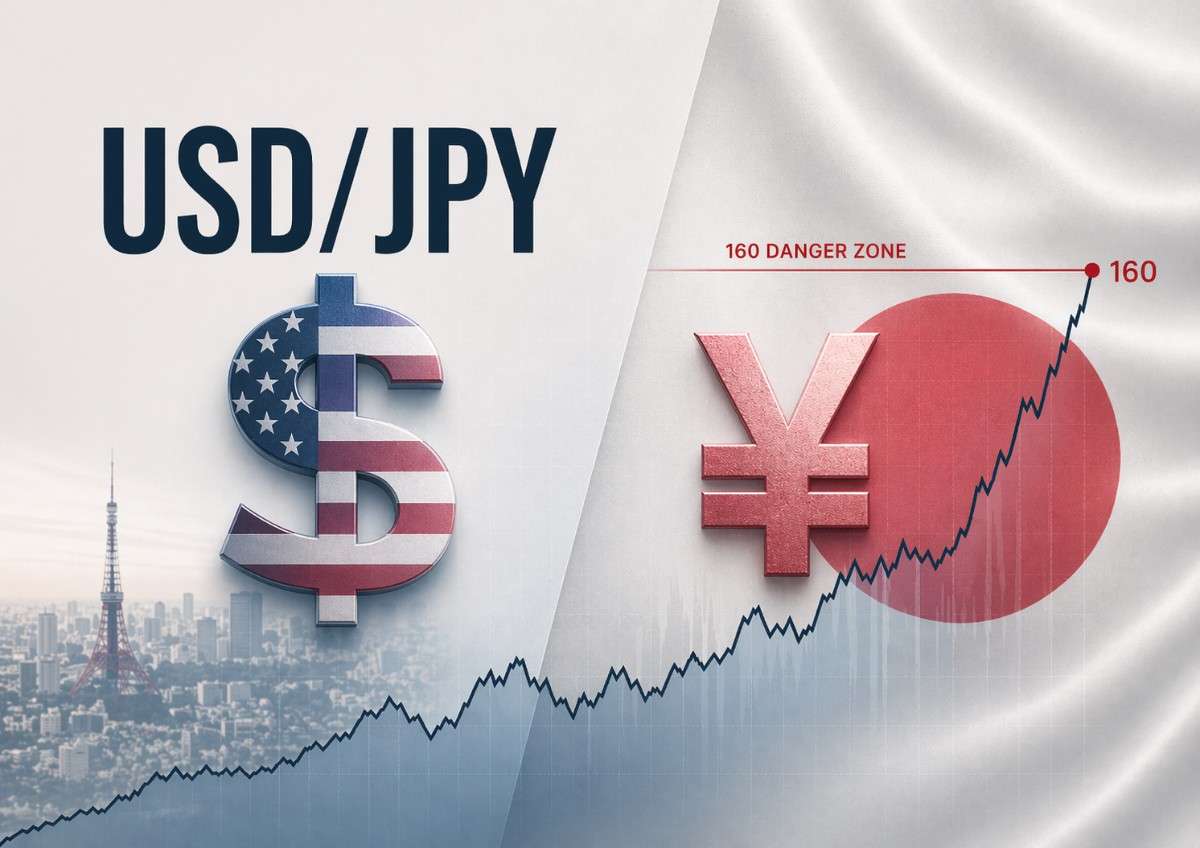
USD/JPY is locked in a tight standoff near the 160.00 handle, trading around 160.00 to 160.20 as the market shifts into wait-and-see mode ahead of the Bank of Japan decision due 16 June. The pair moved lower early in the week, tested the 159.70 to 159.90 area, then stabilized.
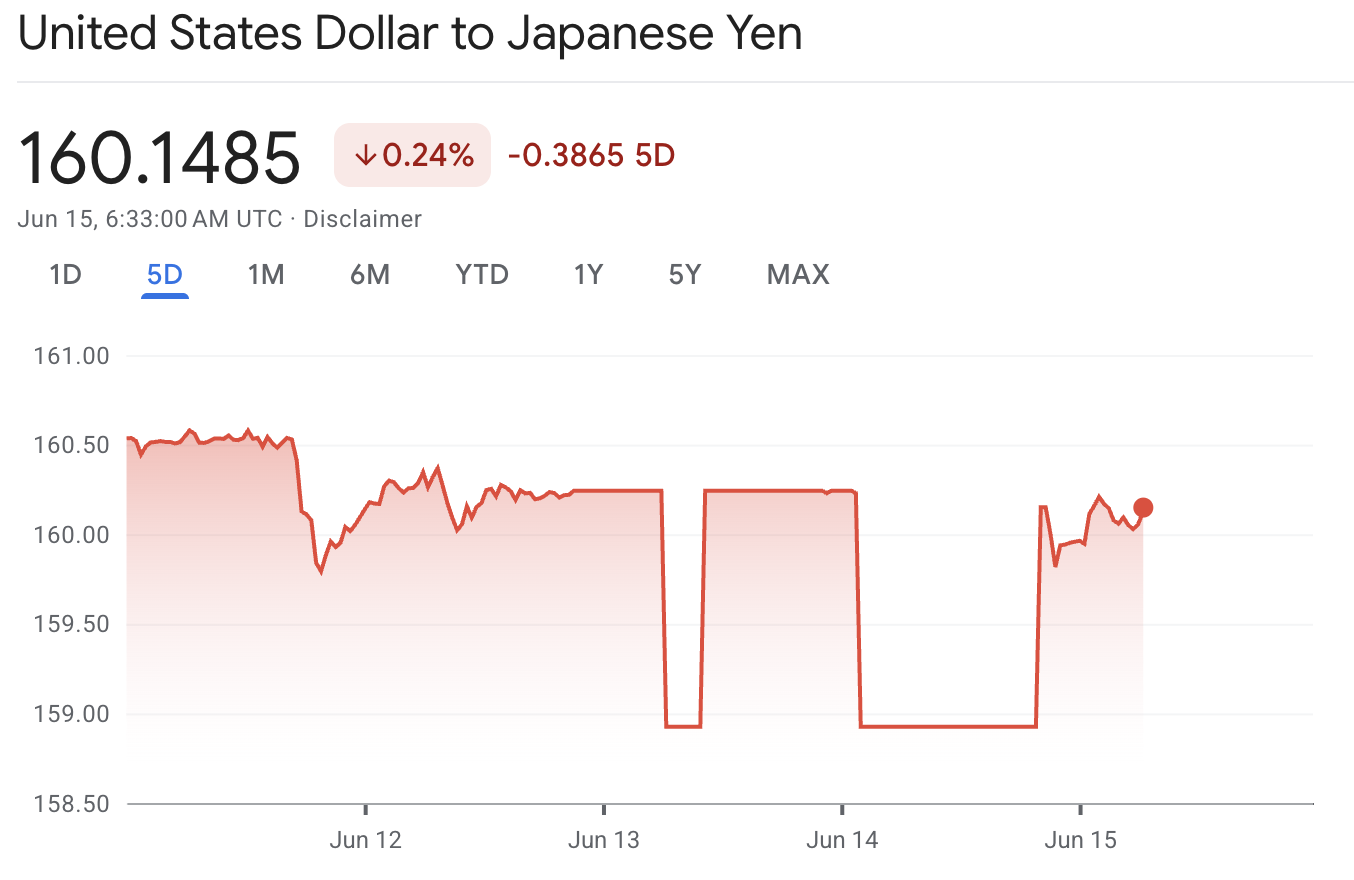
The setup is unusually loaded because 160 plays two roles at once. It is a round-number magnet, and it sits inside the zone where Japanese authorities have stepped in before. The next clean break, in either direction, is likely to define the summer range.
USD/JPY is consolidating near 160.10 to 160.15, holding above its 100- and 200-period four-hour moving averages, which keeps the near-term bias mildly constructive.
The pivotal range is 159.60 support to 160.60 resistance. A four-hour close above 160.60 opens 161.20 and 162.00; a break below 159.60 exposes 158.80 and 158.00.
The 163 to 165 zone is both the bullish breakout target and the most likely level to draw renewed official action.
Markets price roughly a 98% chance of a 25 basis point BoJ hike to 1.00% on 16 June, so forward guidance and bond-purchase plans, not the hike itself, are the bigger driver.
The Fed is expected to hold at 3.50% to 3.75%, leaving a rate gap near 2.5 to 2.75 points that continues to support the dollar.
Intervention is directed by the Ministry of Finance, which acted at a record pace earlier in 2026, making 160.50 to 160.60 the practical line in the sand.
The short-term chart favors the bulls, but only just. After correcting from the 160.60 area, the pair carved out a floor near 159.56 and has since held above both the 100- and 200-period simple moving averages on the four-hour chart. That structure keeps the near-term bias constructive as long as the moving-average support holds.
On the topside, immediate resistance sits at 160.35, followed by the 160.50 to 160.60 band. A sustained four-hour close above 160.60 would expose 161.20, and a break of 161.20 opens the door toward 162.00. Beyond that, the path widens toward the psychological 163 to 165 region that the headline question targets.
On the downside, first support is 159.60, near the 100-period moving average. A close below it would shift attention to 158.80, then 158.00. Those are interpretation of chart levels, not guaranteed turning points, but they frame where momentum would likely accelerate.
| Indicator | Current Signal | Trading Read-Through |
|---|---|---|
| Price action | Compressed between 159.60 and 160.60 | Breakout pressure is building ahead of the BoJ decision |
| 20-period EMA | Price holding near short-term trend support | Momentum has cooled, but buyers have not lost control |
| 50-period EMA | Bias remains constructive while price holds above it | Dip-buying remains active on short pullbacks |
| 100-period SMA | Support near 159.60 on the four-hour chart | First major technical floor for bulls |
| 200-period SMA | Price remains above longer-term four-hour support | Broader trend structure is still bullish |
| RSI | Upper-range but flattening | Momentum is stretched but not yet reversing |
| MACD | Bullish momentum has softened after the 160.60 rejection | Fresh upside confirmation needs a renewed positive crossover |
| ATR / Volatility | Range has narrowed before the BoJ decision | Compression points to a likely volatility expansion |
| Immediate resistance | 160.50 to 160.60 | Break above this zone confirms renewed bullish pressure |
| Breakout confirmation | 161.20 | Sustained close above this level opens 162.00 |
| Immediate support | 159.55 to 159.60 | Break below this zone weakens the bullish setup |
| Downside target | 158.80, then 158.00 | First retracement zones if yen buying accelerates |
| Trend bias | Bullish above 159.60 | Neutral-to-bearish only if support fails |
| Momentum bias | Positive but compressed | Bulls need a clean breakout to regain control |
With 159.60 support and 160.60 resistance framing the range, and a BoJ decision plus live intervention risk sitting directly on top of the chart, USDJPY is positioned for sharp two-way movement once the catalyst lands.
Traders who want to position on either side of this setup can access USDJPY as a CFD through EBC's forex platform, where the pair sits within a 37-pair forex lineup tradeable on MT4, MT5, and the EBC App with access to institutional liquidity and a safe, regulated trading environment.
The trend backdrop is still higher. USD/JPY remains above its key short-term moving averages on the four-hour chart, and the year-to-date path has carried price into the upper part of its range, with a 2026 high near 160.55 printed on 10 June.
Momentum, however, is cooling rather than expanding. The compression between roughly 159.50 and 160.60 over recent sessions points to volatility coiling ahead of the event, a pattern that often precedes a sharp expansion once a catalyst lands.
Daily momentum readings sit in the upper half of their range but have flattened, which is consistent with consolidation rather than a fresh impulse. That is an analytical read of the price action, and it can shift quickly around the decision.
The practical takeaway: the longer the pair holds the 159.60 floor while capped below 160.60, the more energy builds for the eventual break.
Scenario 1: Bullish breakout. If the BoJ delivers the priced-in hike but the statement and the 16 June press conference read as cautious, the rate-gap trade can reassert itself. A four-hour close above 160.60, then 161.20, would target 162.00 and put the 163 to 165 zone in play. This is the path most likely to draw an official response.
Scenario 2: Range and ceiling. The most probable near-term outcome may be continued compression. With a 25 basis point hike already discounted, the decision itself could prove a non-event for price, leaving 160.50 to 161.20 as a ceiling and 159.50 to 159.60 as a floor until the Fed and forward guidance clarify the gap.
Scenario 3: Yen-positive reversal. A hike paired with hawkish guidance, an upgraded inflation view, or firm signals on further tightening could spark yen buying. A break below 159.60 would expose 158.80 and then 158.00, partially closing the divergence trade.
The technical picture sits on top of a rate differential that is not narrowing quickly. Markets price roughly a 97% to 98% probability that the BoJ lifts its policy rate by 25 basis points to 1.00%, which would be the highest level since 1995. The current guideline stands near 0.75% heading in.
On the other side, the Federal Reserve is widely expected to hold its target range at 3.50% to 3.75% at its own meeting this week. Even after a Japanese hike, the gap would remain near 2.5 to 2.75 percentage points, which keeps the carry trade attractive and helps explain why the pair holds 160 despite tightening in Tokyo.
Because the hike is so heavily discounted, the larger driver is likely to be forward guidance, the pace of bond purchases, and how willing policymakers sound about tightening further.
There is also a procedural wrinkle: Governor Kazuo Ueda is hospitalized with a liver cyst infection and is reported to be absent from the vote, with Deputy Governor Ryozo Himino chairing and Shinichi Uchida set to lead the 16 June news conference. Markets will parse that communication closely.
Currency intervention in Japan is directed by the Ministry of Finance, not the BoJ, with the central bank acting only as operational agent.
Finance Ministry data confirmed record intervention of about 11.73 trillion yen, roughly $73.6 billion, over 28 April to 27 May, the first reported yen-buying operation since 2024. Finance Minister Satsuki Katayama has reiterated that authorities are increasingly positioned to act if speculative moves persist.
Speculative positioning underlines the risk. Bearish yen bets have climbed toward a multi-year high, a sign the carry trade is crowded. The 160.50 to 160.60 band is the practical intervention-risk zone: a decisive push above it toward 162 and beyond is the scenario most likely to invite renewed official action, which can produce fast, multi-figure reversals.
The near-term bias is neutral-to-bullish while price holds above 159.60. A four-hour close above 160.60 targets 161.20 and 162.00; a break below 159.60 opens 158.80 and 158.00.
The Ministry of Finance has signaled readiness and intervened at a record pace earlier in 2026. The 160.50 to 160.60 area is the zone most likely to draw action if the dollar breaks higher.
Markets price roughly a 97% to 98% chance of a 25 basis point hike to 1.00% at the meeting that concludes 16 June, which would be the highest rate since 1995.
USD/JPY enters the BoJ decision constructive but capped. Holding above 159.60 keeps the bullish structure intact and leaves 160.60, 161.20, and 162.00 as the upside ladder toward the 163 to 165 zone. A failure to clear 160.60, or a hawkish surprise, flips focus to 158.80 and 158.00.
The realistic base case is range-bound trade until guidance and the Fed clarify the differential. The tail risks sit on both sides: a dovish-sounding hike that powers a breakout into intervention territory, or a hawkish hike that finally rewards yen bulls.