Published on: 2026-08-10
Updated on: 2026-08-10
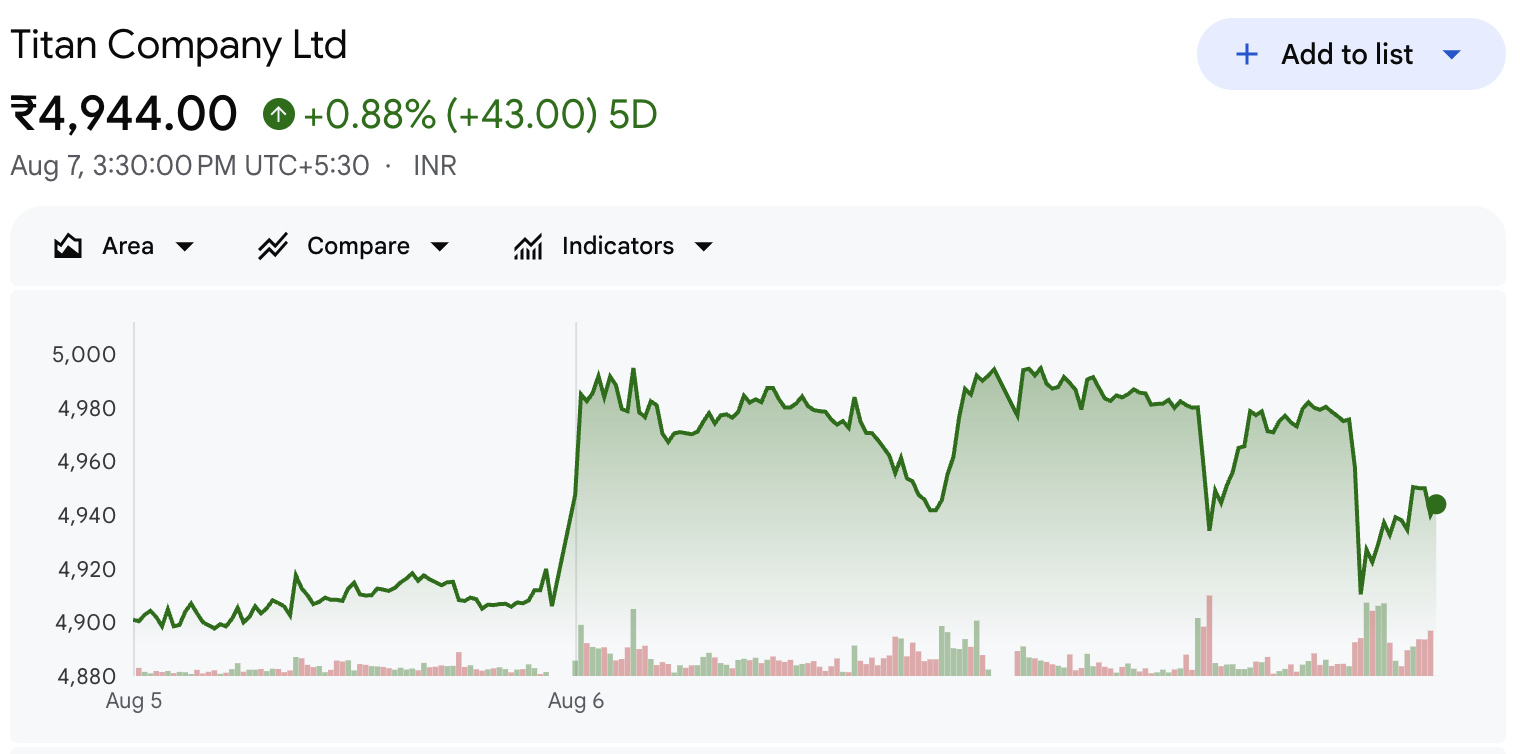
Titan Company shares closed at ₹4,941 on the NSE on Friday, 7 August, down 1.14% and roughly 1.3% below the ₹5,005 fifty-two-week high set earlier the same week. Hours after that close, Titan reported consolidated Q1 FY27 net profit of ₹1,777 crore, up about 63% year on year, on consolidated total income of ₹20,753 crore, up 40%. Monday, 10 August, is the first session in which the market can price the results.

Titan enters it with two forces pulling against each other. The quarter beat almost every published estimate. The stock, meanwhile, had already climbed roughly 26% off its June low and traded above ₹5,000 twice in the preceding week before fading both times. Q1 was clearly strong. How much of that strength the market bought in advance is the open question.
Titan closed at ₹4,941 on 7 August, about 1.3% below the ₹5,005 NSE 52-week high. On the BSE the stock printed a record ₹5,033.80 intraday that same day before closing lower.
Q1 FY27 consolidated net profit reached ₹1,777 crore, up roughly 63% from ₹1,091 crore, against consensus estimates clustered in the ₹1,360–1,390 crore range. Total income rose 40% to ₹20,753 crore, excluding bullion and Digi-gold sales.
Reported profits include a ₹407 crore customs duty gain. Titan disclosed that adjusted for the gold customs duty change, profit before tax grew 37%, against the headline 64%.
Jewellery grew 43% to ₹18,253 crore, powered by festive and Akshaya Tritiya demand. Watches rose 21% to ₹1,543 crore and EyeCare 21% to ₹289 crore.
International jewellery expanded about 136%, reflecting the consolidation of Damas Jewellery alongside genuine Tanishq traction overseas.
Friday’s session is worth understanding before Monday’s. Titan opened at ₹4,978.10, ran to ₹5,003 on the NSE (₹5,033.80 on the BSE, a second consecutive record print), then sold off to close at ₹4,941, down 1.14% from the previous close of ₹4,998.
The results were published after the close, so Friday’s fade carried no verdict on the quarter. It reflected a stock that had already run hard. Titan bounced roughly 26% from its three-month low of ₹3,963.85 on 11 June, cleared its previous ₹4,944.05 high on 4 August, crossed ₹5,000 on 6 August, and crossed it again on 7 August.
Titan therefore arrives at Monday having spent two sessions probing above ₹5,000 and finishing below it each time. The rally was underway well before the earnings landed. Monday tests whether a genuine earnings beat can convert a level the stock keeps touching into one it can hold.
| Q1 FY27 (Consolidated) | Result | YoY Change |
|---|---|---|
| Total income (ex-bullion, Digi-gold) | ₹20,753 cr | +40% |
| EBITDA | ₹3,036 cr | +57% |
| EBITDA margin | 14.6% | +154 bps |
| Profit before tax | ₹2,429 cr | +64% |
| PBT margin | 11.7% | From 10.0% |
| Net profit | ₹1,777 cr | ~+63% |
| Jewellery | ₹18,253 cr | +43% |
| Watches | ₹1,543 cr | +21% |
| EyeCare | ₹289 cr | +21% |
Jewellery is the engine, and it accelerated. The 43% growth (excluding bullion and Digi-gold) came from festive buying, Akshaya Tritiya, and an unusually strong response to Titan’s gold exchange programmes, which is worth flagging because exchange volumes cushion the demand hit from expensive gold.
The composition of that growth is as informative as the total. In the June-quarter business update, Titan reported buyer growth in the early double digits and average ticket size growth in the high double digits, with plain and studded jewellery each growing in the mid-thirties and coins continuing an investment-led run. Most of the revenue lift therefore came from customers spending more per visit rather than from a proportional increase in the number of customers.
Nothing outside jewellery was weak. Watches grew 21% despite a decline in smartwatches, carried by premium analog demand. EyeCare grew 21% on a similar premiumisation shift. Titan also added 77 net new stores during the quarter, taking its network to roughly 3,680 outlets.
Most coverage of the quarter will stop at the headline number. The more useful figure sits one line below it.
Titan’s reported profits include customs duty gains of ₹407 crore, arising from the increase in import duty on gold during the quarter. On the company’s own disclosure, stripping that out leaves profit before tax growing 37% year on year rather than 64%.
A 37% underlying PBT increase on 40% income growth remains a strong result, and it still exceeded the 24–32% profit growth most brokerages had modelled. The adjustment changes what an investor can reasonably extrapolate, though. Duty-related inventory gains follow from a policy change rather than from Titan selling more jewellery at better margins, and they do not repeat next quarter.
The operating picture underneath holds up either way. EBITDA margin expanded 154 basis points to 14.6%, PBT margin moved from 10.0% to 11.7%, and the mix improved through studded jewellery and premium watches. Titan delivered a strong quarter that a one-off gain made look spectacular.
International jewellery grew roughly 136% in the quarter, with the June-quarter update having flagged 128% growth for the international business overall. Most of that step-change is arithmetic. Damas Jewellery has been consolidated into Titan’s numbers since January 2026, and Titan finalised the acquisition accounting this quarter, recognising additional goodwill.
Tanishq, Mia and CaratLane saw strong traction in North America and encouraging double-digit growth in the GCC, while the core Damas business is recovering gradually against a volatile geopolitical backdrop in the region.
Titan holds a 67% stake in Damas, whose network spans six GCC markets: the UAE, Saudi Arabia, Qatar, Oman, Kuwait and Bahrain. Combined with plans to open around 50 Tanishq stores internationally over the medium term, international becomes a structurally larger part of Titan’s reported growth from here.
Year-on-year comparisons will be flattered by consolidation until Damas laps its base in January 2027, so segment-level and like-for-like disclosure will say more than headline growth rates over the next three quarters.
The case for a fresh high is straightforward. Profit rose 63% and beat consensus by a wide margin, income grew 40%, all three core segments grew 21% or better, and brokerage targets sit above the current price: CLSA around ₹5,249, Motilal Oswal ₹5,250, Morgan Stanley ₹5,182, Citi ₹5,075 and Nomura ₹5,000. Titan has also been a rare outperformer in a weak tape, gaining through calendar 2026 while the benchmark fell.
The case against will be in the price action rather than the P&L. ₹5,000 has already attracted selling on two separate attempts, twice at record highs. The stock trades at a demanding multiple, and a meaningful part of the profit beat is a non-recurring duty gain that a careful market will discount.
Three signals are worth watching:
Level: whether Titan clears the ₹5,005 NSE high (₹5,033.80 on the BSE) rather than merely approaching it.
Durability: whether a gap-up holds past the first hour or fades the way Thursday’s and Friday’s moves did.
Participation: whether volume expands on the breakout, or the move happens on thin trade.
Titan has delivered enough to put a fresh high within reach: a 63% profit jump, 37% growth after adjusting for the customs duty gain, jewellery accelerating to 43%, and a widening international base. It has not yet delivered a share price that can stay above ₹5,000.
The growth case is intact. Valuation is the open question, because after about a 25% run off the June low, expectations sit considerably higher than they did eight weeks ago, and the market has already had two chances to pay above ₹5,000 and declined each time.