Published on: 2026-06-30
Updated on: 2026-06-30
Gold fell below $4,000, yet Indian households did not wait for a rebound. Nearly 50 tonnes of old gold returned to the market in April-June as record rupee prices turned old jewellery into cashable profits. A falling gold price usually brings Indian buyers back; this time, it pushed family gold into the market.
Gold fell below $4,000 on 24 June 2026, breaking a psychological floor last seen in November 2025.
Indian households sold nearly 50 tonnes of old gold in April-June, up 43% YoY.
Domestic prices near ₹1.4 lakh per 10g turned old jewellery into profit families could lock in.
Jewellery demand fell 19% YoY by volume, even as India’s total gold demand rose 10%.
Import duty at 15% gave recycled gold more value as fresh imports slowed.
The clearest signal is not gold’s fall below $4,000 alone, but how quickly household gold moved back into circulation.
| Signal | Latest Data | Market Meaning |
|---|---|---|
| Gold price | Below $4,000 | Momentum cracked |
| Old gold sold | Nearly 50t | Old supply returned |
| Selling increase | 43% YoY | Profit-taking widened |
| India gold demand | 151t | Demand held |
| Jewellery volume | -19% YoY | Fresh buying weakened |
| Import duty | 15% | Recycling gained value |
The 50-tonne surge puts a number on the emotion. Families are not waiting to see how much of the rally survives.
Indian households sold because prices were still high enough to preserve years of gains. Waiting for a rebound carried a new risk: gold could fall further before old jewellery was converted into cash.
The Economic Times, citing the India Bullion & Jewellers Association, reported that Indian households sold nearly 50 tonnes of old gold in April-June, up 43% YoY. Domestic prices had recently touched around ₹1.4 lakh per 10 grams, while fears of a drop toward ₹1.2 lakh pushed more families toward cash sales rather than jewellery exchanges.
Gold held in a locker can feel permanent until the profit becomes too large to ignore. An old bangle bought years ago now carries a visible market value, not just emotional value.
The selling was profit protection, not distress. Indian households are not giving up on gold; they are refusing to give back the gain.
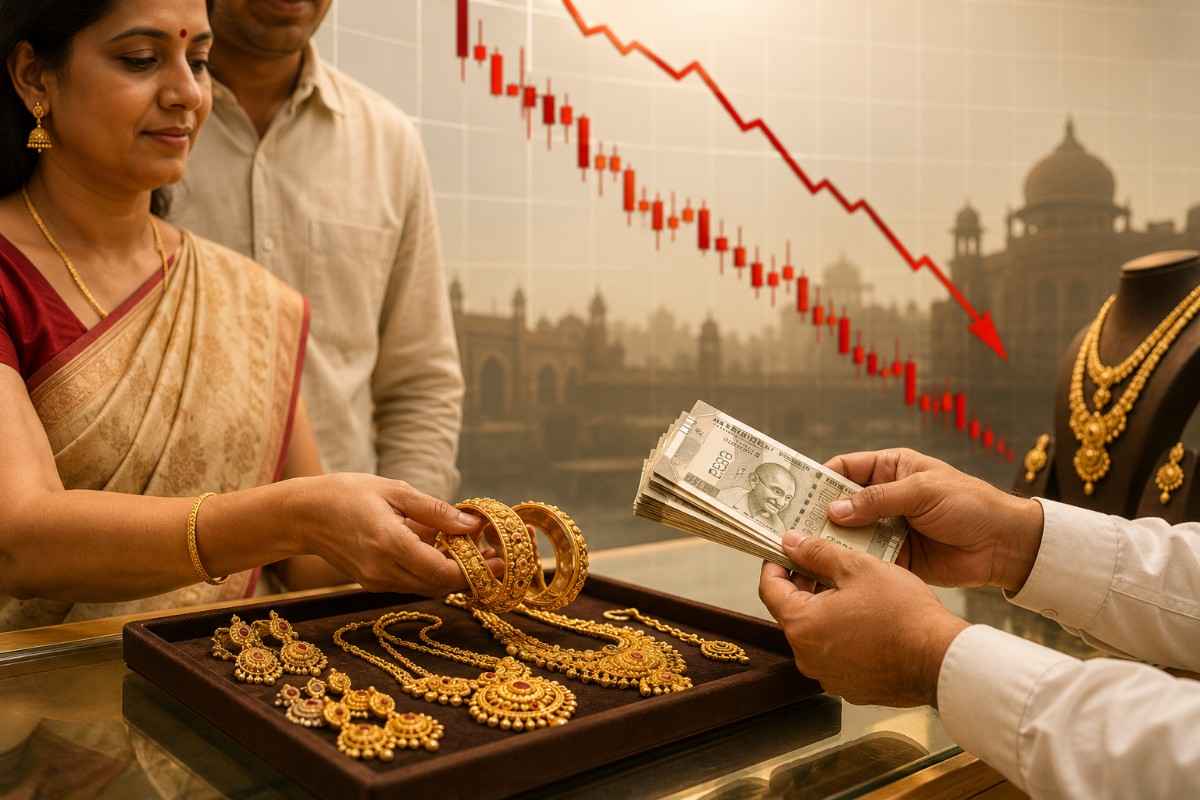
India’s gold market now sends two different signals. Demand by weight is weakening. Demand by value remains high.
World Gold Council’s Q1 2026 Gold Demand Trends showed Indian gold demand rose 10% YoY to 151 tonnes, while its value surged 99% to a record ₹2,275 billion, or about $25 billion. Jewellery volumes fell 19% YoY, even as jewellery spending rose 47%.
That gap pushed old jewellery back into shops. Families are buying less gold by weight, paying more when they do buy, and using existing holdings to manage the cost.
Old gold exchange already accounted for 40% to 60% of jewellery transactions across retailers in Q1. Recycling has moved from occasional family practice to a core part of how India absorbs high prices.
The emotional value of gold remains intact. The financial value has become too large to leave untouched.
Gold below $4,000 changed the timing. High rupee prices gave households a reason to sell; the global break gave them a reason not to wait.
Gold futures fell below $4,000 on 24 June 2026 for the first time since 18 November 2025, with the most-active contract near $3,992. The move came as a stronger US dollar and rising expectations for higher interest rates weighed on precious metals.
Higher interest-rate expectations weaken gold because the metal pays no yield. A stronger dollar adds pressure by making dollar-priced bullion more expensive abroad.
For Indian households, the global break arrived while rupee prices still made selling attractive. The dollar move did not erase local gains; it made waiting feel more expensive.
India’s gold market normally leans on imported bullion. More old jewellery returning to shops gives jewellers and refiners another source of supply.
The import backdrop changed quickly. India raised the gold import duty from 6% to 15% in May, while domestic prices rose by less than the full duty increase, leaving the local market at a discount to the landed import cost.
Monthly gold imports reportedly fell to about 25-30 tonnes from 75-100 tonnes after the duty hike. Import value still rose 34% YoY in May to $3.41 billion, driven by higher prices.
Recycled gold cannot replace India’s entire import requirement. It can reduce the urgency to source fresh metal when jewellery demand is soft, duties are high, and households are selling at elevated prices.
Old jewellery has become a domestic supply buffer. The more gold returns from lockers, the less pressure falls on imports at the margin.
Gold’s next test is whether $4,000 becomes support again or turns into resistance. A clean recovery above that level would ease the fear that January’s peak marked a larger turning point.
A failed recovery would keep households alert. If prices remain high in rupees while global gold struggles to reclaim $4,000, more families may choose cash over waiting.
Three numbers now decide whether the selling wave fades: old-gold recycling volumes, monthly import tonnage, and the gap between domestic prices and landed import cost.
If old-gold selling stays high while imports remain compressed, the April-June surge will look less like a one-quarter rush and more like a change in market behaviour. India’s gold market would move from pure accumulation toward circulation.
Indian households are selling old gold to lock in gains while rupee prices remain at historically high levels. Prices near ₹1.4 lakh per 10 grams made old jewellery unusually valuable, while fears of a deeper fall pushed more families toward cash sales.
Yes. Gold futures fell below $4,000 on 24 June 2026 for the first time since November 2025. The break came as a stronger US dollar and higher interest-rate expectations pressured non-yielding assets such as gold.
Gold prices in India reflect the global dollar price, the rupee-dollar exchange rate, import duty and local market premiums or discounts. A weaker rupee or higher duty can keep domestic prices elevated even when global gold falls, which explains why old jewellery still carried unusually high cash value.
No. It shows price discipline, not a loss of attachment. Gold still holds cultural and financial value in India, but households are more willing to monetise old jewellery when the gain becomes too large to leave untouched.
Old gold selling can pressure India’s local premiums and reduce import demand. It is unlikely to drive global gold prices alone. The larger global signal remains whether gold reclaims $4,000 or turns that level into resistance.
India’s Q2 recycling data and July import volumes will decide whether the April-June surge was a cash-out rush or the start of a domestic supply shift. A recovery above $4,000 slows the urge to sell; repeated rejection below it keeps old jewellery moving from lockers to shops.
Gold’s next signal is no longer only the Fed, the dollar or central banks. It is how much family gold India brings back to market.