Published on: 2025-12-31
Updated on: 2025-12-31
A limit order is an instruction to buy or sell an asset at a specific price or better, giving the trader control over the price but not a guarantee that the trade will happen. It is one of the most fundamental tools in trading, yet it plays a crucial role in how trades are planned and executed.
Instead of accepting the current market price, a trader sets the exact price they are willing to pay or accept. This simple choice can shape entry timing, exit results, and trading costs.
For real traders, limit orders are crucial because they help avoid rushed decisions and unexpected price movements, especially in fast or thin markets where prices can fluctuate rapidly.
In trading terms, a limit order sets a maximum price for a buy or a minimum price for a sell. A buy limit order sits below the current market price, and it only executes if the market falls to that level or lower. A sell limit order sits above the current market price, and it only executes if the market rises to that level or higher.
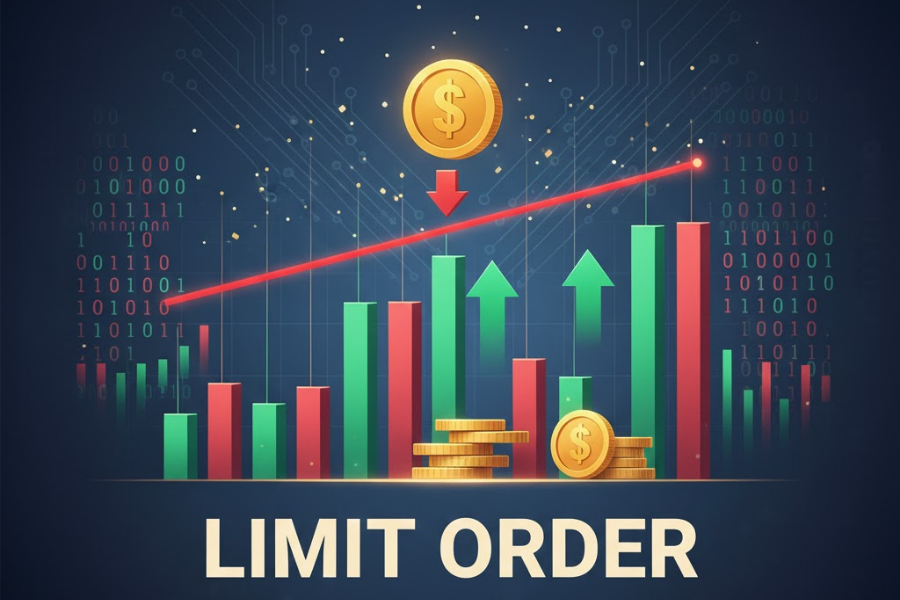
The key idea is price control. The trader decides the price in advance.
Traders see limit orders directly on their trading platform. They appear as pending orders, often marked on the price chart and listed in the order panel.
Long-term traders, swing traders, and range traders use them often because they plan entries and exits in advance. Short-term traders also use limit orders, but they must be careful in fast markets where the price may touch the level briefly and then move away.
Some platforms also allow variations such as:
Day limit orders, which expire at the end of the trading session
Good Till Canceled (GTC) limit orders, which remain active until filled or manually canceled
Several market forces affect how useful or risky a limit order can be on any given day.
Market volatility: When prices move quickly, limit orders may not fill because the price jumps past the level too fast.
Liquidity: In liquid markets with many buyers and sellers, limit orders fill more smoothly. In thin markets, they may sit unfilled.
News and data releases: During major economic news, prices can gap over limit levels, leaving orders untouched.
Time of day: Active sessions, such as when major markets overlap, tend to give better fills than quiet hours.
When volatility rises, limit orders offer price protection but increase the risk of missing the trade.
Limit orders shape both entry and exit decisions. On entry, they help traders avoid buying too high or selling too low. This supports disciplined trading, especially when a clear price level has been identified from analysis. On exit, limit orders are often used to take profit at a planned target, removing emotion from the decision.
However, there is a trade-off. While price is controlled, execution is uncertain. A limit order may never fill, or it may fill only partially. This can affect trade size and timing.
Good situation:
Calm market conditions
Clear support or resistance levels
High liquidity
Bad situation:
Fast news-driven moves
Low liquidity periods
Sharp gaps or spikes
Understanding this balance helps traders choose when a limit order fits the situation.
Assume a stock is trading at $100. A trader believes $95 is a fair buy price based on past price behavior. Instead of buying at $100, the trader places a buy limit order at $95.
If the price falls to $95, the order is filled at $95 or better. If the price only drops to $97 and then rises, the order stays unfilled.
Now compare this with a market order. If the trader used a market order at $100, the trade would execute immediately, but at a higher price. The limit order offers better price control, but it also risks missing the trade if the market never reaches the chosen level.
Limit orders are often confused with stop orders, but they serve different purposes.
A limit order focuses on price control. It tells the market, “Only trade at this price or better.” A stop order focuses on activation, meaning it becomes active only after the price reaches a trigger level.
For example, traders often use:
Limit orders to enter at value levels
Stop orders to exit losing positions or protect profits
Confusing the two can lead to unintended executions or missed trades, especially in fast markets.
Before placing a limit order, traders should review a few key items on their platform.
Check the current bid and ask prices to see where the market is trading now.
Look at recent price action to confirm the level makes sense.
Review market depth or order book if available, to see nearby buying or selling interest.
Confirm order duration, such as a day order or good till canceled.
A practical tip is to recheck limit orders whenever market conditions change, especially before major news or the session opens.
Placing the price too far away, which leads to many missed trades and frustration.
Ignoring news risk, causing orders to sit uselessly during sharp moves.
Forgetting open orders, which may trigger unexpectedly later.
Using limits in illiquid markets, where fills are uncertain.
Assuming execution is guaranteed, which can distort trade planning.
Each of these mistakes comes from misunderstanding the balance between price control and execution risk.
Market order: Executes immediately at the best available price.
Stop order: Activates only when the price reaches a trigger level.
Stop limit order: Combines a stop trigger with a limit price.
Liquidity: Measures how easily trades can be filled.
Slippage: Difference between expected and actual execution price.
A limit order focuses on price control, while a market order focuses on speed. With a limit order, the trader chooses the exact price and waits, accepting that the trade may not happen. With a market order, the trader accepts the current market price to ensure immediate execution. This difference matters because it affects both cost and certainty. Beginners often prefer market orders for simplicity, but limit orders offer more discipline once price planning becomes important.
Yes, a limit order can expire or be canceled without any execution. This happens when the market never reaches the chosen price during the order’s active period. Some orders last only for the day, while others remain open until manually canceled. Understanding order duration is important because an expired limit order means no trade took place, which can affect a trading plan that depended on that entry or exit.
Limit orders are safer in terms of price control, but not always safer overall. They protect traders from unexpected prices, especially during fast moves. However, they can also lead to missed trades or partial fills. Safety depends on the situation. In calm markets, limit orders reduce risk. In fast markets, they may increase frustration or missed opportunity risk.
This can happen because many orders may be resting at the same price, and execution depends on order priority and available volume. If the price touches the level briefly and then moves away, there may not be sufficient liquidity to fill all orders. This is common in fast markets or low-liquidity conditions. Traders should be aware that a price touch does not guarantee full execution.
Beginners can benefit from limit orders once they understand basic price behavior. Limit orders encourage planning and patience, which are good habits. However, beginners should also learn how market orders work to understand execution speed. Using small trade sizes and observing how limit orders behave in real conditions is a practical way to learn without taking large risks.
A limit order lets traders set their price in advance and wait for the market to meet it. This improves discipline and price control, but it does not guarantee execution. Used well, limit orders support calm, planned trading. Used poorly, they can lead to missed opportunities or confusion. Knowing when market conditions favor limit orders is just as important as knowing how to place them.
Disclaimer: This material is for general information purposes only and is not intended as (and should not be considered to be) financial, investment or other advice on which reliance should be placed. No opinion given in the material constitutes a recommendation by EBC or the author that any particular investment, security, transaction or investment strategy is suitable for any specific person.



World's Best Broker