Published on: 2026-08-19
Updated on: 2026-08-19
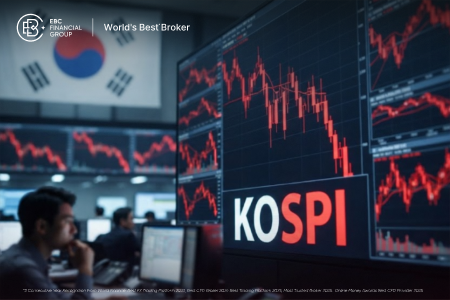
South Korea’s KOSPI fell as much as 6.8% on August 19, yet the market never entered a full circuit breaker. KRX activated a five-minute sell-side sidecar at 9:06 a.m. after KOSPI 200 futures fell 6.02%, while ordinary share trading continued. At its low, the KOSPI stood only about 81 points above the 8% threshold for a market-wide halt.
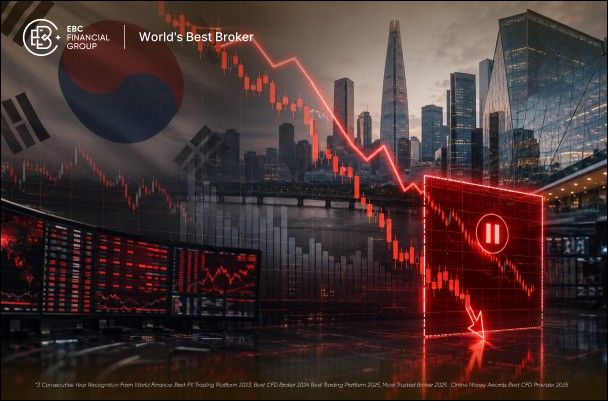
KOSPI fell 6.83% to 6,400.81, stopping about 81 points above Wednesday’s Level 1 circuit-breaker threshold.
KOSPI 200 futures fell 6.02% at 9:06 a.m., triggering a five-minute sell-side sidecar while ordinary stock trading continued.
It was the 25th sell-side sidecar of 2026 and the 48th overall, compared with 26 KOSPI sidecars during all of 2008.
Samsung Electronics and SK Hynix represented roughly half of KOSPI market capitalization before the selloff, magnifying the impact of the global semiconductor retreat.
The cash KOSPI’s 8% line marks the next escalation. A one-minute break would trigger a Level 1 circuit breaker and shift the event from a program-trading restriction to a market-wide halt.
KOSPI 200 futures fell 6.02% to 1,013.26, crossing the 5% threshold required for a sell-side sidecar after the decline held for one minute. KRX activated the measure at 9:06 a.m., restricting computer-driven basket sell orders classified as program trading for five minutes while ordinary share trading continued.
The circuit breaker watches the cash KOSPI instead. Its morning low of 6,400.81 was 6.83% below Tuesday’s 6,869.83 close, leaving the index about 81 points above the 6,320.24 Level 1 threshold. A market-wide halt required an 8% decline sustained for one minute, the threshold the KOSPI actually crossed during its July circuit-breaker selloff.
| Feature | Sidecar | Circuit breaker |
|---|---|---|
| Trigger | KOSPI 200 futures | Spot KOSPI |
| Threshold | -5% for 1 min | -8% for 1 min |
| What stops | Program sells | Broad trading |
| Duration | 5 min | 20 min |
The safeguards can activate independently because they monitor different markets.
Wednesday marked the 25th sell-side KOSPI sidecar of 2026 and the 48th activation overall, alongside 23 buy-side events. The KOSPI recorded only 26 sidecars during the entire 2008 global financial crisis year.
The comparison measures volatility, not economic severity. Forty-eight activations in less than eight months show how often extreme futures moves have occurred in 2026.
The broader market had already been moving at unusual speed. From its July 30 low, the KOSPI rallied about 21% in two weeks after a severe correction, restoring a technical bull market almost as quickly as the previous selloff had unfolded.
Tuesday added another warning. KOSPI reached 7,216.62 intraday before reversing to close 1.55% lower at 6,869.83, producing a range of more than 427 points in one session. Wednesday’s opening plunge therefore followed an already violent reversal rather than a calm market.
A safeguard tied to extreme volatility has become a recurring feature of the KOSPI in 2026.
A roughly 5% overnight fall in the Philadelphia Semiconductor Index hit Samsung Electronics and SK Hynix as the U.S. 30-year Treasury yield reached 5.33%, its highest since 2007. Higher long-term yields reduced the price markets were willing to pay for future technology earnings just as semiconductor shares were already selling off.
Oil added another layer of pressure. Brent traded above $91 a barrel as stalled U.S.-Iran talks lifted geopolitical risk, reinforcing inflation concerns while global borrowing costs were already surging.
The KOSPI’s concentration amplified the damage. At Tuesday’s close, Samsung Electronics represented about 27.71% of KOSPI market capitalization and SK Hynix another 21.43%, giving the two companies a combined share of roughly 49.14%. Their combined weight had briefly exceeded 50% during Tuesday’s session.
Losses in two companies carrying almost half of the market’s capitalization therefore had an unusually large influence on the benchmark. Samsung Electronics fell more than 7% in early trading while SK Hynix dropped more than 9%, turning a global semiconductor correction into an index-level shock in Seoul.
Capital flows reinforced the pressure. By 10:30 a.m., foreign accounts had sold a net ₩1.31 trillion and institutions another ₩975 billion, while domestic retail accounts bought ₩2.18 trillion. The buying absorbed part of the supply without reversing the pressure from large-cap semiconductor losses and rising global yields.
A sidecar changes order flow for five minutes. It cannot lower Treasury yields, reverse a semiconductor selloff or unwind crowded positioning.
A 2020 Journal of Futures Markets study of Korean intraday trading found that sidecars did not consistently eliminate trade imbalances and that some program trades supplied liquidity during stressed periods. The restriction can slow one source of market pressure without setting the direction of prices.
KOSPI rebounded from its 6,400.81 morning low after the sidecar, but the five-minute restriction addressed only program order flow. Higher global yields, semiconductor losses and large-cap selling remained in place.
For Wednesday, 6,320.24 remained the escalation line. A one-minute break below it would move the market into Level 1 circuit-breaker territory. Thursday’s threshold will reset from Wednesday’s final close because KRX measures the 8% trigger against the previous session’s closing index.
The 8% cash-market line determines when futures-driven stress becomes a market-wide event.
Program trading refers to computer-based strategies that submit linked stock baskets or stock and derivatives orders according to predefined rules. Under KRX definitions, it includes index arbitrage and qualifying basket trades involving multiple KOSPI stocks.
Yes. A rise of at least 5% in KOSPI 200 futures for one minute can trigger a buy-side sidecar and restrict program buy orders for five minutes. Of the KOSPI’s 48 sidecars in 2026, 23 have been buy-side activations.
Yes. They are separate safeguards with different triggers. A futures move can activate a sidecar first, while a later 8% decline in the spot KOSPI can still trigger a Level 1 circuit breaker.
No. A sidecar changes how certain program orders enter the market for five minutes. It does not change bond yields, semiconductor prices, positioning or other forces driving the selloff, so the activation itself provides no reliable directional signal.
Wednesday’s final close will set a new 8% Level 1 circuit-breaker threshold for August 20. If KOSPI 200 futures trigger another sidecar while the cash KOSPI approaches that line, stress will have moved beyond a futures-led interruption toward the conditions for a market-wide halt.
The next warning comes from the cash index, not another sidecar headline.