Published on: 2026-03-17
South Africa's new bank-channel rollout for Smart
ID Card services is moving faster than initially signalled under the Department
of Home Affairs' (DHA) Digital Partnership Model. After the DHA launched the
fully-digital bank-assisted model on 9 March with nine live branches and a
stated target of 17 by the end of the week, Home Affairs Minister Leon Schreiber
said by 12 March that 34 new bank branches were already live across all nine
provinces, effectively doubling the original launch-week target.
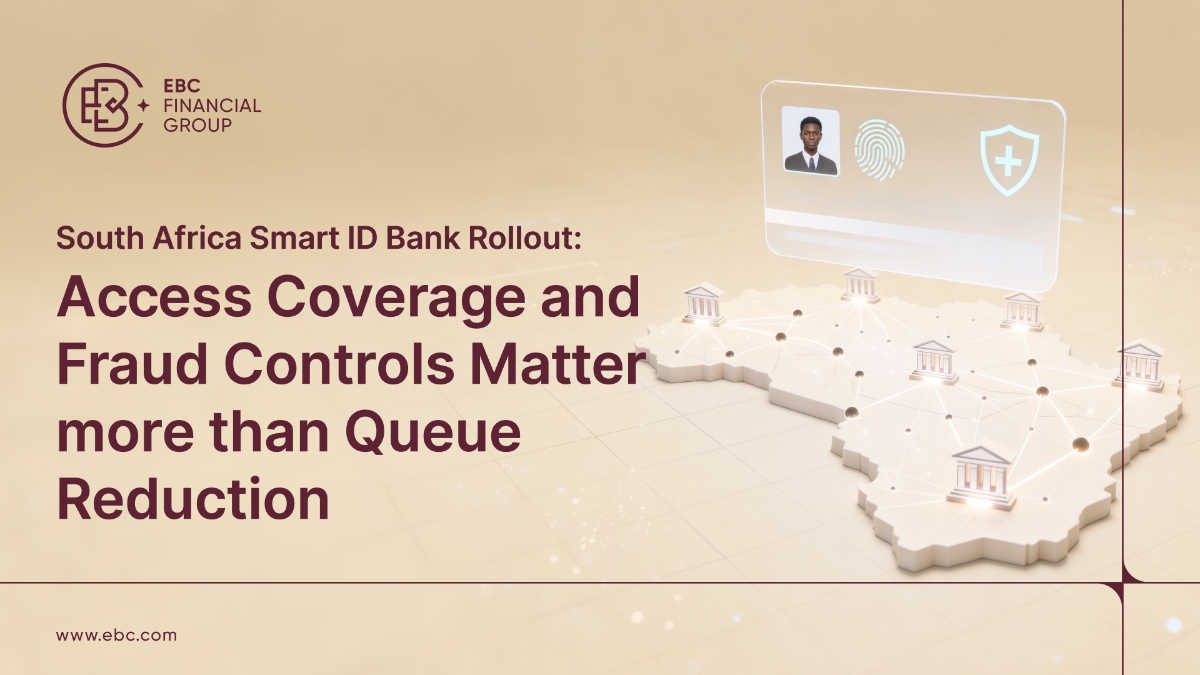
EBC Financial Group ("EBC") notes that the significance goes beyond shorter queues. With roughly 16 million South Africans still relying on the green barcoded ID book, the real test is whether the country can widen secure identity access at speed while maintaining strong verification, consistent service standards, and public trust as volumes scale. The DHA has said the model will expand in phases through 2026 to hundreds more bank branches and, under the Medium-Term Development Plan, to 1,000 participating bank branches by 2029.
"South Africa is effectively turning everyday bank infrastructure into a front door for state identity services. The success metric is not speed at a few branches, but secure access at scale, because identity integrity underpins jobs, banking, and public services." said David Barrett, Chief Executive Officer of EBC Financial Group (UK) Ltd.
The DHA says the previous bank model relied on applicants completing forms on the eHomeAffairs platform, booking online, and visiting the branch mainly for biometric capture. Under the new approach, participating banks connect directly to DHA systems through a secure Application Programming Interface (API) digital gateway, enabling paperless processing through the bank's own service environment and, in the initial wave, without requiring a booking. This matters because the operational bottleneck moves from appointment capacity to coverage, reliability, and consistency of verification across branches as the footprint expands.
The access challenge is not theoretical. Capitec notes that the DHA has 349 offices nationwide, yet only 190 are currently equipped to process Smart IDs, while Capitec alone has more than 860 branches across suburbs, townships and rural areas. That is why the pace and geography of rollout matter as much as the technology itself. The new model moved from an initial target of 17 live bank branches in launch week to 34 new branches across all nine provinces within days, including first-time Smart ID access in the Free State and North West. Bank rollout coverage therefore has a direct inclusion implication: if expansion continues into underserved communities rather than remaining concentrated in a limited set of high-traffic urban sites, it can materially reduce travel time, queue pressure and opportunity cost for applicants who still need to move off the green ID book.
Cost structure will influence uptake, especially among lower-income applicants. The baseline DHA application fee for a Smart ID Card is R140 for other citizens, while first-time Smart ID issuance is free for youth aged 16 and above and for pensioners aged 60 and above. On top of that, bank charges are already diverging in the early rollout: Capitec says the total application fee is R150, comprising the standard DHA fee of R140 and a R10 service fee to cover logistics, while Standard Bank says it will not charge customers during the launch phase and FNB has said clients in its initial phase will pay only the standard DHA application fee of R140 with no additional convenience or logistics fees. As the network expands, fee transparency and consistency will matter because even small add-ons can become meaningful barriers when multiplied across large populations that still need to convert from the green ID book.
The DHA describes the green ID book as widely recognised as one of the most defrauded documents on the African continent and says accelerating transition to the Smart ID is critical to strengthening the identity system and protecting citizens from identity fraud. The external environment makes that urgency sharper. A recent TransUnion Africa digital fraud study notes that, in South Africa, digital banking fraud rose 45% in 2023, driving a 47% increase in total losses to nearly R3.3 billion, and it highlights the rise of deepfake-driven impersonation and authorised push payment fraud tactics that blend social engineering with AI-enhanced deception. In that context, widening access to stronger identity credentials is only half the job; the other half is ensuring verification remains robust and consistent when more branches, more staff, and more daily applications are added.
A bank-channel identity model depends on biometric capture and sensitive personal data handling. South Africa's Protection of Personal Information Act (POPIA) treats biometric information as "special personal information" and places restrictions on processing unless lawful conditions and safeguards apply, making governance and accountability central as the model scales across more private-sector touchpoints. For public confidence, it will matter how clearly responsibilities are defined between the state system and bank environments, how data is secured, and how compliance is operationalised at branch level.
"Early rollout numbers are encouraging, but the strategic question is no longer whether South Africa can switch the model on. It is whether access, verification discipline, fee fairness and data governance can scale together as the footprint expands beyond the launch week. That is what will determine whether the Smart ID transition delivers a real inclusion and fraud-control dividend." said Barrett.
As Smart ID services move into bank branches, the wider context is that identity checks are becoming the front line of trust in South Africa's fast-growing digital banking and payments ecosystem, especially as Artificial Intelligence (AI) makes impersonation scams more convincing and harder to detect.
EBC has covered these shifts in more detail here: