Published on: 2026-03-16
Updated on: 2026-03-16
EBC Financial Group ("EBC") notes that South
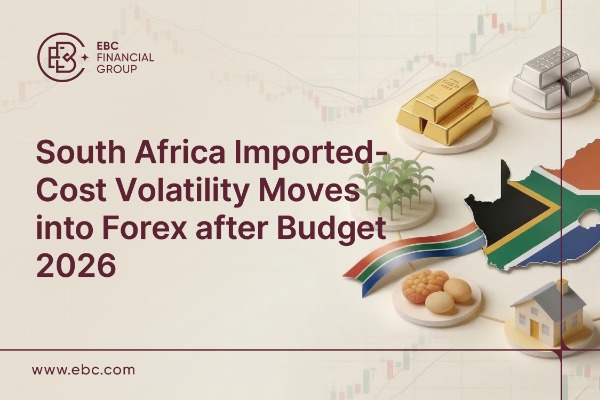
Africa's post-Budget 2026 inflation risk has shifted from domestic tax policy to
the foreign-currency cost of landing imports. The National Treasury withdrew the
R20 billion tax increase previously pencilled in for the 2026 Budget, while
fully adjusting personal income tax brackets, rebates and medical tax credits
for inflation after two years without full relief. South Africa then entered
March with headline Consumer Price Index (CPI) at 3.5% in January, down from
3.6% in December, goods inflation at 2.7% from 3.0%, and services inflation
unchanged at 4.2%. However, that calmer domestic picture now sits alongside a
much more volatile external bill as oil, shipping disruption and war-risk
pricing have all moved higher since late February.
"When the domestic tax shock is removed but the landed cost of imports becomes more erratic, the inflation risk shifts from local tax pressure to the foreign-currency cost of fuel, freight, insurance, and imported inputs," said David Barrett, Chief Executive Officer, EBC Financial Group (UK) Ltd. "That is why USD/ZAR may register the pressure before it becomes visible in the headline CPI data."
The budget has reduced one obvious local inflation trigger, but it has not reduced South Africa's reliance on imported energy, machinery, and intermediate goods. Treasury's revenue chapter shows the tax package is neutral overall after the withdrawal of the proposed increase, but fuel-related charges still rise from 1 April 2026, with the general fuel levy increasing to R4.10 per litre for petrol and R3.93 for diesel, the Road Accident Fund (RAF) levy rising to R2.25, and the carbon fuel levy to 19c for petrol and 23c for diesel. That matters because the news value after this budget is no longer only whether government added inflation at home, but whether higher external transport and settlement costs may begin feeding back into local prices despite that domestic relief.
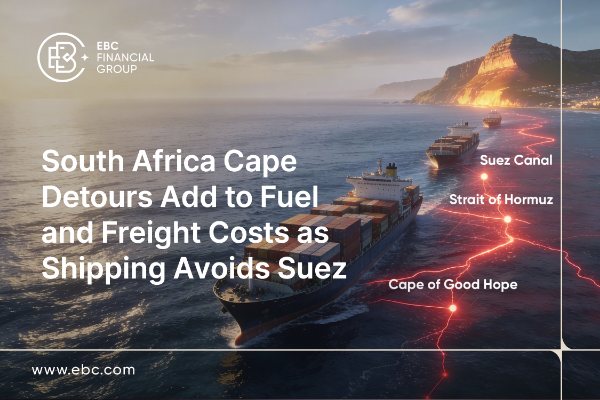
Maersk has suspended vessel crossings in the Strait of Hormuz until further notice and rerouted selected services around the Cape of Good Hope, while Hapag-Lloyd has introduced a war-risk surcharge for cargo to and from or via the Upper Gulf, Arabian Gulf and Persian Gulf. Maritime war-risk premiums have also surged by more than 1000% in some cases, with hull-war cover moving to around 3% of vessel value from about 0.25% before the conflict, sharply lifting the non-fuel cost of moving cargo. Brent crude then rose to an intraday high of $119.50 on 9 March before settling at $98.96, underlining how quickly the energy component of that bill can move.
This matters for South Africa because the import basket is broad enough for a landed-cost shock to travel beyond retail fuel. SARS said January imports rose 3.9% month on month to R146.5 billion from R141.0 billion in December, with the increase driven by crude oil, original equipment components, and aeroplanes. Machinery and appliances accounted for 24.34% of the January import basket, mineral products 16.83%, transport equipment 11.57%, and chemical products 10.51%. The practical consequence is that a volatile external bill may show up first in diesel-driven logistics, imported equipment costs, chemical inputs, inventory financing, and corporate treasury hedging, rather than only in a later CPI headline.
The recent imported-price cushion also looks narrower when the oil effect is separated out. The import unit value index for imported commodities fell 2.2% year on year in December 2025, but imports excluding crude petroleum were down only 0.9%, while crude petroleum itself fell 17.8% and subtracted 1.4 percentage points from the annual rate. That gap suggests the next inflation story may begin in supply chains and production costs before it becomes obvious on retail shelves.
The South African Reserve Bank (SARB) said in January that the near-term inflation outlook had improved because of a stronger rand and lower oil prices, while official current market rates showed USD/ZAR at 16.6164 and EUR/ZAR at 19.2809 on 6 March. On 6 March, the central bank also said it would redraw its adverse risk scenario for the 26 March rate-setting meeting, and Governor Lesetja Kganyago said a 10% move in the exchange rate would have a much stronger impact on South African inflation than a similar jump in oil prices. That is why the first South African markets likely to absorb this story are USD/ZAR spot, short-dated USD/ZAR forwards, EUR/ZAR and inflation-sensitive government bond pricing, rather than a vague idea that all markets in general may react.
"South Africa is not facing a broad inflation resurgence today, but it is facing a narrower and more immediate test," Barrett added. "If the rand has to absorb a more volatile oil and freight bill while import unit values begin to firm, forex is likely to show the strain before a broad CPI print does."
The next checkpoints are close enough to keep the story live. Statistics South Africa said the January 2026 export and import unit value release is due on 19 March, and the South African Reserve Bank has scheduled its next Monetary Policy Committee press conference for 26 March. If import unit values start rising again while USD/ZAR remains sensitive to oil and freight shocks, the post-budget story may become clearer: Treasury reduced one domestic inflation impulse just as the external landed-cost stack began to reprice.
For traders following how fiscal credibility, import costs and external volatility feed into the rand, EBC offers access to 37 currency pairs and educational content around the South African rand and wider forex market mechanics.
Disclaimer: This material is for information only and does not constitute a recommendation or advice from EBC Financial Group and all its entities ("EBC"). Trading Forex and Contracts for Difference (CFDs) on margin carries a high level of risk and may not be suitable for all investors. Losses can exceed your deposits. Before trading, you should carefully consider your trading objectives, level of experience, and risk appetite, and consult an independent financial advisor if necessary. Statistics or past investment performance are not a guarantee of future performance. EBC is not liable for any damages arising from reliance on this information.